

Why AI-Native Fintechs Can't Treat KYC and AML as an Afterthought

This is an original analysis piece for founders and operators building regulated fintech/crypto products

Why AI-Native Fintechs Can't Treat KYC and AML as an Afterthought

AI has collapsed the time it takes to go from idea to working fintech product. A two-person team can now ship a lending app, a payments rail, or a crypto on-ramp in weeks using off-the-shelf models, no-code infrastructure, and a handful of APIs. What hasn't collapsed is the regulatory floor underneath them. If anything, it's rising: the EU's new Anti-Money Laundering Authority (AMLA) became operational in mid-2025, the EU's crypto Travel Rule now applies to every transaction with zero minimum threshold, and MiCA-driven licensing is pushing crypto-asset service providers toward the same compliance bar as traditional financial institutions. Founders who treat identity verification and AML as a "we'll bolt that on before the Series A" problem are building on borrowed time.

Why "Move Fast" Breaks on Regulated Rails

The move-fast-and-ship playbook works well for consumer apps and horizontal SaaS, where the worst-case failure mode is a bad review. It works badly for anything that touches money movement, custody, or cross-border payments, where the worst-case failure mode is a frozen account, a blocked banking partner, or a regulator asking hard questions about your onboarding logs. Investors and banking partners have gotten sharper about this too, due diligence on fintech and crypto startups now routinely includes questions about KYC coverage, sanctions screening, and Travel Rule readiness well before it includes questions about model architecture.

The practical problem is that "add compliance later" almost never means adding it cleanly. It means retrofitting identity checks onto a user base that was never verified, reconstructing transaction histories for a regulator's data request, and explaining to a banking partner why thousands of accounts opened before day 400 have no audit trail. Compliance debt compounds the same way technical debt does, except the interest is paid in blocked accounts and frozen banking relationships.

KYC, AML, and Travel Rule as Day-One Infrastructure

For any startup handling payments, lending, custody, or crypto, three things have effectively become table stakes rather than nice-to-haves:

Identity verification (KYC). Document checks, biometric liveness, and database verification at onboarding, ideally handled through an API-based provider rather than built in-house. Building a document-verification pipeline from scratch is a multi-quarter distraction for a team that should be building product.

Ongoing AML monitoring. Sanctions and PEP screening isn't a one-time gate; it needs to run continuously as watchlists update and user behaviour changes.

Travel Rule interoperability. Any startup moving crypto value between platforms needs a way to exchange originator and beneficiary data with counterparty exchanges under the FATF Travel Rule, otherwise transactions simply get rejected by compliant counterparties, which is now a real, recurring failure mode rather than a theoretical one.

What Compliance Infrastructure Actually Looks Like in 2026

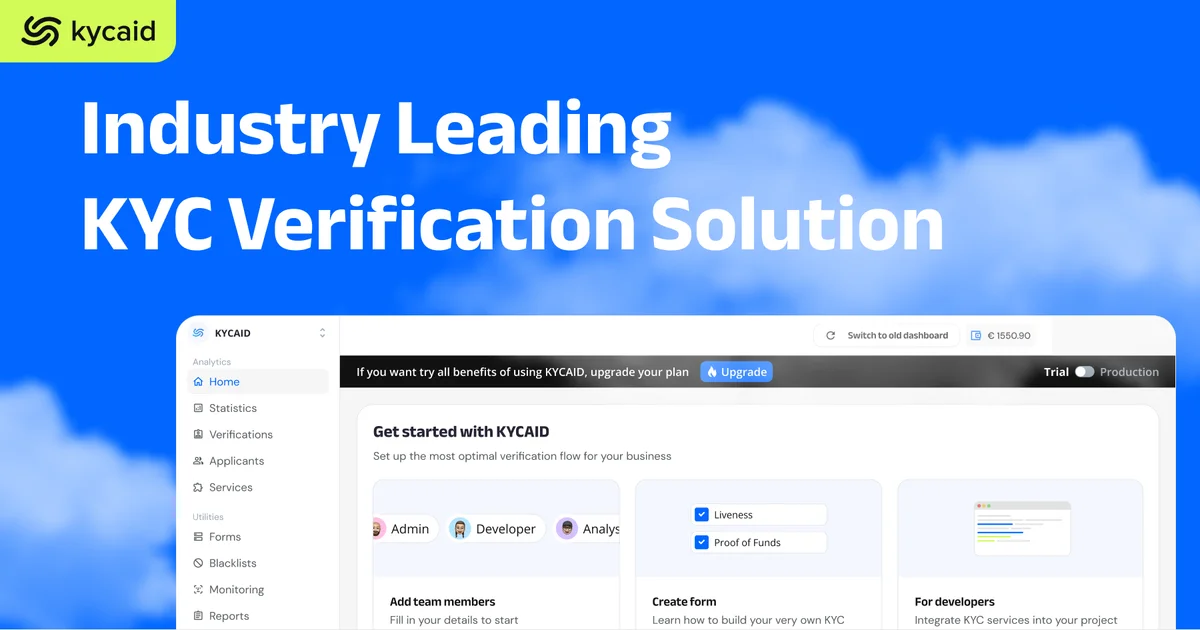
The good news for founders is that none of this requires an in-house compliance engineering team anymore. A handful of API-first providers now handle document verification, biometric checks, and sanctions screening as a single onboarding flow that can be integrated in days rather than months, KYCAID is one example of this category, offering configurable KYC/AML workflows aimed specifically at fintech and crypto platforms that need to move fast without skipping steps. The shift mirrors what happened with payments infrastructure a decade ago: what used to require a banking relationship and months of integration work is now an API call.

Travel Rule Interoperability

Identity verification gets most of the attention, but Travel Rule compliance is the piece founders tend to discover too late, usually when a counterparty exchange starts rejecting incoming transfers because required originator data is missing. Dedicated platforms like Travel-Rule.com have emerged specifically to handle this data exchange layer between virtual asset service providers, so a crypto startup doesn't have to build point-to-point integrations with every exchange it wants to interoperate with. For any team building a crypto on-ramp, exchange, or wallet product, wiring this up before launch, not after the first rejected transfer, is the difference between a smooth counterparty relationship and a support queue full of "why is my transfer stuck" tickets.

Building Compliance Into the Product

The startups getting this right treat compliance as a product decision, not a legal afterthought. That means:

  • Choosing KYC and AML providers during the initial architecture phase, not after the first regulatory inquiry

  • Designing onboarding flows where identity verification feels like part of the product experience rather than a friction point bolted on top

  • Budgeting engineering time for Travel Rule integration alongside payment-rail integration, not after it

  • Treating compliance data, verification records, screening logs, transaction data, as a first-class part of the data model, since it's what regulators and banking partners will ask for first

  • What Investors and Partners Are Starting to Ask For

    Ask any fintech-focused investor what's changed in due diligence over the past two years, and compliance readiness comes up fast. Banking-as-a-service partners have gotten burned by fintechs with weak KYC programs and are now underwriting compliance posture as carefully as they underwrite the business model. For AI-native fintech and crypto startups in particular, where the pitch is often "we move faster than incumbents", being able to show a clean, automated compliance stack from day one is turning into a genuine differentiator rather than a checkbox. Speed got you in the room. Compliance infrastructure is increasingly what keeps you in business once you're there.

    © 2026 StartupHub.ai. All rights reserved. Do not enter, scrape, copy, reproduce, or republish this article in whole or in part. Use as input to AI training, fine-tuning, retrieval-augmented generation, or any machine-learning system is prohibited without written license. Substantially-similar derivative works will be pursued to the fullest extent of applicable copyright, database, and computer-misuse laws. See our terms.