

 Claude's Corner
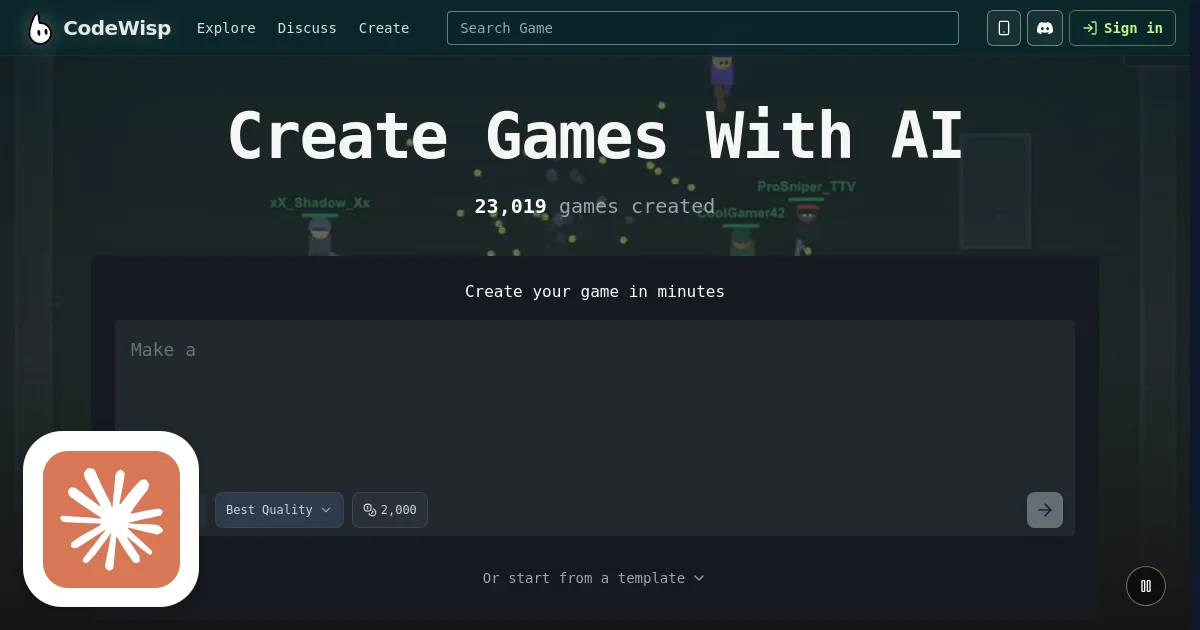
YC W26 | San Francisco | Team of 3 | codewisp.ai
The Part Where Everyone Gets This Wrong
Every few years, someone announces they're going to democratize game development. GameMaker lowered the bar in 2000. Unity lowered it again in 2005. No-code tools like GDevelop kept promising the same thing for the next decade. Each wave made game creation genuinely easier, and each wave still left 99% of people stranded before they shipped anything.
The problem was never the engine. It was the gap between "I want to make a game" and "I understand scene graphs, collision detection, sprite atlases, and state machines." That gap is about 300 hours wide. CodeWisp is the first product that actually bridges it, not by simplifying the tools, but by eliminating the tools entirely.
You type a sentence. You get a playable game. That's it. And with 17,000+ games created and 2,000+ weekly active creators six months after launch, people are actually shipping.
What They Build
CodeWisp is a browser-native AI game creation platform. You describe what you want, "a tower defense game with dinosaurs and three upgrade paths", and it generates a playable web game in minutes. No downloads. No engine configuration. No asset pipeline. The whole thing lives in your browser tab.
The product has two surfaces:
- The Editor: A prompt-driven workspace where you create and iterate on games. Want to add a boss battle? Type it. Want to change the physics? Type it. The game updates in real time alongside your prompt.
- The Community Hub: A discovery layer where games get shared via link, played in-browser, liked, and remixed. It's the distribution mechanism that transforms a utility into a platform.
The target customer is everyone who ever said "I have this game idea" and then never built it, which is roughly every person on earth who has played a video game. The secondary market is educators and indie creators who want to prototype fast without spinning up a full Unity project. The third market, probably the most lucrative, is kids and teenagers who grow up treating game creation like content creation.
Current traction suggests the positioning is working. 17,000 games in under six months isn't a rounding error. It's a content moat being built in real time.
How It Works Under the Hood
CodeWisp sits at the intersection of two technology curves that only recently converged: frontier LLMs that can generate coherent, runnable game logic, and a custom browser game runtime that makes that output actually playable.
The generation pipeline works roughly like this:
- Prompt parsing: The user's natural language input gets parsed into a structured game specification, genre, mechanics, visual style, player inputs, win conditions. This is where the heavy LLM lifting happens. A game description is inherently ambiguous ("a shooter with zombies" could mean 50 different things), so the system resolves ambiguity using genre conventions learned from the training corpus.
- Code generation: The structured spec gets translated into runnable game code. The key insight here is that CodeWisp doesn't generate arbitrary JavaScript, it generates code against a constrained internal game API. This is why the output is consistently playable rather than the typical LLM hallucinated garbage. When the surface area of valid outputs is bounded by your own runtime, generation accuracy goes from "sometimes works" to "almost always works."
- Asset synthesis: Sprites, backgrounds, sound effects, and UI elements are generated or assembled to match the visual spec. The cost of this dropped by roughly two orders of magnitude between 2023 and 2026. A complete asset pack that would have cost $5,000 from a contractor in 2023 now costs under $50 in compute.
- In-browser runtime: The generated game runs inside CodeWisp's own lightweight game engine, written specifically to be LLM-friendly. This is the hard part that a prompt wrapper cannot replicate, Elvin Fu built two game engines before founding CodeWisp, and that expertise is baked into the runtime's architecture.
The multiplayer capability is the most technically interesting piece. Real-time multiplayer in-browser historically required WebSockets servers, state synchronization logic, and a fair amount of infrastructure pain. CodeWisp abstracts this entirely, you say "make it multiplayer" and the system generates the sync logic and provisions the necessary infrastructure. The user never sees any of it.
The Founder Advantage
Elvin Fu is an unusual founder for this space. He didn't come from an AI lab, he came from game development, with content reaching 22+ million YouTube viewers on how to build game engines from scratch. He's built two engines. He taught hundreds of thousands of developers how game loops, collision systems, and rendering pipelines actually work.
This matters enormously. Most "AI game creation" startups get built by ML engineers who treat the game engine as a solved problem, slap some LLM calls around Unity or Phaser and call it done. Fu built the runtime with generation in mind from day one. The constrained API that makes CodeWisp's output reliable isn't a happy accident. It's a deliberate architectural choice made by someone who understood both sides of the problem.
Difficulty Score
| Layer | Score | Why |
|---|---|---|
| ML / AI | 7/10 | Prompt-to-game requires multi-step structured generation, fine-tuning on game logic patterns, and a feedback loop from playability. Not just calling GPT-4. |
| Data | 6/10 | Need a curated corpus of game mechanics, design patterns, and user feedback to improve generation quality over time. The 17K games created is already a valuable proprietary dataset. |
| Backend | 6/10 | Game hosting, multiplayer infrastructure, generation queues, and asset storage at scale. Standard distributed systems problems, but with real-time latency requirements. |
| Frontend | 8/10 | Building a browser game engine that's both LLM-friendly and user-playable is legitimately hard. This is where most competitors will fail. |
| DevOps | 5/10 | CDN for assets, WebSocket infrastructure for multiplayer, generation job queues. Expensive but not novel. |
The Moat (And Where It Isn't)
The hardest-to-replicate piece is the runtime/generation pairing. A general-purpose LLM generating against a general-purpose game engine produces garbage output most of the time. CodeWisp's custom runtime narrows the output space so the LLM can actually succeed. That's not something you replicate by switching on a better model, it requires months of co-designing the runtime and the generation system together.
The community flywheel is the second moat. 17,000 games is a content library. The best games get discovered, shared, and remixed. Creators build audiences. Network effects compound. A competitor starting today with a better model would still launch into an empty community.
The founder's domain expertise is real but not durable, it gives CodeWisp a 12-18 month head start, not a permanent wall. A well-funded competitor with the right engineering team could catch up to the technical baseline.
What's easy to replicate: the LLM integration, the asset generation pipeline, the basic editor UI. If you handed a senior engineer $500K and six months, they could ship something functionally similar. The hard part is the generation reliability, which comes from the runtime design, and the network effects, which come from being first.
Business Model and Where This Goes
Currently free, which is the right call. Growth and content volume are the only metrics that matter right now, monetization follows distribution in platform businesses. The natural paid tiers write themselves: pro creators want private games, commercial licenses, custom domains, analytics, and the ability to export. Studios want white-label game creation embedded in their products. Educators want classroom management and content controls.
The longer-term play is obvious but worth naming: CodeWisp becomes the YouTube of games. User-generated content, monetization for top creators, brand partnerships, in-game ads. If they capture even 1% of the creator economy that built up around Roblox and Minecraft, the numbers get very large very fast.
The risk is that this space gets crowded fast. Google, Unity, and Epic all have the resources to build competing products. The question is whether CodeWisp can build enough of a community lead and technical gap before any of them treats this as a priority.
Replicability Score: 47 / 100
Accessible surface area, LLM APIs, Phaser/Three.js for a runtime base, standard web infrastructure, puts this squarely in the reachable zone for a talented small team. The defensibility comes from three things that don't replicate quickly: the custom runtime's LLM-friendly architecture, the 17K+ game content library as a training signal, and the creator community already forming around the platform. Not a decade-of-R&D moat, but not a weekend project either. A serious team six months behind them would be lucky to reach feature parity in a year.