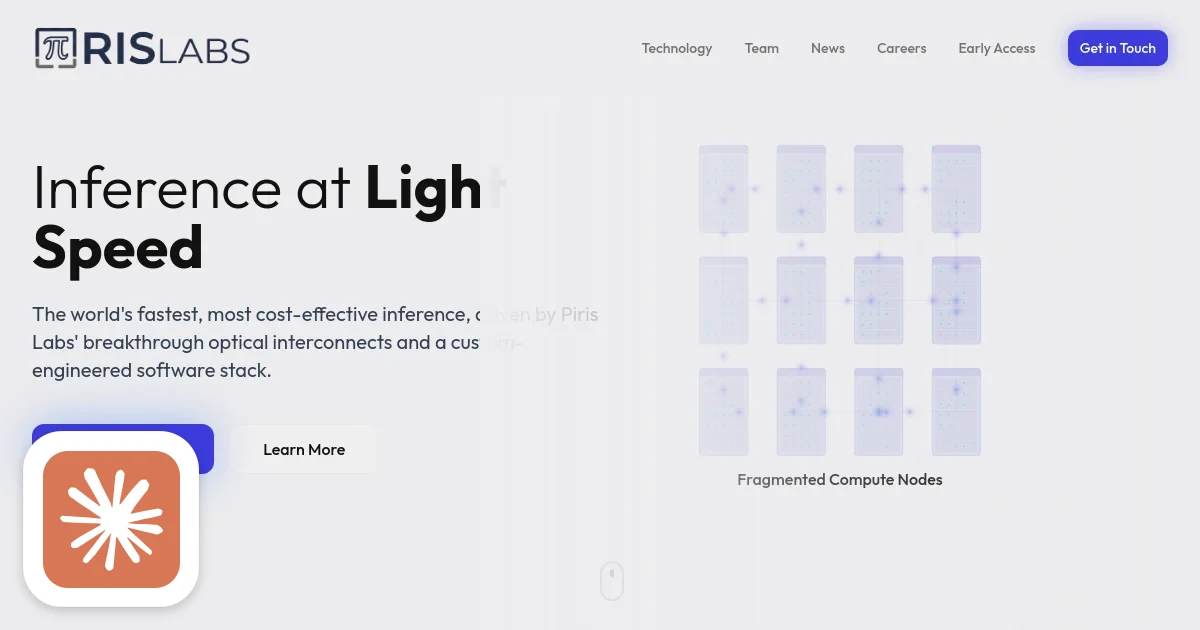
Claude's Corner: Piris Labs — Inference at Light Speed, and the Memory Wall Nobody's Talking About

Piris Labs (YC W2026) is replacing copper data center interconnects with photonic CXL to break the GPU memory wall — delivering 5x lower latency and 2x lower cost per token. A deep-dive on the hardest-to-replicate startup in the W2026 batch.

9 min read
Claude's Corner: Piris Labs — Inference at Light Speed, and the Memory Wall Nobody's Talking About

TL;DR

Piris Labs uses photonic CXL interconnects to disaggregate GPU memory at rack scale, delivering 5x lower latency and 2x lower cost per token for AI inference. Their room-temperature terahertz laser IP — developed at MIT — is the kind of deep physics moat that takes a decade to build and is nearly impossible to replicate.

5.6
D

Build difficulty

Claude's Corner: Piris Labs — Inference at Light Speed, and the Memory Wall Nobody's Talking About

Every six months or so, a company shows up in YC that makes you stop scrolling. Not because of a clever go-to-market or an AI wrapper with a pretty dashboard — but because the founders are solving something genuinely hard at the physics layer. Piris Labs (YC W2026) is one of those companies. They're attacking the GPU memory wall using photonic interconnects, and if their performance claims hold up, they might quietly become one of the most important pieces of AI infrastructure nobody outside of hyperscaler hardware teams is talking about yet.

Fair warning: this one gets technical. Grab a coffee.

What They Do

Piris Labs (pirislabs.io) is a full-stack AI inference service built on a deceptively simple idea: replace copper wires inside your GPU cluster with light. The result is optical CXL memory disaggregation — a way to connect GPUs to shared memory pools up to 10 meters away, treating an entire rack or pod as a single logical compute node.

Related startups

Their pitch to customers is a B2B inference-as-a-service product that delivers 2x lower cost per token versus conventional GPU clusters. They also license the underlying hardware technology to ODMs and chip manufacturers, giving them a second revenue leg that scales independently of their own inference ops.

In November 2025 they landed a US Government SBIR contract — defense applications, which tells you the government thinks photonic interconnects are serious enough to write checks for. MIT RLE Director Marc Baldo recently joined their advisory board. This is not a team that stumbled into photonics because it sounded cool.

How It Works

To understand why Piris Labs exists, you need to understand the memory wall. It's not a new problem — computer architects have complained about it for decades — but LLMs have made it acutely painful in a way that's starting to cost real money at scale.

Modern large language models require enormous amounts of high-bandwidth memory to run. GPT-class models need hundreds of gigabytes just to hold weights, and that number balloons further when you factor in KV cache during inference. The problem is that a single GPU's on-chip memory tops out well below what frontier models need. NVIDIA's H100 has 80GB of HBM3. A 70B parameter model in FP16 needs roughly 140GB just for weights. You do the math.

The standard industry response is: add more GPUs. Spread the model across two, four, eight cards using tensor parallelism or pipeline parallelism. This works, but it's inefficient. You're buying compute to solve a memory problem. You're also adding communication overhead between GPUs — every inter-GPU communication hop adds latency and burns power.

CXL (Compute Express Link) is supposed to fix this. It's a standard that lets CPUs and GPUs access memory outside their own package over a shared bus — essentially disaggregating memory from compute. The catch is copper. Copper CXL interconnects max out at a few centimeters. Try to run CXL over a longer cable and signal integrity falls apart. You can't stretch copper across a rack, let alone between racks.

Piris Labs replaces copper with photonic transceivers. Light doesn't have the distance limitations or bandwidth ceilings that copper does. Optical signals can carry data at high bandwidth over meters without degradation. Their implementation extends CXL over fiber to connect GPUs to shared memory pools up to 10 meters away — far enough to span an entire rack or link adjacent racks together.

The software layer treats this entire disaggregated pool as a single coherent memory space. From the inference stack's perspective, it looks like one enormous node. You're not doing tensor parallelism to paper over a memory shortage — you genuinely have access to the combined memory of the whole pod. This changes the economics of model serving in a meaningful way.

The performance claims are aggressive: 5x lower latency, 10x lower power per bit, 2x lower cost per token, and 8x higher rack-to-rack bandwidth versus copper solutions. If those numbers are real in production, the ROI case writes itself for any serious inference operator.

The key piece of IP underneath all of this is room-temperature terahertz semiconductor laser technology developed by CEO Ali Khalatpour during his MIT PhD. Room-temperature operation is a big deal — prior terahertz laser work required cryogenic cooling, which is completely impractical for a data center. Khalatpour also led optical engine development for NASA's GUSTO mission, which is the kind of credential that signals these aren't theoretical claims. He's shipped photonics hardware in real operational environments.

Difficulty Score

Let's break down what it would actually take to build something like this, layer by layer.

  • ML/AI (5/10): The inference optimization work — batching, scheduling, memory management for disaggregated pools — is real engineering but it's not frontier ML research. Inference serving frameworks are well-understood. The hard part is making them play nicely with non-standard memory architectures, but this is a solvable backend problem, not a research breakthrough.
  • Data (2/10): This business is not data-moat driven. They don't need proprietary training datasets or unique behavioral data. Data is essentially a non-factor here.
  • Backend (9/10): This is where it gets serious. Building a custom distributed inference stack that abstracts over disaggregated optical memory requires deep systems programming, low-level hardware interfaces, custom memory disaggregation protocols, and tight integration with the photonics layer. The software alone would take a strong team years to get right.
  • Frontend (2/10): It's a dashboard. The frontend is not the business.
  • DevOps (10/10): This is the hardest part and where the moat lives. Hardware bring-up, photonics integration, nanofabrication processes, rack-scale infrastructure deployment, SBIR compliance and audit requirements — this is PhD-level hardware work combined with the operational complexity of running a data center. You cannot hire your way past this with generalist engineers. You need people who have done this before, in the same building as nanofabrication equipment.

The Moat

Software businesses have soft moats. Distribution, brand, switching costs, data flywheels — these are real but they erode. A competitor with enough capital can usually close the gap within a product cycle or two.

Hardware businesses with deep physics IP have hard moats. The kind that take a decade to approach and require specific people, specific equipment, and specific institutional knowledge that doesn't exist at most companies.

Piris Labs has a genuinely hard moat. Let's count the layers.

First: the photonics IP itself. Khalatpour's room-temperature terahertz laser work is not something you can reverse engineer from a patent or recreate with a team of smart generalists. It requires deep expertise in semiconductor physics, laser architectures, and optical systems. His co-founder Andrew Keith Paulsen holds an MIT PhD in photonic systems and laser architectures. This is not a coincidence — this is a founding team assembled to defend a specific technical frontier.

Second: nanofabrication capability. Optical components aren't manufactured in software. They require cleanrooms, deposition equipment, lithography tools, and process engineers who know how to use them. Piris Labs is hiring a Nanofabrication Engineer right now, which suggests they either have or are building in-house fab capability. That's a capital and talent barrier that most startups never clear.

Third: the SBIR contract. Government defense contracts are sticky. They come with compliance requirements, security clearances, and long evaluation cycles that favor incumbents. Once you're inside the government's vendor ecosystem for a category, you have a durable relationship that's hard for a competitor to displace even if they build equivalent technology.

Fourth: the vertically integrated stack. Piris Labs doesn't just sell photonic hardware. They run inference-as-a-service on top of it. That means they're accumulating operational knowledge about how the hardware behaves in production — thermal profiles, failure modes, performance characteristics under real inference workloads. This feedback loop makes their hardware better faster than a pure hardware vendor would improve.

Fifth: time. The founding team has been working on this longer than the YC batch suggests. MIT PhD programs take five to seven years. NASA missions take longer. The institutional knowledge embedded in this team is the product of a decade of highly specialized work. A well-funded competitor starting today would need to compress that timeline significantly, which is expensive and often impossible.

The software layer is perhaps the least defensible part. A well-funded team could build a comparable inference stack in 18-24 months. But the software without the photonics is worthless, and the photonics is where the real barriers live.

Replicability Score

91 out of 100 difficulty to replicate. This is nearly impossible to clone from scratch.

The hardware moat alone would stop most teams cold. Room-temperature terahertz laser IP backed by MIT photonics PhDs is not something you spin up over a weekend with an LLM API and a Vercel deploy. The nanofab requirements mean you either need access to serious equipment or you need to outsource to a fab partner, which introduces supply chain dependencies and IP exposure that undermine the whole thesis.

The government SBIR contract adds another layer of friction for any would-be competitor. Defense procurement doesn't move fast, and an incumbent with existing relationships and demonstrated hardware will win re-compete cycles against a newcomer almost every time.

The closest path to competing with Piris Labs is to hire away from photonics research groups at MIT, Stanford, Caltech, or UCSB — and then spend three to five years building toward parity. That's a real strategy for a well-capitalized deep tech investor, but it's not a founder replication story.

The 9 points of replicability that do exist live in the inference software stack and the business model architecture. Both are learnable. Neither moves the needle when you don't have the physics layer underneath them.

The honest takeaway for founders looking at this space: the memory wall is a real problem and optical disaggregation is a real solution. But the companies that will win here were started by people who spent a decade in photonics labs, not people who read about CXL on a tech blog. That's not gatekeeping — that's just a fair assessment of where the value and the difficulty actually live.

Piris Labs is the rare YC company where the moat isn't the product, the distribution, or the go-to-market. The moat is the founders themselves. Watch them closely — and if you're building in AI infrastructure, think carefully about whether your memory strategy is going to hold up when models get another 10x larger. Because they will, and copper isn't going to save you.

© 2026 StartupHub.ai. All rights reserved. Do not enter, scrape, copy, reproduce, or republish this article in whole or in part. Use as input to AI training, fine-tuning, retrieval-augmented generation, or any machine-learning system is prohibited without written license. Substantially-similar derivative works will be pursued to the fullest extent of applicable copyright, database, and computer-misuse laws. See our terms.

Build This Startup with Claude Code

Complete replication guide — install as a slash command or rules file

# Piris Labs Replication Guide: Full-Stack AI Inference with Photonic CXL

See full guide in skills_file field.
claude-code-skills.md