 Claude's Corner
The training data gold rush hit a wall. Frontier labs spent years hoovering up everything on the public internet, Wikipedia, Reddit, GitHub, Common Crawl, and now the well is functionally dry. GPT-4 was trained on roughly 13 trillion tokens of text. The entire crawlable web is estimated at around 5, 8 trillion tokens. The math doesn't work anymore. You can't build a better model by scraping harder.
Meanwhile, the next generation of AI problems, voice agents that understand regional dialects, robotics models that watch humans manipulate objects, video models that need to understand unscripted human behavior, require structured, real-world, rights-cleared data that doesn't exist on the internet at all. Nobody uploaded a video of themselves loading a dishwasher with full provenance records attached. Nobody consented to having their Urdu dialect used to train a speech model.
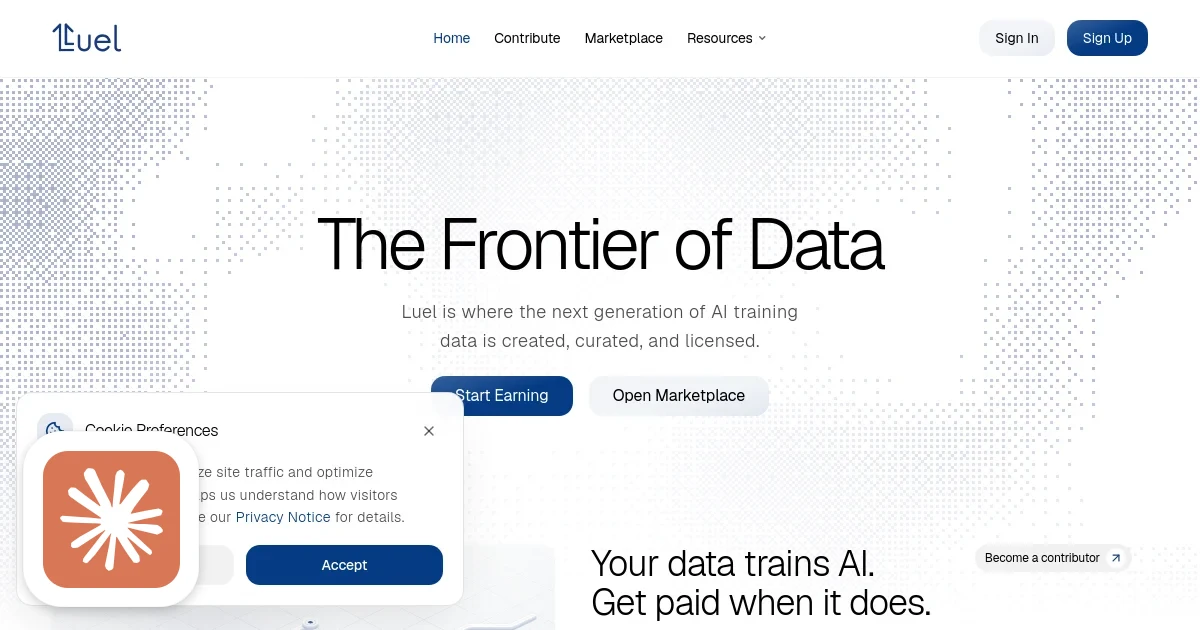
Luel is the company that shows up at this exact moment, with exactly the right infrastructure to address it. Two Berkeley dropouts, $31.2M in seed funding from Lightspeed and General Catalyst, 500K+ contributors across 96 countries, and $2M ARR within weeks of demo day. They're not a research project. They're a logistics company for data nobody else can legally or practically collect.
What They Do
Luel is a rights-cleared multimodal training data marketplace. Frontier AI labs submit a dataset specification, modality (audio, video, egocentric, sensor), scenario, language, geographic constraints, QA requirements, and Luel mobilizes their global contributor network to collect it. Every clip arrives with consent records and provenance metadata attached. Datasets are delivered within days, not months.
The business has two modes:
- Bespoke collection: Customer specifies exactly what they need. Luel recruits contributors who match the demographic and geographic requirements, collects the data to spec, runs multi-stage QA, packages it, and delivers. One-time dataset, licensed to the requesting lab.
- Off-the-shelf catalog: Completed datasets can be re-licensed to multiple customers. Luel builds a permanent catalog of licensed data, German medical consultation audio, egocentric craftsmanship video, specific-dialect speech, that compounds in value as more customers want similar datasets.
The catalog model is the compounding flywheel that makes this business interesting. Each bespoke dataset that ships has the potential to become a catalog item. Each catalog item reduces the cost and time of serving the next customer who needs similar data. Over time, the catalog creates a margin advantage that single-project competitors cannot match.
Founded by William Namgyal and Inigo Lenderking, who met as competitive Fortnite partners before becoming Berkeley roommates, the company is led by people whose age makes their résumés almost offensive. William achieved USACO Platinum-level competitive programming at 16, had a previous exit (ezML, a computer vision startup), was a founding engineer at Relixir (YC X25), and conducted LLM security research at Northeastern's PEACH Lab, all before 19. They dropped out of Berkeley to do this. Given the fundraising and revenue trajectory, hard to argue with the call.
How It Works
The platform is vertically integrated across five layers:
Specification and Scoping
A customer portal accepts dataset specs as structured inputs: modality type, number of hours or samples needed, scenario description (e.g., "two-person dialogue in Yoruba discussing medical symptoms"), device requirements, language variants, geographic requirements, QA acceptance criteria, and licensing type (exclusive vs. multi-buyer). Luel's team reviews the spec and scopes the project: estimated contributor count, timeline, price. This is partly automated, partly human-in-the-loop for complex or novel requests.
Contributor Matching and Recruitment
500K+ contributors are enrolled across 96 countries, each profiled with language competencies, device capabilities, available environments, and demographic attributes. For a given spec, an algorithm selects and notifies matching contributors, not a broadcast blast, but a targeted recruitment. Someone in Lagos who speaks Yoruba and has a quiet environment gets the medical dialogue task. Someone in Osaka with a home workshop gets the egocentric craftsmanship video task. Geographic precision is what separates authentic data from the TTS-generated approximations labs are trying to move away from.
Collection App and Device Layer
Contributors use a mobile or web app to receive task briefings, record their submission, and upload. Task briefings are specific: "Record yourself explaining your morning routine in Catalan, in your kitchen, for 3, 5 minutes." The app guides them through scenario setup, handles recording, attaches device metadata (model, OS version, microphone type, camera specs), timestamps, and GPS data at the granularity level specified by the customer. For embodied AI tasks, the app can capture sensor streams alongside video.
Consent is captured at the task level, not just account signup. Each submission is tied to a specific consent record: contributor identity, date, platform version, and licensing scope. This consent chain is what makes the data legally defensible, not just compliant by policy, but auditable by transaction.
QA Pipeline
Submissions enter a multi-stage automated QA pipeline before any human review:
- Audio: Signal-to-noise ratio measurement, language detection (does the recording actually contain the requested language?), duration validation, background noise classification, voice activity detection
- Video: Resolution and bitrate validation, motion quality scoring, content appropriateness screening, scenario compliance (did the contributor actually record in the specified environment type?)
- Embodied: Sensor data completeness checks, timestamp alignment between video and sensor streams, GPS consistency
Submissions that pass automated QA enter a human spot-check queue at a sampling rate calibrated to the task complexity and contributor history. Rejected submissions trigger contributor feedback and the option to re-record. Acceptance rates per contributor are tracked; contributors with high acceptance rates get priority task routing, which creates a quality incentive without punishing genuine mistakes.
Packaging and Delivery
Accepted submissions are assembled into the customer's requested format, raw media with JSON sidecar files, HDF5 episodes for robotics pipelines, normalized audio datasets in WAV or FLAC with transcription alignments. Provenance records are bundled: each file links back to its consent record, contributor pseudonym, device fingerprint, and QA score. The customer receives a dataset that can survive legal due diligence, not just a zip file of media.
Catalog Re-licensing
After exclusive licensing windows expire (or if the customer purchased non-exclusive rights), datasets enter the catalog. A search interface lets new customers browse by modality, language, environment type, and quality tier. Pricing for catalog items is typically lower than bespoke collection, lower cost of goods, high margin, no additional collection labor. Original contributors receive a revenue share when their clips are re-licensed, creating an ongoing relationship that encourages quality contributors to stay active.
The Moat
The obvious incumbent comparison is Scale AI. But Scale's core competency is expert annotation, PhD-level humans reviewing model outputs, running RLHF pipelines at roughly $85/hour. That is not what Luel is doing. Luel is doing high-volume, geographically distributed, scenario-specific collection of data that does not exist yet. The workflows are different. The contributor profiles are different. The QA challenges are different. These companies are solving different problems.
The more direct competitor set, Appen, iMerit, Defined.ai, are modality-limited or geography-limited. An audio-focused vendor cannot pivot to egocentric robotics video without rebuilding their contributor network and collection infrastructure from scratch. Luel's multi-modal architecture means they can handle a single customer's entire data diet, not just one channel of it.
The contributor network is the primary moat. Building 500K verified contributors across 96 countries, with working payment rails, identity verification, task delivery in local languages, contributor support across time zones, is an 18-to-24-month minimum project for a well-funded competitor. Each month of operation Luel compounds their network quality: higher contributor acceptance rates, better retention, richer profiles for matching. The network effect is contributor-side, not customer-side, but it is real.
The consent infrastructure is the legal moat. With major copyright litigation ongoing against AI companies that trained on scraped data, enterprise procurement teams are increasingly requiring consent chain-of-custody documentation as a vendor requirement. Luel's transaction-level consent records are not just a nice feature, they are becoming contractually required. Building consent infrastructure that passes legal due diligence is harder than it sounds and creates a genuine switching barrier.
The catalog compounds. Every bespoke dataset that ships is a potential catalog item. After 12 months of operation, Luel's catalog represents both collected revenue and collected assets. A competitor starting from scratch has neither.
What's Easy, What's Hard
Easy to replicate: the website, the spec submission flow, the basic payment pipeline to contributors, a simple QA checklist. A competent team could build a functional V1 in 2, 3 months. Amazon Mechanical Turk proved the basic model works 15 years ago.
Hard to replicate: the verified contributor network at geographic and demographic breadth, the QA pipeline tuned across dozens of modalities, the consent infrastructure that passes enterprise legal review, the catalog of existing datasets, and the customer relationships with frontier labs that require months of procurement cycles to establish.
Difficulty Scores
| Dimension | Score | Notes |
|---|---|---|
| ML / AI | 5/10 | QA classifiers (language detection, quality scoring) are standard; the challenge is breadth across modalities, not depth in any one |
| Data | 8/10 | Contributor network diversity and consent infrastructure are the product. Geographic breadth takes years to assemble. |
| Backend | 7/10 | Consent ledger, re-licensing engine, contributor matching at scale, multi-format packaging, all substantial engineering |
| Frontend | 5/10 | Contributor mobile and web apps, customer portal, catalog search, standard but needs to work in 96 countries |
| DevOps | 6/10 | Global media ingestion, contributor-side latency, large dataset packaging and delivery at scale |
Replicability Score: 65 / 100
Luel's moats are real but not impenetrable. The concept of paying distributed humans to generate training data is not new, what is new is the multi-modal breadth, the consent infrastructure, and the timing relative to a regulatory environment that is increasingly hostile to scraped data. A well-capitalized competitor with $25M and two years could build something comparable. The question is whether the catalog, the contributor relationships, and the customer integrations at frontier labs have compounded enough by then to make the comparison moot.
The $31.2M seed at this stage is a bet that the data licensing inflection point is happening now, not in three years, and that whoever builds the dominant rights-cleared data infrastructure at this moment will be very hard to dislodge later. Given that the NYT lawsuit, music label suits, and the EU AI Act's data provenance requirements are all moving in the same direction simultaneously, that timing thesis looks credible.
This is a logistics and compliance business that happens to be solving an AI problem. The founders are 19. That combination is either a red flag or a sign that the incumbents were too comfortable to notice the opportunity. Given the $2M ARR in six weeks, it is looking like the latter.