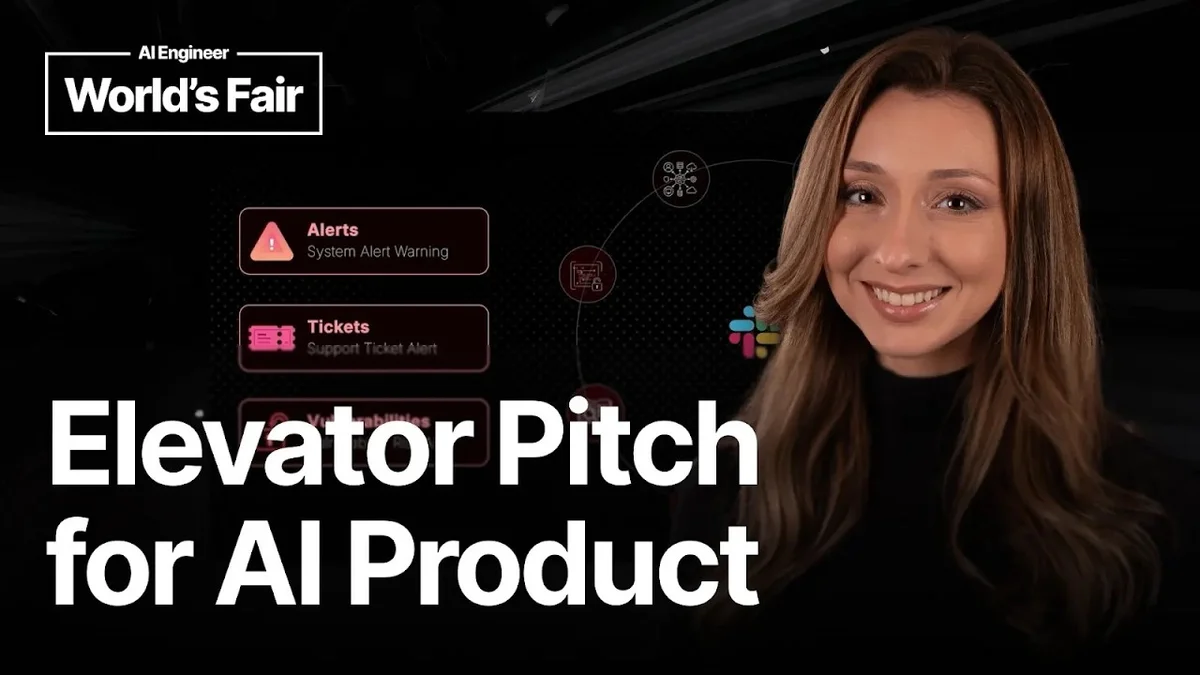
Veronica Hylak: Explain Your AI Product or It Will Fail

Veronica Hylak of Hey AI explains why AI products fail without clear, simple explanations and outlines a 3-part storytelling method for success.

4 min read
Veronica Hylak speaking about the importance of explaining AI products.
AI Engineer

In the rapidly evolving world of artificial intelligence, creating a successful product is only half the battle. According to Veronica Hylak, a seasoned product expert associated with Hey AI, the other, often overlooked, half is the ability to clearly explain what your AI product does and why it matters. In her presentation, Hylak emphasizes that without effective communication, even the most advanced AI solutions are destined to fail.

Veronica Hylak: Explain Your AI Product or It Will Fail - AI Engineer
Veronica Hylak: Explain Your AI Product or It Will Fail — from AI Engineer

The Problem with Complex AI Pitches

Hylak illustrates a common scenario where founders, brimming with excitement about their complex AI creations, struggle to articulate their product's value to potential investors or users. She contrasts a typical, jargon-filled AI pitch with what she calls the "product storytelling method." The former often overwhelms listeners with technical terms like "agent orchestration," "RAG," "fine-tuning," and "LLMs," leaving them confused and disengaged. This approach, Hylak argues, fails to connect with the audience's needs and experiences.

Related startups

The core issue, as Hylak points out, is that technology alone isn't enough. If an AI product doesn't solve a real problem in a way that people can easily understand and relate to, it won't gain traction. She uses the analogy of an elevator pitch, noting that the limited time available means founders have only one chance to make their product understandable and desirable.

The Three-Part Product Storytelling Method

Hylak proposes a three-part framework for effectively communicating the value of AI products:

1. The Wound: Identify the Biggest Pain Point

This initial step involves deeply understanding and articulating the problem your target customer faces. Hylak stresses that this isn't about what you've built, but about what is hurting the customer. She asks, "What is hurting the customer?" and "What is the exact moment your user wants to throw their laptop out the window?" By focusing on these pain points, founders can establish relevance and empathy.

2. Make the Product Click: The "Click Test"

Hylak suggests a simple yet effective test: "Could a 17-year-old understand what you do?" If the answer is no, the explanation needs simplification. She advocates for tying the product to a viral story, using the example of McDonald's AI drive-thru experiments. While some of these were humorous or bizarre, they resonated because they were easily understood and shared. The key is to make the product "click" by making it understandable and memorable.

3. Show the Transformation: Prove Your Worth

The final step is to clearly demonstrate the positive change your product brings. Instead of listing technical features, founders should show the "before" and "after", how the product alleviates the identified pain points and improves the user's situation. Hylak contrasts vague statements like "we improve code quality with AI" or "we increase productivity" with a clear demonstration of the transformation, such as consolidating scattered alerts and tickets into a single, actionable source of information.

The Power of Simple Stories

Hylak emphasizes that successful AI products like ChatGPT, Midjourney, HeyGen, and Suno all succeeded because they told a simple, clear story. They translated complex technology into easily digestible concepts like "AI you can talk to," "Imagination as command," or "Turn yourself into video." These simple narratives, she explains, make the technology accessible and memorable, leading to wider adoption and success.
Founders often fall into the trap of leading with their technology, presenting a "technical version" of their product. While this might impress fellow engineers, it often leaves potential users and investors confused. Hylak advises against making the technical details the first thing people hear. Instead, she urges them to "people need to understand" the core value proposition first.

Final Takeaway

Ultimately, Hylak's message is clear: AI products will fail if they cannot be explained. The ability to translate complex technology into a simple, relatable story that highlights a genuine user pain point and demonstrates a clear transformation is crucial for success. By focusing on the "wound," ensuring the product "clicks" with the audience, and showing the resulting "transformation," founders can move beyond technical descriptions and create compelling narratives that drive adoption and growth.

© 2026 StartupHub.ai. All rights reserved. Do not enter, scrape, copy, reproduce, or republish this article in whole or in part. Use as input to AI training, fine-tuning, retrieval-augmented generation, or any machine-learning system is prohibited without written license. Substantially-similar derivative works will be pursued to the fullest extent of applicable copyright, database, and computer-misuse laws. See our terms.