
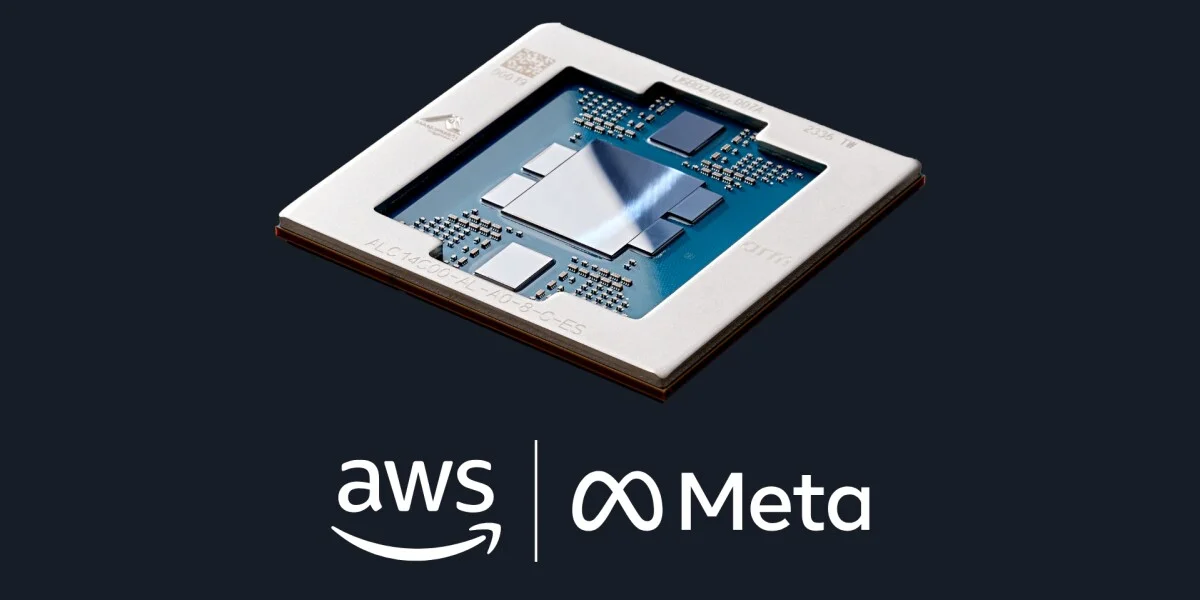
Meta has inked a significant deal with Amazon Web Services (AWS) to deploy Amazon's custom AWS Graviton processors at scale. This move is set to power the company's burgeoning agentic AI initiatives, marking a major expansion of their long-standing cloud partnership.
The deployment begins with tens of millions of Graviton cores, with built-in flexibility to scale as Meta's AI capabilities evolve. This strategic decision underscores a critical shift in AI infrastructure: while GPUs remain indispensable for training massive models, the rise of agentic AI is driving substantial demand for CPU-intensive tasks.
Agentic AI systems, capable of reasoning, planning, and executing complex, multi-step tasks, require robust compute for real-time operations. Workloads like code generation, sophisticated search, and orchestrating intricate workflows are inherently CPU-bound. The latest generation of AWS Graviton chips, specifically Graviton5, are engineered for these precise demands.
Graviton's Role in Agentic AI
Meta's agentic AI efforts involve infrastructure that can manage billions of interactions and coordinate complex, multi-step agent workflows. Graviton5 processors, featuring up to 192 cores and significantly larger caches, are designed to reduce communication delays between cores, boosting data processing speed and bandwidth. This is crucial for AI systems that need to process information and execute tasks with minimal latency.
The chips leverage the AWS Nitro System for enhanced performance, availability, and security. This includes enabling bare-metal instances for direct hardware access while maintaining compatibility with familiar AWS services. The Graviton5 instance range also supports Elastic Fabric Adapter (EFA), facilitating the low-latency, high-bandwidth communication essential for distributing large-scale AI tasks across numerous coordinated processors.
This broad deployment of Graviton signifies Meta's commitment to diversifying its compute resources as it scales its AI ambitions. "Expanding to Graviton allows us to run the CPU-intensive workloads behind agentic AI with the performance and efficiency we need at our scale," stated Santosh Janardhan, head of infrastructure at Meta.
Efficiency and Performance
Built on advanced 3-nanometer chip technology, Graviton5 processors offer improved performance and energy efficiency. AWS's end-to-end control over chip design and server architecture allows for optimizations that off-the-shelf processors cannot match. This results in infrastructure that delivers superior performance while minimizing environmental impact, aligning with Meta's sustainability goals.
The deal signals a new era in large-scale AI infrastructure development, where purpose-built silicon like Graviton plays a pivotal role in enabling advanced AI experiences. Meta's extensive use of Graviton processors demonstrates their importance for powering the next generation of AI that understands, anticipates, and scales globally.



