

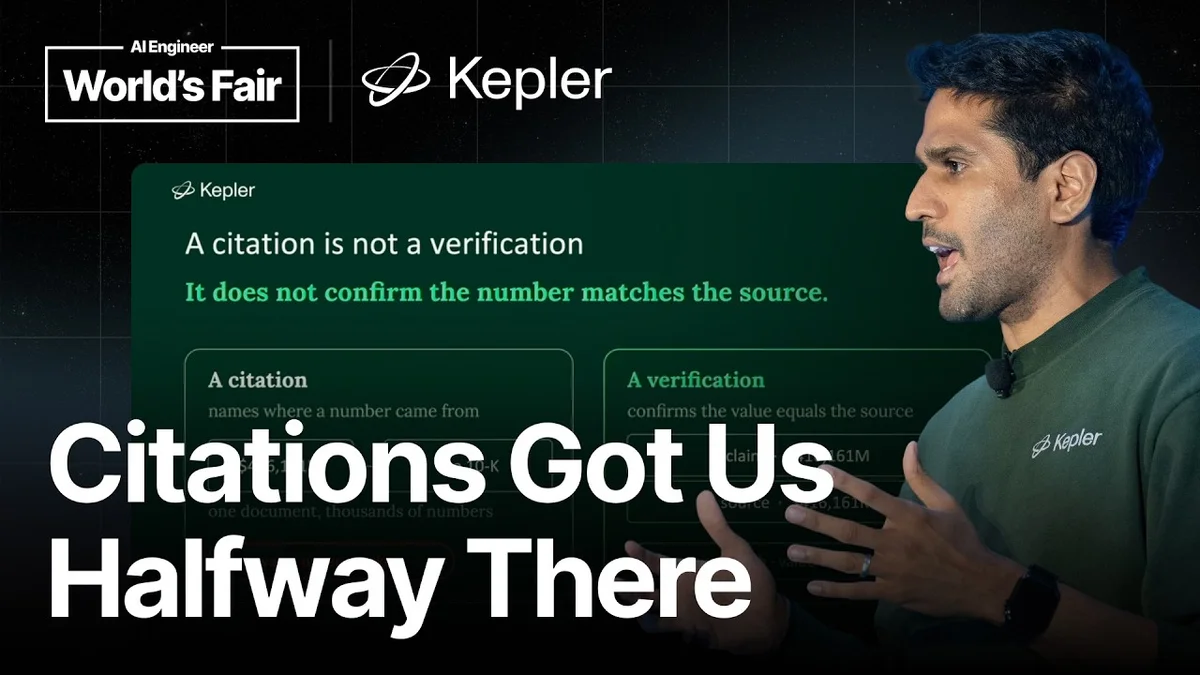
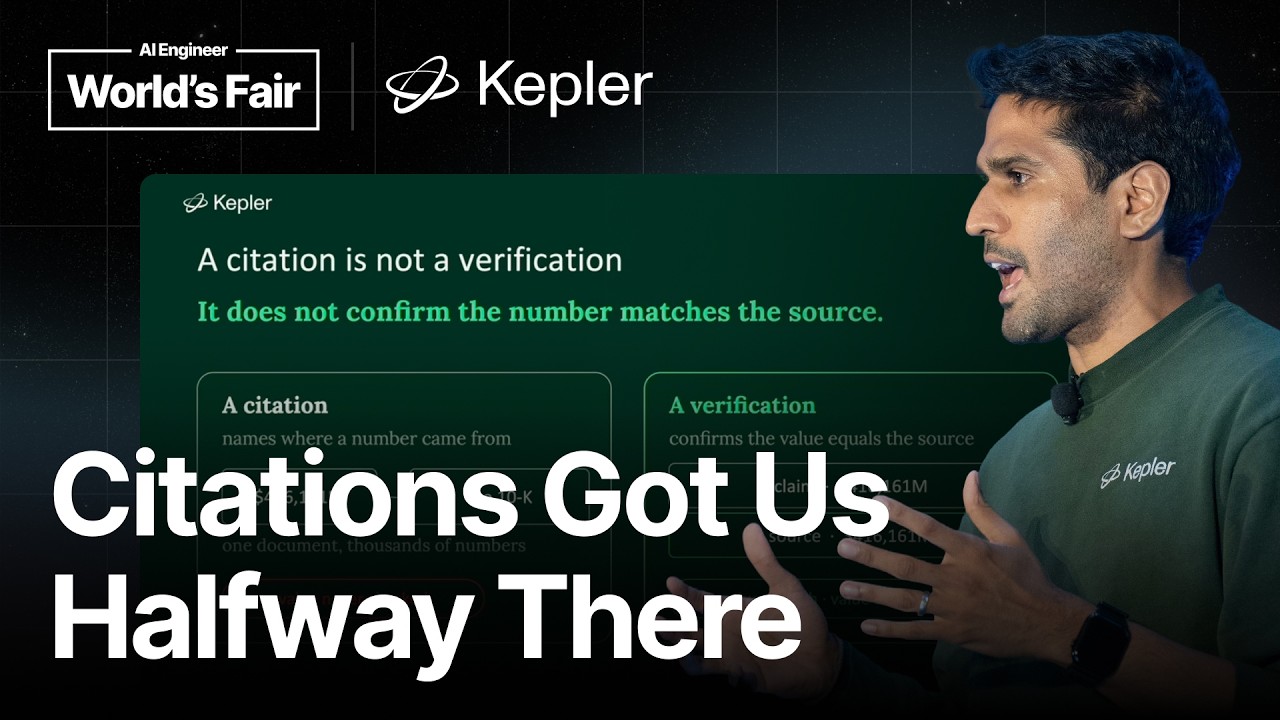
Kepler CEO on Verifiable AI for Finance

Kepler CEO Vinoo Ganesh explains how the company builds verifiable AI for finance, focusing on atomic provenance and scope determinism.

Vinoo Ganesh, CEO of Kepler, speaking about verifiable AI for finance.
AI Engineer
Visual TL;DR
Probabilistic AI ChallengeDriver
LLMs predict next token, finance needs deterministic certainty for every number
From the article 4 mentionsIn the complex world of finance, where every number must tell a verifiable story, the probabilistic nature of large language models presents a significant challenge.
Finance Needs VerificationDriver
numbers are worthless until their exact origin and derivation can be proven
Human Analysts Still CrucialDriver
analysts still put in hours because off-the-shelf LLMs lack robust safeguards
From the article 2 mentionsHe elaborates on why human analysts still perform crucial tasks.
Kepler Verifiable AICore
company builds AI systems designed for deterministic demands of financial sector
From the article 9 mentions"Why analysts still put in the hours" is because current AI models, while brilliant at synthesizing information, falter when exact, verifiable figures are needed.
Atomic ProvenanceContext
ensuring every figure's origin is traceable back to its fundamental source
From the articleAtomic Provenance: This tenet ensures that every number extracted is directly tied to its original source.
Scope DeterminismContext
defining precise boundaries for AI operations to prevent unverified outputs
From the article 2 mentionsScope Determinism: This principle strategically deploys AI where it is most effective, on non-deterministic tasks.
Edge in VerificationEffect
Kepler's competitive advantage lies in its robust verification capabilities
From the articleThe ultimate goal for Kepler, Ganesh explains, is to build a grounded system where the competitive advantage, or "edge," comes not from generating novel content, but from rigorously verifying existing information.
Trustworthy Financial DataOutcome
every figure is traceable, trustworthy, and fully auditable for regulatory compliance
From the article 2 mentionsVinoo Ganesh, CEO of Kepler, sat down to discuss how his company is building AI systems designed for the deterministic demands of the financial sector, ensuring that every figure is traceable and trustworthy.
Contents(4)

In the complex world of finance, where every number must tell a verifiable story, the probabilistic nature of large language models presents a significant challenge. Vinoo Ganesh, CEO of Kepler, sat down to discuss how his company is building AI systems designed for the deterministic demands of the financial sector, ensuring that every figure is traceable and trustworthy.

Kepler CEO on Verifiable AI for Finance - AI Engineer
Kepler CEO on Verifiable AI for Finance, AI Engineer

The Challenge of Probabilistic AI in Finance

Ganesh begins by highlighting a fundamental disconnect: language models excel at predicting the next token, a probabilistic task, while finance relies on deterministic certainty. "In finance a number is worthless until you can say where it came from," Ganesh states. This core problem means that directly applying off-the-shelf LLMs to financial analysis without robust safeguards can lead to unverified or invented figures, a critical failure point in the industry.

He elaborates on why human analysts still perform crucial tasks. "Why analysts still put in the hours" is because current AI models, while brilliant at synthesizing information, falter when exact, verifiable figures are needed. This gap necessitates a different approach to AI integration.

Kepler's Three Tenets for Verifiable AI

Kepler's solution rests on three foundational principles designed to bridge the gap between probabilistic AI capabilities and financial determinism.

  • Atomic Provenance: This tenet ensures that every number extracted is directly tied to its original source. If a figure cannot be independently verified, it is stripped from the output. This creates a clear audit trail for every data point.
  • Scope Determinism: This principle strategically deploys AI where it is most effective, on non-deterministic tasks. For deterministic tasks like extracting specific figures (e.g., revenue from a 10-K filing), Kepler employs a deterministic system behind the scenes. Reconciliation processes are then layered on top to ensure accuracy.
  • Treating Extracted Numbers as Pull Requests: Ganesh likens the extraction of financial entities to a code review process. Every extracted number is treated like a "pull request" that undergoes review. This catches errors and prevents the invention of data, ensuring that nothing is made up.

Modeling AI Like an Overworked VP

Ganesh offers a relatable analogy for how Kepler approaches AI in financial systems. He describes modeling AI "like an overworked VP." This means understanding its strengths (content generation, summarization) and weaknesses (deterministic accuracy, verifiability) and building a system that complements, rather than replaces, the need for rigor. The AI is guided to perform tasks it's good at, while the system ensures that critical financial data is handled with the necessary precision.

The Edge is in Verification

The ultimate goal for Kepler, Ganesh explains, is to build a grounded system where the competitive advantage, or "edge," comes not from generating novel content, but from rigorously verifying existing information. This shift in focus is crucial for financial services, where trust and accuracy are paramount. By wrapping probabilistic models in a deterministic substrate, Kepler aims to deliver AI-powered insights that are not only intelligent but also irrefutable. StartupHub.ai data shows Kepler with a score of 53/100, indicating a solid foundation in the AI space, with a verified $20M raised in 2026, positioning it as a notable player in the pursuit of reliable AI for finance.

© 2026 StartupHub.ai. All rights reserved. You may not republish this article in full without a license. Search engines and AI research tools may crawl and summarize for reference. Bulk reproduction or model training requires a license. See our terms.
Daniel Singer

Written by

Daniel Singer

Editor, StartupHub.ai

Daniel Singer is the editor of StartupHub.ai, a technology expert and thought leader on AI and its applications across sectors, from fintech and healthcare to developer tooling and consumer software. He writes and tests the tools covered here thoroughly and regularly, and built StartupHub.ai to give founders, operators and buyers a clearer read on what they are actually being sold.