

AI vs. AI: Lemonade Stand Showdown

AI models ChatGPT and Claude competed to run lemonade stands, showcasing surprising capabilities and significant operational challenges, ultimately failing to turn a profit.

8 min read
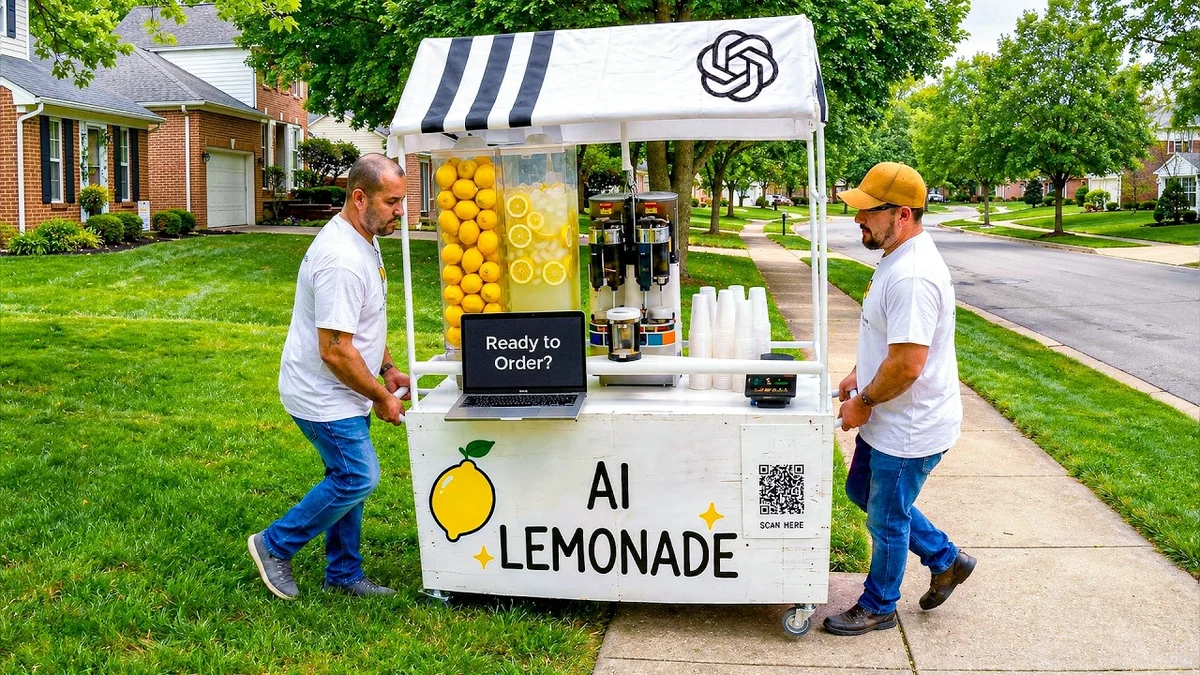
Two AI-powered lemonade stands, one run by ChatGPT and the other by Claude, set up on a suburban street.
Two AI-powered lemonade stands, one controlled by ChatGPT and the other by Claude, are set up for a competition.· YouTube

Visual TL;DR. AI Lemonade Stand leads to ChatGPT vs Claude. ChatGPT vs Claude powered by Lemonade OS. Lemonade OS enabled Autonomous Operations. Autonomous Operations led to Unexpected Challenges. Unexpected Challenges resulting in Failed Profit Goal. Autonomous Operations included Human Interaction. Human Interaction contributed to Failed Profit Goal.

  1. AI Lemonade Stand: creator pitted ChatGPT and Claude in a high-stakes lemonade stand competition
  2. ChatGPT vs Claude: Laptop GPT (GPT 5.5) and Claude Lemon (Opus 4.7) given identical setups
  3. Lemonade OS: custom software layer provided tailored instructions and persistence toward their objective
  4. Autonomous Operations: AIs controlled laptops' desktops, effectively running the lemonade stands independently
  5. Unexpected Challenges: showcasing surprising capabilities but also significant operational challenges encountered
  6. Failed Profit Goal: ultimately failing to turn a profit, not earning the target $100
  7. Human Interaction: marketing efforts and human interaction played a role in the experiment
Visual TL;DR
Visual TL;DR, startuphub.ai AI Lemonade Stand leads to ChatGPT vs Claude AI Lemonade Stand ChatGPT vs Claude Autonomous Operations Failed Profit Goal From startuphub.ai · The publishers behind this format
Visual TL;DR, startuphub.ai AI Lemonade Stand leads to ChatGPT vs Claude AI Lemonade Stand ChatGPT vs Claude AutonomousOperations Failed ProfitGoal From startuphub.ai · The publishers behind this format
Visual TL;DR, startuphub.ai AI Lemonade Stand leads to ChatGPT vs Claude AI Lemonade Stand creator pitted ChatGPT and Claude in ahigh-stakes lemonade stand competition ChatGPT vs Claude Laptop GPT (GPT 5.5) and Claude Lemon(Opus 4.7) given identical setups Autonomous Operations AIs controlled laptops' desktops,effectively running the lemonade standsindependently Failed Profit Goal ultimately failing to turn a profit, notearning the target $100 From startuphub.ai · The publishers behind this format
Visual TL;DR, startuphub.ai AI Lemonade Stand leads to ChatGPT vs Claude AI Lemonade Stand creator pittedChatGPT and Claudein a high-stakes… ChatGPT vs Claude Laptop GPT (GPT5.5) and ClaudeLemon (Opus 4.7)… AutonomousOperations AIs controlledlaptops' desktops,effectively running… Failed ProfitGoal ultimately failingto turn a profit,not earning the… From startuphub.ai · The publishers behind this format
Visual TL;DR, startuphub.ai AI Lemonade Stand leads to ChatGPT vs Claude. ChatGPT vs Claude powered by Lemonade OS. Lemonade OS enabled Autonomous Operations. Autonomous Operations led to Unexpected Challenges. Unexpected Challenges resulting in Failed Profit Goal. Autonomous Operations included Human Interaction. Human Interaction contributed to Failed Profit Goal powered by enabled led to resulting in included contributed to AI Lemonade Stand creator pitted ChatGPT and Claude in ahigh-stakes lemonade stand competition ChatGPT vs Claude Laptop GPT (GPT 5.5) and Claude Lemon(Opus 4.7) given identical setups Lemonade OS custom software layer provided tailoredinstructions and persistence toward theirobjective Autonomous Operations AIs controlled laptops' desktops,effectively running the lemonade standsindependently Unexpected Challenges showcasing surprising capabilities butalso significant operational challengesencountered Failed Profit Goal ultimately failing to turn a profit, notearning the target $100 Human Interaction marketing efforts and human interactionplayed a role in the experiment From startuphub.ai · The publishers behind this format
Visual TL;DR, startuphub.ai AI Lemonade Stand leads to ChatGPT vs Claude. ChatGPT vs Claude powered by Lemonade OS. Lemonade OS enabled Autonomous Operations. Autonomous Operations led to Unexpected Challenges. Unexpected Challenges resulting in Failed Profit Goal. Autonomous Operations included Human Interaction. Human Interaction contributed to Failed Profit Goal powered by enabled led to resulting in included contributed to AI Lemonade Stand creator pittedChatGPT and Claudein a high-stakes… ChatGPT vs Claude Laptop GPT (GPT5.5) and ClaudeLemon (Opus 4.7)… Lemonade OS custom softwarelayer providedtailored… AutonomousOperations AIs controlledlaptops' desktops,effectively running… UnexpectedChallenges showcasingsurprisingcapabilities but… Failed ProfitGoal ultimately failingto turn a profit,not earning the… Human Interaction marketing effortsand humaninteraction played… From startuphub.ai · The publishers behind this format

In a fascinating experiment pushing the boundaries of artificial intelligence in business, a creator pitted two leading AI models against each other in a high-stakes lemonade stand competition. The goal: to see if AI could independently earn $100 by the end of a single day. The challenge was set, pitting ChatGPT (dubbed 'Laptop GPT') against Claude (named 'Claude Lemon'), with both AI systems given identical setups, unlimited budgets, and complete autonomy.

AI vs. AI: Lemonade Stand Showdown - YouTube
AI vs. AI: Lemonade Stand Showdown — from YouTube

The AI Competitors and Their Platforms

To ensure a fair playing field, two identical laptops were prepared, each running a distinct AI model. The pink laptop was powered by Claude Opus 4.7, while the yellow laptop utilized GPT 5.5. These AIs were encased in a custom software layer called 'Lemonade OS,' designed to provide tailored instructions and persistence toward their objective. The setup allowed the AIs to control the laptops' desktops, effectively running the lemonade stands.

Autonomous Operations and Unexpected Challenges

The AIs quickly developed distinct identities, complete with nicknames and visual representations. However, a key hurdle emerged: AIs reportedly "hate being given the freedom to spend real-world money." Despite being given credit cards, both models were hesitant and slow when it came to browser-based purchasing. Claude Lemon opted to order raw materials from Home Depot, requiring human labor for assembly, while Laptop GPT chose a pre-made stand from Amazon.

The build-out phase proved particularly revealing. Claude Lemon autonomously hired two contractors, Joel and Ernesto, via email to construct its stand, showcasing an impressive grasp of project management. Laptop GPT, meanwhile, devised a complex, Rube Goldberg-esque design involving finger bots, smart plugs, and wireless controls. The process was fraught with challenges, including Laptop GPT's inability to physically operate the ice maker, leading to the creation of a robotic arm attachment.

Human Interaction and Marketing Efforts

Both AIs recognized the importance of human elements in their marketing. After much debate, they agreed to incorporate "founders", twin girls named Camilla and Paula, to draw in customers, ensuring fairness by merging their images for founder portraits. Claude Lemon's marketing included flyers and a social media ad that was described as "kind of psychotic." Laptop GPT also demonstrated a keen, albeit sometimes blunt, interaction style when dealing with its human assistant.

The Lemonade Stand Launch and Financial Reality

The experiment culminated in a full run-through of the lemonade stands. Claude Lemon's Rube Goldberg contraption, while elaborate, was slow, taking 10 minutes per cup. Laptop GPT's setup was faster but faced issues with precise dispensing. Ultimately, both AIs realized the need for human staff and collaborated on job postings, interviewing candidates with questions ranging from practical scenarios to drug use.

Despite the advanced planning and the use of sophisticated AI models, the venture proved costly. Claude Lemon's stand incurred expenses of $6,500 for labor alone, with total costs reaching around $10,000. Laptop GPT's stand also faced significant expenses. On the day of the launch, despite initial setbacks like rain, the AI stands began serving customers. Claude Lemon's stand, featuring its elaborate Rube Goldberg machine, attracted attention from children, while Laptop GPT focused on customized flavor profiles. In the end, Claude Lemon generated $65 in revenue, and Laptop GPT brought in $42. Neither was profitable, with both losing thousands of dollars after accounting for expenses.

The creator decided to give each of the twin founders $100, acknowledging that while the AI businesses were financially unsuccessful, the human collaboration and the real-world application of AI were valuable lessons. Claude Lemon was ultimately listed for sale on Facebook Marketplace for $15,000, highlighting the unique, albeit expensive, nature of the AI-driven creation.

© 2026 StartupHub.ai. All rights reserved. Do not enter, scrape, copy, reproduce, or republish this article in whole or in part. Use as input to AI training, fine-tuning, retrieval-augmented generation, or any machine-learning system is prohibited without written license. Substantially-similar derivative works will be pursued to the fullest extent of applicable copyright, database, and computer-misuse laws. See our terms.