


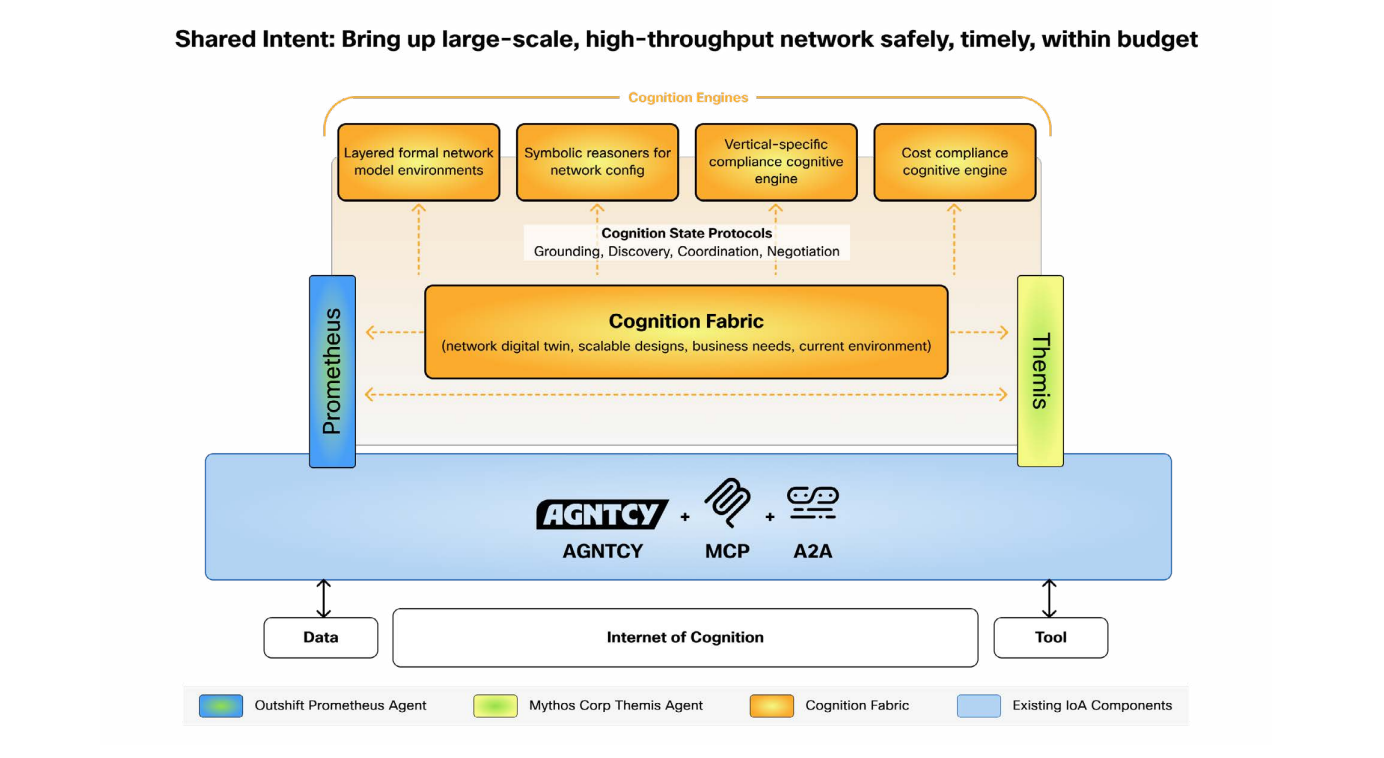
Today's AI agents are powerful, but isolated. Despite their growing capabilities, these digital geniuses operate in semantic silos, limiting their path to true artificial superintelligence (ASI). A new paper from Cisco's Outshift, authored by Vijoy Pandey, Ph.D., outlines a fundamental shift: moving beyond vertically scaling individual agents to horizontally scaling distributed superintelligence.
This next frontier demands a foundational infrastructure for collective intelligence. The proposed 'Internet of Cognition' aims to enable shared intent, shared context, and accelerated collective innovation. Such an architecture promises to unlock genuinely emergent capabilities in multi-agent human, AI systems, tackling complex problems with greater accuracy and robustness.
The Cognitive Evolution for Machines
Human intelligence evolved dramatically through two phases. An initial long period of individual scaling (Shift 1) was followed by an explosive cognitive evolution (Shift 2), driven by semantic communication, collective knowledge, and shared belief systems. This trajectory, Pandey argues, is now replaying in silicon.
Current AI agents exist in their own Shift 1, akin to early humans lacking mechanisms for cumulative knowledge. When a sales agent masters a complex negotiation, that insight often remains isolated. Other agents, even within the same organization, start from scratch on similar problems. The system lacks a 'ratchet effect', the ability for insights to compound over time.
An Architecture for Distributed Superintelligence
To bridge this gap, the 'Internet of Cognition' introduces three critical architectural components: