AI Agents Evolve: From Harnesses to Autonomous Claws

Mastra CEO Sam Bhagwat discusses the evolution of AI agents from LLMs to autonomous 'Claws,' the shift to cloud-based systems, and the inevitable market shakeout.

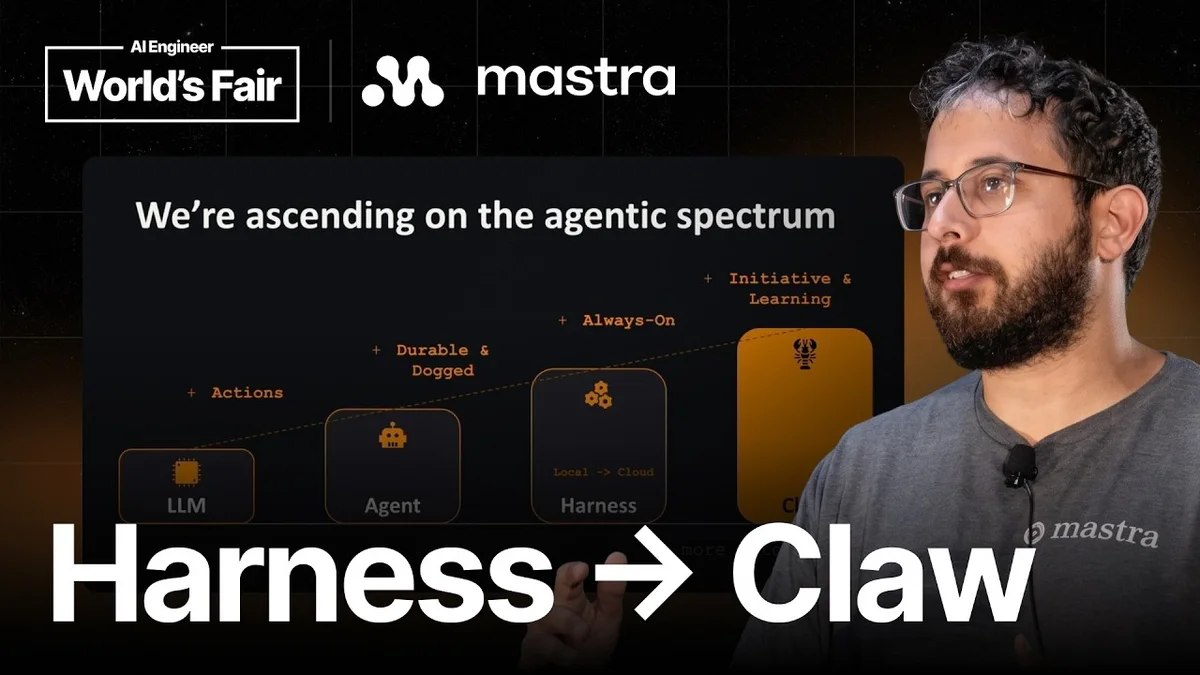
Sam Bhagwat speaking on stage about AI agents at AI Engineer World's Fair.
Sam Bhagwat, CEO of Mastra, presents at the AI Engineer World's Fair.· AI Engineer
Visual TL;DR
LLMsCore
starting point for agents, enhanced with tools, memory, and retry capabilities
From the article 2 mentionsBhagwat outlined the progression of AI agents, moving from simple Large Language Models (LLMs) to more sophisticated entities capable of complex tasks and autonomous action.
AgentsContext
LLMs gain tool calls, memory, and retry capabilities to perform tasks
From the article 9+ mentionsSam Bhagwat, CEO of Mastra, a Typescript agent framework, delivered a presentation titled "Every Harness Will Become A Claw" at the AI Engineer World's Fair.
HarnessesContext
agents with durability, planning, and managing parallel sub-agents for complex workflows
From the article 4 mentionsThese agents further develop into 'Harnesses' by gaining durability, planning modes, and the ability to manage parallel sub-agents.
Cloud HarnessesCore
From the article 5 mentionsThe next stage, 'Always-On' cloud harnesses, signifies agents that are persistently available and can interact across various platforms like Slack, mobile apps, and cloud sandboxes.
Autonomous ClawsOutcome
ultimate evolution of agents, capable of complex tasks and autonomous action
From the article 7 mentionsThe ultimate evolution, according to Bhagwat, is the 'Claw', characterized by initiative and learning.
Greater ParallelismEffect
From the article 2 mentionsThis transition enables greater parallelism and more complex workflows, such as PR-native operations.
Market ShakeoutOutcome
inevitable consolidation and competition as AI agents evolve and mature
From the articleLooking ahead, Bhagwat predicted a significant shakeout in the AI agent market.
Contents(4)

Sam Bhagwat, CEO of Mastra, a Typescript agent framework, delivered a presentation titled "Every Harness Will Become A Claw" at the AI Engineer World's Fair. Bhagwat outlined the progression of AI agents, moving from simple Large Language Models (LLMs) to more sophisticated entities capable of complex tasks and autonomous action.

StartupHub data

Companies working on this

Profiles of the companies named in this story, with funding and a one-liner from our database.

Mastra
$36M
An open-source TypeScript/JavaScript framework for building AI agents, from the creators of Gatsby.
AI Agents Evolve: From Harnesses to Autonomous Claws - AI Engineer
AI Agents Evolve: From Harnesses to Autonomous Claws, from AI Engineer

The Agentic Spectrum: From LLM to Claw

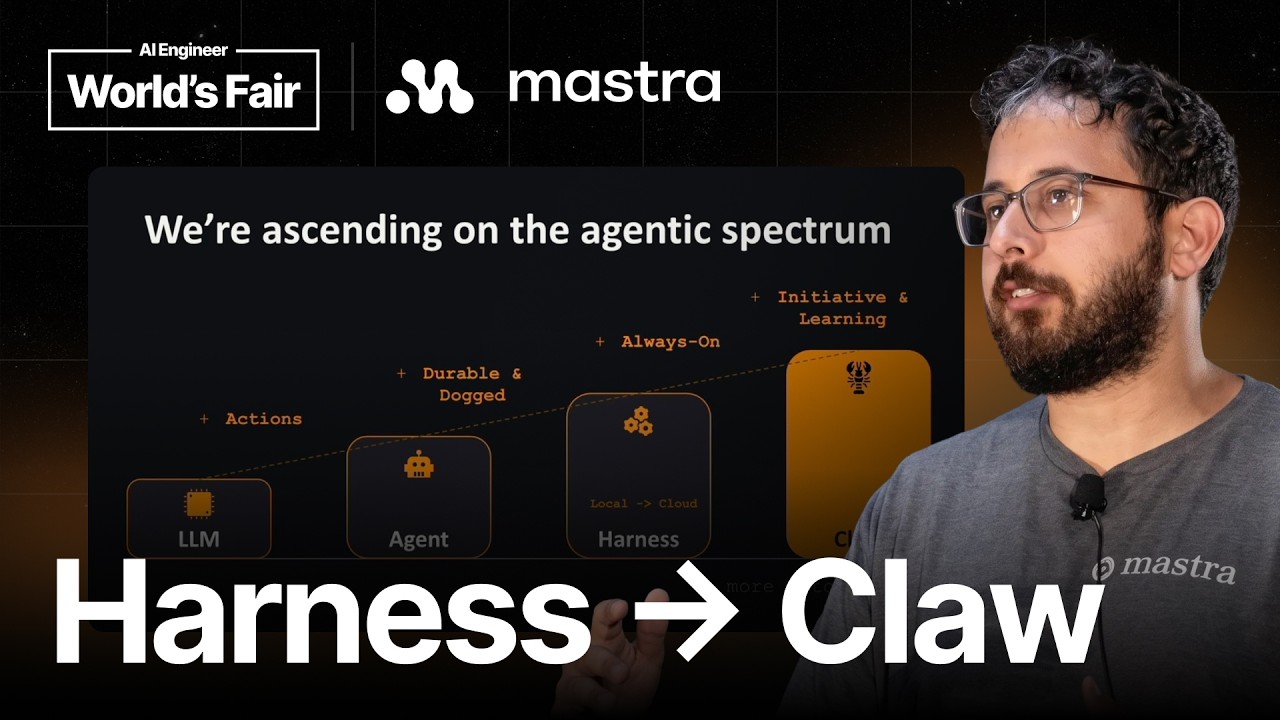
Bhagwat positioned the evolution of AI agents on a spectrum, starting with LLMs, which are enhanced by features like tool calls, memory, and retry capabilities to become 'Agents'. These agents further develop into 'Harnesses' by gaining durability, planning modes, and the ability to manage parallel sub-agents.

The next stage, 'Always-On' cloud harnesses, signifies agents that are persistently available and can interact across various platforms like Slack, mobile apps, and cloud sandboxes. This transition enables greater parallelism and more complex workflows, such as PR-native operations.

The ultimate evolution, according to Bhagwat, is the 'Claw', characterized by initiative and learning. These agents can proactively engage, such as by monitoring external feeds for urgent information or learning from their own operational traces to improve performance. He noted that while concepts like automated skill generation are emerging, the industry is still exploring the best methodologies for continuous learning.

The Shift to Cloud Harnesses and the Drive for Initiative

A significant trend highlighted is the move from local to cloud-based harnesses. These cloud-native agents offer enhanced capabilities, including increased parallelism and the ability to tunnel to local machines or operate independently in cloud sandboxes. Bhagwat emphasized that this shift requires different architectural considerations but ultimately leads to more powerful agents.

The transition from harnesses to 'Claws' is marked by the infusion of initiative and learning. Bhagwat described initiative as an agent having a 'heartbeat,' waking up periodically to perform tasks or respond to external triggers. This proactive behavior, combined with continuous learning mechanisms that allow agents to self-improve based on their actions and outcomes, defines the Claw stage.

Steinberger's Law and the Future Shakeout

Bhagwat introduced "Steinberger's Law," a prediction that "Every harness will expand until it becomes a Claw." He attributed this to both technological advancements and psychological factors, noting that users desire more capable and proactive AI assistants. The drive for more functionality, from interacting via direct messages on Slack to initiating overnight tasks, fuels this expansion.

Looking ahead, Bhagwat predicted a significant shakeout in the AI agent market. Drawing a parallel to the consolidation of mobile platforms like Android and iOS, he suggested that users will only have the mental capacity for a limited number of highly effective "Claws." This evolutionary pressure will favor agents that are either highly economically valuable or frequently used, leading to a consolidation where only the most compelling user experiences survive.

For developers, Bhagwat advised ensuring their agents possess the necessary capabilities to meet user needs and to stay abreast of the rapid pace of innovation. He cautioned that without differentiation, agents risk becoming obsolete as more powerful alternatives emerge.

© 2026 StartupHub.ai. All rights reserved. You may not republish this article in full without a license. Search engines and AI research tools may crawl and summarize for reference. Bulk reproduction or model training requires a license. See our terms.
Daniel Singer

Written by

Daniel Singer

Editor, StartupHub.ai

Daniel Singer is the editor of StartupHub.ai, a technology expert and thought leader on AI and its applications across sectors, from fintech and healthcare to developer tooling and consumer software. He writes and tests the tools covered here thoroughly and regularly, and built StartupHub.ai to give founders, operators and buyers a clearer read on what they are actually being sold.

More from Daniel Singer

