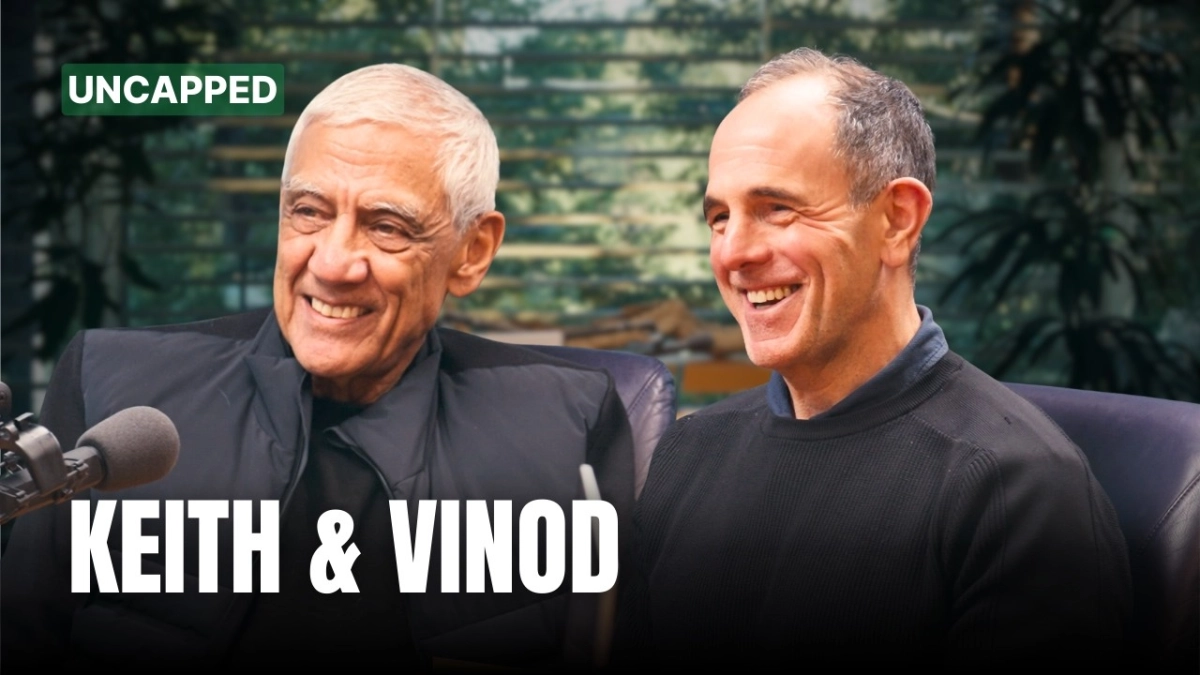
Khosla and Rabois on AI, Founders, and Brutal Honesty

4 min read
Khosla and Rabois on AI, Founders, and Brutal Honesty

Keith Rabois, Managing Director at Khosla Ventures, observed a stark reality of the current technology landscape: since rejoining the firm two years ago, approximately 70% of his investments have been centered on artificial intelligence. This dramatic shift underscores the central theme of a recent discussion with his partner, Vinod Khosla, and interviewer Jack Altman: the immense, paradigm-shifting opportunity that AI presents, and the specific, often non-consensus approach required to capitalize on it. Khosla and Rabois, known for their directness and commitment to first principles, offered a rare joint perspective on their investment philosophy, the qualities they seek in founders, and how the venture capital ecosystem is, or isn't, adapting to the age of generative AI.

The working relationship between Khosla and Rabois, despite their individual prominence and strongly held views, is defined by an intellectual rigor that values truth over harmony. When asked about their day-to-day collaboration, Khosla stated plainly that their alignment comes down to "first principles thinking." By breaking down complex decisions to their fundamental truths, they can swiftly identify where they agree and, more importantly, where they might fundamentally disagree. This dedication to intellectual clarity, rather than emotional agreement, is central to the firm's ethos. Khosla noted that this approach "makes it easy to know where you agree and where you disagree," avoiding the pitfalls of ambiguity or, as he termed it, "hand-wavy" decisions.


Related startups

This commitment to directness extends to their relationship with founders, serving as a critical filter for determining who they choose to back. Khosla argued that most venture firms suffer from "hypocritical politeness," which ultimately hurts founders by withholding the difficult, necessary truths required to build enduring companies. He likened it to giving children everything they want. Strong founders, by contrast, actively seek out and prefer candid feedback, even if it’s harsh. "Strong founders almost always select for the best feedback they can get, and also know how to say, 'no thank you, I disagree with you,'" Khosla asserted, emphasizing that the venture capitalist’s role is not to simply be nice, but to be a proactive partner dedicated to the company’s success. Rabois views his role not as a traditional venture capitalist, but as a "venture consigliere to the founder," committed to helping them achieve their highest potential over a 10-to-20-year horizon.

When assessing founders, their criteria revolve around exceptionalism, viewing the process as a search for outliers. Rabois explained that he looks for founders who exhibit a top one basis point trait on some dimension. This exceptional trait could be anything from deep technical expertise or strategic insight to sheer tenacity. He cited an anecdote about a founder who, despite never training for a triathlon and not owning a bike, rented a city bike and completed a competition simply to fit in with his new team, a demonstration of extreme grit. This reveals a fundamental quality that is predictive of success in the face of insurmountable odds. Furthermore, Khosla stressed that the most important metric for him is the "learning rate of the founder." In a rapidly shifting industry, static brilliance is less valuable than the agility to absorb new information, pivot, and reject bad ideas quickly, even those suggested by their investors.

The accelerated pace of AI development has fundamentally changed how companies must be built. Rabois noted that the old model of hiring a seasoned product manager to create a 12-month roadmap is irrelevant in AI, where foundational capabilities and customer needs are evolving monthly. The traditional product management approach, which relies on gathering customer feedback and creating a sequential roadmap, fails when the underlying technology is changing too quickly. The focus must instead shift to radical internal research and development, requiring technical leaders who are capable of constantly iterating and pushing the boundaries of what is possible.

Khosla highlighted a critical technical challenge in AI that dictates the architectural approach for successful companies: the problem of hallucination. For certain high-stakes applications, such as those in finance, healthcare, or defense, hallucinating is an existential risk. Khosla noted that Khosla Ventures is actively investing in "all other approaches than transformer models" that prioritize reliability and accuracy, aiming to create AI agents that "do not hallucinate." This focus drives investment toward hard-tech and deep scientific breakthroughs outside of the current large language model consensus, including AI oncologists, structural engineers, and fusion energy initiatives. Khosla believes that the market for AI is still completely "up for grabs," especially for companies pursuing non-consensus approaches that solve real-world problems requiring absolute fidelity.

© 2026 StartupHub.ai. All rights reserved. Do not enter, scrape, copy, reproduce, or republish this article in whole or in part. Use as input to AI training, fine-tuning, retrieval-augmented generation, or any machine-learning system is prohibited without written license. Substantially-similar derivative works will be pursued to the fullest extent of applicable copyright, database, and computer-misuse laws. See our terms.