


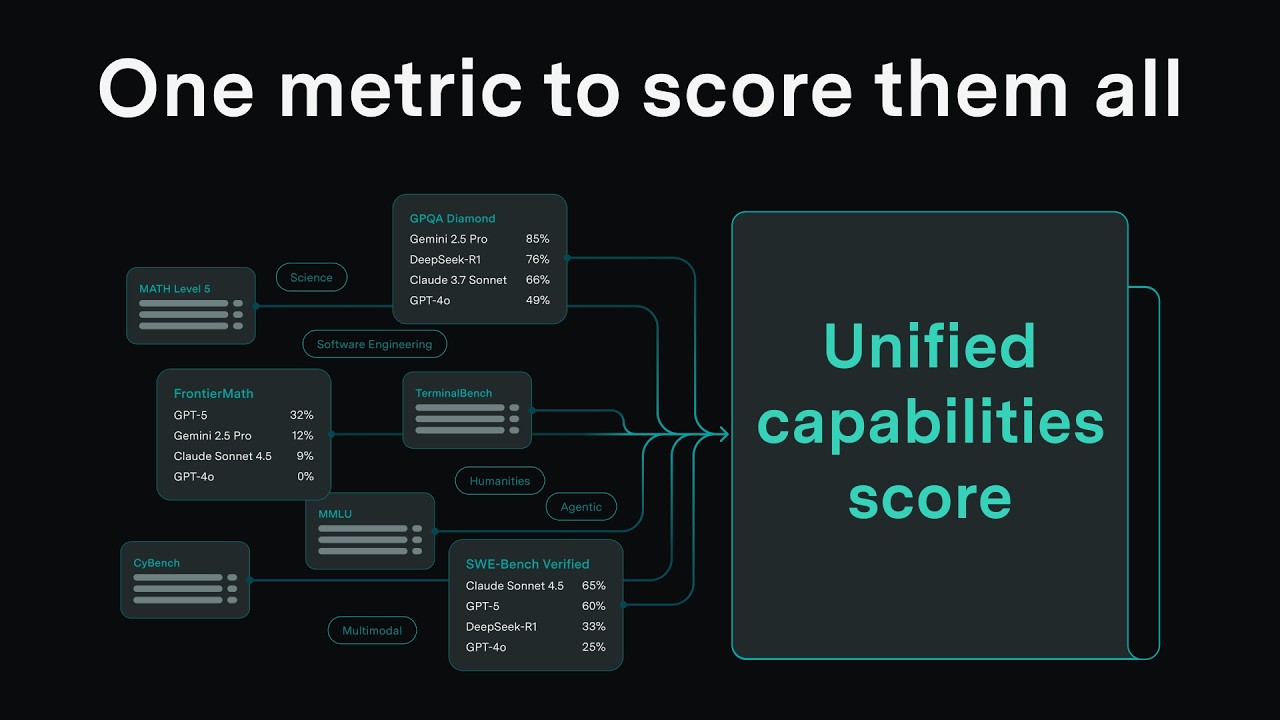
The challenge of accurately measuring and comparing AI capabilities has long plagued researchers and industry professionals, as traditional benchmarks offer only limited, often quickly saturated, insights. Anson Ho, representing Epoch AI in collaboration with Google DeepMind, recently unveiled "A Rosetta Stone for AI Benchmarks," a novel statistical framework designed to stitch together diverse AI benchmarks into a singular, unified metric. This groundbreaking work, detailed in their December 2, 2025, release, offers a refined perspective on benchmark saturation, facilitating more precise model comparisons and robust long-term forecasting of AI advancement.
Ho articulates the fundamental flaw in conventional benchmarking: "Even the best benchmarks only give us a narrow glimpse into what AI systems can do." He illustrates this with a compelling S-curve analogy, explaining that models performing at the extremes, either exceptionally poor or remarkably proficient, often register identical scores of 0% or 100% respectively. This saturation renders meaningful differentiation impossible at these critical boundaries, limiting effective comparison to a narrow, transient "middle regime" where models are neither too good nor too bad. The rapid pace of AI development means models quickly outgrow benchmarks, making them obsolete for tracking true progress.
To circumvent this inherent limitation, the "Rosetta Stone" framework introduces a sophisticated statistical approach. "Our core idea is to assume that each model has its own latent capability, and each benchmark has its own latent difficulty, and a slope," Ho explains. This methodology posits an underlying, unobservable capability for each AI model, alongside a difficulty and a saturation rate for each benchmark. By modeling the relationship between a model's latent capability and a benchmark's latent characteristics as an S-curve, the framework can infer true performance across a continuum, rather than relying on binary pass/fail outcomes. This allows for a more granular understanding of performance, even when models are at the very low or very high ends of the spectrum, where traditional benchmarks would simply cap out.
This unified metric, dubbed the Epoch Capabilities Index (ECI), is a composite score derived from hundreds of models across over 40 distinct benchmarks. This comprehensive data integration is crucial because it resolves the dilemma of disparate evaluation criteria. "It allows us to compare models across a wide range of different capabilities, even if those models were not evaluated on the same benchmark," Ho notes. This capability is paramount in a fragmented AI landscape, providing a consistent lens through which to assess diverse models and track their evolution.
Beyond mere comparison, the ECI enables the construction of robust time series data, offering unprecedented clarity on the trajectory of AI capabilities. This allows for the extrapolation of trends, providing simple forecasts of how AI capabilities are likely to evolve in the coming years. Such insights are invaluable for strategic planning, resource allocation, and risk assessment within the AI ecosystem, from nascent startups to national defense initiatives.