


"We are currently being swept along by the avalanche of demand," declared Greg Brockman, OpenAI's Co-founder and President, during a recent CNBC interview, underscoring the unprecedented pace of growth in artificial intelligence. This stark assessment came as OpenAI announced a multi-year partnership with Broadcom, a collaboration focused on developing custom AI chips and a 10-gigawatt deployment to fuel the burgeoning AI revolution. Speaking on CNBC’s ‘Squawk on the Street,’ Brockman, alongside Broadcom President Charlie Kawwas, elucidated the strategic imperative behind this alliance, revealing a deep dive into the foundational infrastructure required to sustain AI’s rapid ascent.
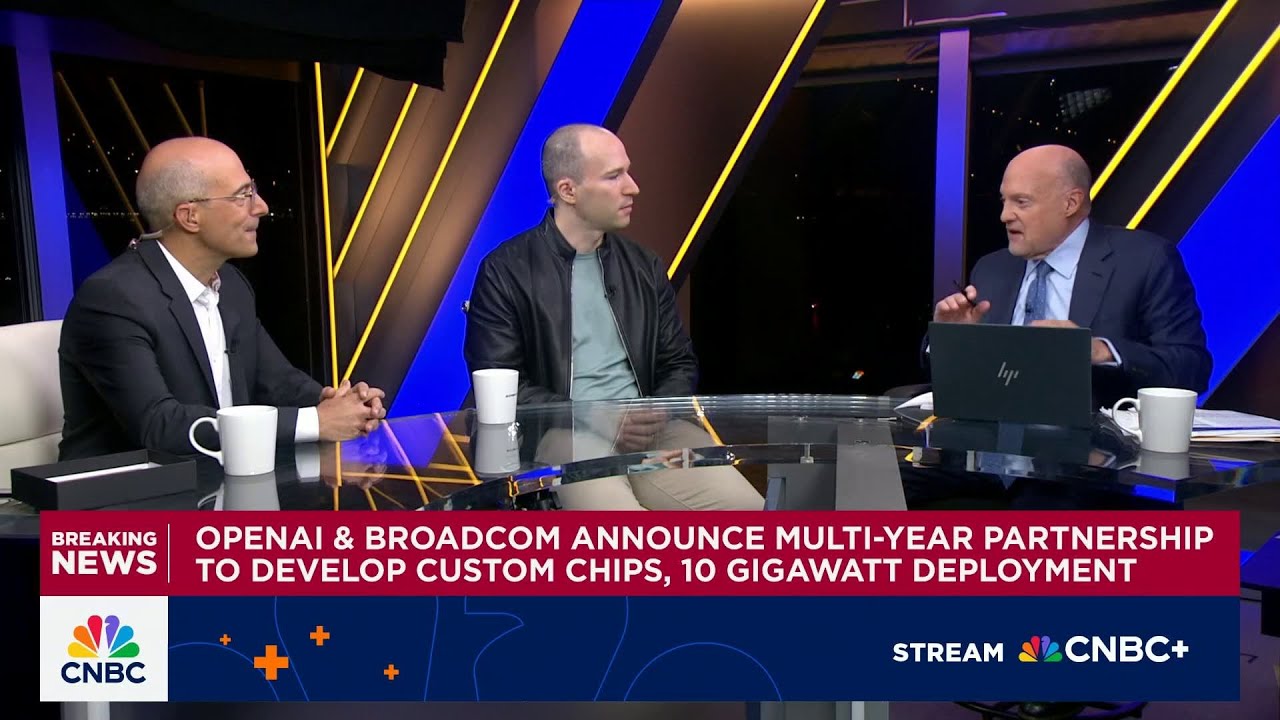
The discussion quickly centered on the sheer scale of compute power now required to advance AI models. While OpenAI has previously engaged with industry giants like AMD and Nvidia, the move towards custom silicon with Broadcom signals a shift toward highly specialized, optimized solutions. Brockman articulated this need concisely: "we need way more compute power than we are still on trajectory to build. And so I think that there is a whole industry that still needs to be created, in terms of how to have both the power and the computational power available to power the AI revolution that we see coming." This is not merely about incremental improvements; it’s about a fundamental re-architecture of the digital backbone.
The rationale behind custom chips, Brockman explained, lies in tailoring hardware precisely to the unique demands of AI workloads. "Part of what we're looking for here, part of what we've been working with Charlie and his team on, is how to actually build chips that are customized for specific workloads, so that we can take our knowledge of how to build the AI models and combine it with the best possible way of implementing that into silicon." This bespoke approach aims to squeeze every ounce of efficiency from the hardware, ensuring that the intricate algorithms of large language models run with unparalleled speed and energy effectiveness. Such optimization is crucial for managing the astronomical costs associated with training and deploying advanced AI.
Broadcom's role in this partnership extends beyond mere chip fabrication. Charlie Kawwas highlighted a "trifecta" approach that integrates three critical components: custom AI accelerators, the underlying network, and the overarching software. Broadcom's long history in enabling AI infrastructure, spanning over a decade, positions them uniquely to address these complex requirements. The networking aspect, in particular, is vital for connecting vast arrays of these specialized processing units, allowing them to function as a cohesive, scalable supercomputer. This interconnectedness, built on open-standard Ethernet networking, is essential for breaking down computational bottlenecks and facilitating seamless data flow across the massive AI clusters.
The synergy between OpenAI's deep understanding of AI models and Broadcom's hardware and networking expertise is designed to yield an AI platform that delivers "the highest performance at really unprecedented power... and costs," as Kawwas stated. This integrated strategy contrasts sharply with a piecemeal approach, offering a holistic solution that optimizes performance, power consumption, and overall cost efficiency. It’s a pragmatic response to the immense demand, ensuring that the financial outlays translate directly into superior computational capabilities and tangible advancements.