

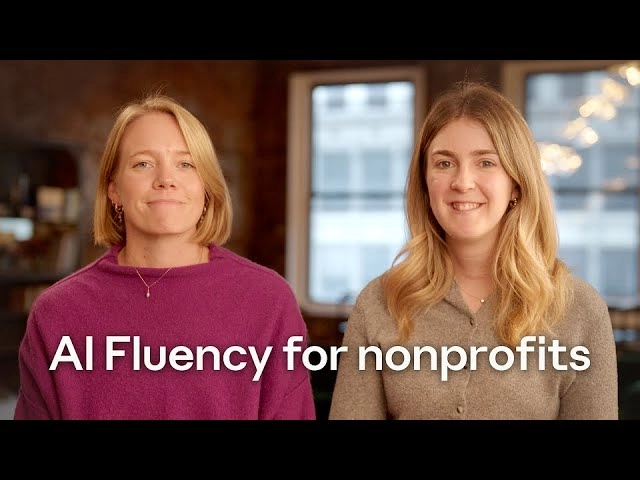
Anthropic, a leading AI safety and research company, has partnered with Giving Tuesday to introduce "AI Fluency for nonprofits," a free course designed to equip mission-driven organizations with the skills to effectively integrate artificial intelligence into their operations. This initiative, highlighted in a recent trailer featuring Zoe Ludwig, Claude Apps Education Lead at Anthropic, and Kelsey Kramer, Director of Partnerships at Giving Tuesday, underscores a strategic push to democratize access to advanced AI tools and foster responsible adoption within the social impact sector. The collaboration reflects a shared conviction that AI holds transformative potential for addressing complex societal challenges, and that nonprofits, often operating with limited resources, are uniquely positioned to benefit from enhanced technological capabilities.

Zoe Ludwig and Kelsey Kramer presented this new course, detailing its framework and practical applications for mission-driven teams. Their discussion centered on empowering nonprofits to leverage AI responsibly and intentionally, moving beyond superficial engagement with technology to a deeper, more strategic integration. This foundational approach aims to ensure that AI serves as a true accelerant for impact, rather than merely another tech expense.
The core philosophy driving this course is Anthropic’s belief that "AI can help solve humanity's most important problems. And nonprofits are on the front lines of those challenges. That's why they deserve AI that's built for their reality." This statement from Zoe Ludwig encapsulates the underlying ethos: to tailor sophisticated AI capabilities, specifically Anthropic's Claude, to the unique operational and ethical landscape of the nonprofit world. It recognizes that generic AI solutions may not adequately address the nuanced requirements of organizations dedicated to public good.
Kelsey Kramer emphasized that "Claude for nonprofits is designed as an ecosystem, not just a product." This distinction is crucial, signaling a holistic approach that combines AI tools with a comprehensive educational framework. It acknowledges that simply providing access to an AI model isn't enough; users need the strategic understanding and practical guidance to apply it effectively and ethically within their specific contexts. This ecosystem includes the "4D Framework" for fluent AI use: Delegation, Description, Discernment, and Diligence, which are explored through the course.
The "4D Framework" acts as a structured guide for integrating AI. Delegation involves understanding which tasks are suitable for AI and how to distribute work between human and machine intelligently. Description focuses on clearly defining desired outputs, formats, audiences, and styles when prompting AI. Discernment teaches users to critically evaluate AI-generated content for accuracy, bias, and relevance. Finally, Diligence covers the ongoing monitoring, refinement, and ethical considerations necessary for sustained, responsible AI use. This framework provides a robust mental model for navigating the complexities of AI adoption.