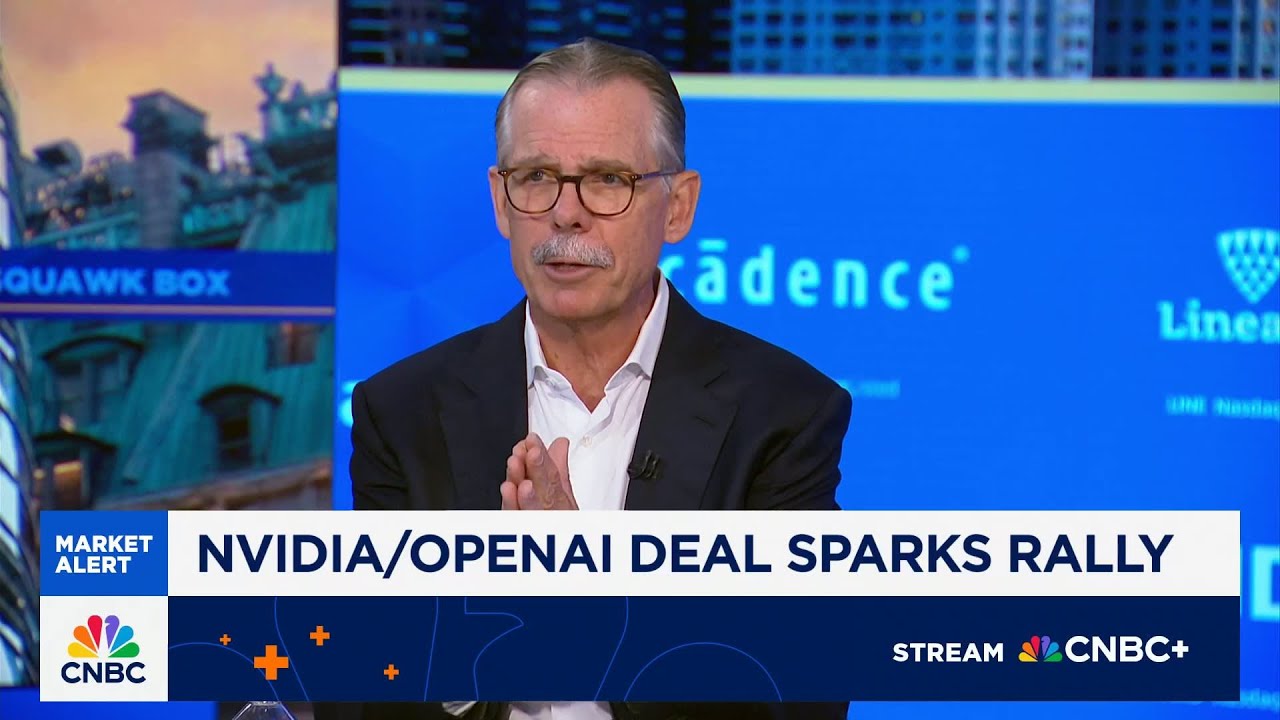
“This is the kind of scale transactions and scale balance sheets you're going to need to finance what's happening in AI. I've never seen anything so huge as this.” These words from Glenn Hutchins, co-founder and chairman of North Island and lead independent director of CoreWeave, encapsulated the core challenge of the artificial intelligence boom during a recent appearance on CNBC’s Squawk Box. Hutchins, alongside interviewers Sara Eisen and Andrew Ross Sorkin, delved into the profound implications of Nvidia's reported $100 billion investment in OpenAI, the innovative financing models emerging to support this growth, the critical role of skilled immigration, and the looming energy demands of the AI revolution.
Hutchins immediately framed the current AI infrastructure build-out as unprecedented, drawing parallels to the early days of semiconductor and hard drive development. He noted that the sheer capital requirements for these foundational technologies were so immense that traditional capital markets struggled to finance them. Historically, this led to countries like Singapore and Taiwan leveraging their government balance sheets to fund the necessary foundries, securing their place in the global tech supply chain. A similar dynamic, he argued, is now unfolding in the AI space, demanding financial commitments on a scale typically associated with national economies.
A key insight from Hutchins revolved around the innovative financing structures that are enabling this massive capital deployment. He highlighted CoreWeave, a company specializing in data centers for AI needs, as a pioneer in this regard. CoreWeave has adopted a "project finance framework" to fund its GPU infrastructure. This model involves taking long-term contracts from major AI players like Microsoft, OpenAI, Claude, and Google, who commit to "off-take" or utilize the cloud computing facilities. These guaranteed cash flows, typically spanning four to five years, the useful depreciable life of the GPUs, are then matched with financing. At the end of this period, CoreWeave retains ownership of the depreciated GPUs, providing an optionality for future use or resale.
This innovative approach to financing has rapidly gained traction. In recent months, it has become the standard for funding AI infrastructure, adopted by peers and rivals across the industry.
Sorkin pressed Hutchins on the long-term viability of valuing GPUs as assets, given the rapid pace of technological obsolescence in AI. Hutchins countered by explaining that the project finance model inherently addresses this risk. He stated, "You extract roughly two times your money from the chips over the four to five years of the contract. So they're fully depreciated, basically free, and you can, you have an option to do with them if they, if you, something if you want." This model ensures the initial investment is recouped within the contracted period, mitigating the risk of future depreciation or technological irrelevance.