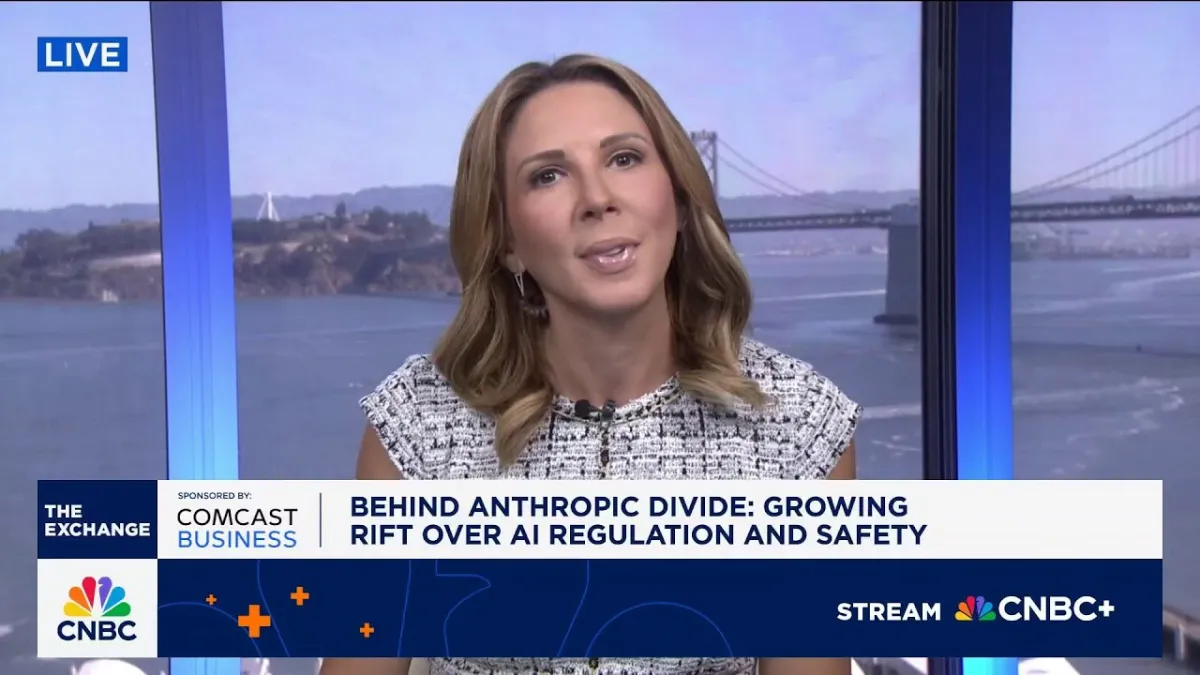
The nascent field of artificial intelligence, poised to redefine industries and societies, finds itself increasingly embroiled in a fierce debate over its very foundations: safety and regulation. This isn't merely a technical discussion among engineers; it is a politically charged power struggle, fracturing Silicon Valley and drawing the attention of the White House. CNBC's MacKenzie Sigalos, reporting on "The Exchange," recently highlighted how Anthropic, a prominent AI developer, sits at the epicenter of this growing regulatory rift, polarizing tech titans and government officials alike.
MacKenzie Sigalos spoke on "The Exchange" about the escalating tensions surrounding AI safety protocols and their interpretation, noting that "this isn't just about safety protocols anymore, it's a power struggle over who defines responsible AI and who gets to write the rules for what comes next." At the heart of this contention is Anthropic's stated commitment to "responsible R&D," a position that its critics argue masks a strategic maneuver for regulatory advantage. The company, known for its cautious approach to AI development, has notably hired senior Biden administration officials, a move that has fueled suspicions among some venture capitalists and industry observers.
Critics, including David Sacks, a former White House AI Czar under Trump and a backer of rival AI firm XAI, contend that Anthropic's advocacy for safety measures is an "agenda to backdoor Woke AI." This sentiment suggests a belief that the company is leveraging its influence to push for regulations that align with a particular ideological bent, potentially stifling competition and shaping the industry in its favor. Marc Andreessen, co-founder of Andreessen Horowitz (A16Z), echoed this skepticism, characterizing the situation as "morally corrupt politics." These accusations paint a picture of a company not merely striving for ethical AI, but actively engaging in political lobbying to secure a dominant position by influencing the regulatory framework.
The concept of "regulatory capture" looms large in these discussions. When an industry player actively shapes regulations to its benefit, often under the guise of public good or safety, it can create significant barriers to entry for smaller, less resourced competitors. If Anthropic's "responsible R&D" leads to stringent, complex compliance requirements, it could inadvertently (or intentionally) disadvantage startups and open-source initiatives, solidifying the market position of well-funded incumbents. This dynamic is particularly concerning for founders and VCs who champion a more open, competitive AI ecosystem.
Conversely, Anthropic has its staunch defenders. Reid Hoffman, co-founder of LinkedIn and a significant Democratic donor, as well as an investor in both OpenAI and Anthropic, publicly supports the company's approach. He characterizes Anthropic as "trying to deploy AI the right way," emphasizing its consistency in being cautious about frontier risks and selective about the products it releases. This perspective highlights the genuine concern many in the AI community hold regarding the potential catastrophic risks of advanced AI and the necessity for a measured, safety-first development paradigm. For these proponents, Anthropic’s actions are not self-serving but represent a vital commitment to preventing unforeseen societal harms.
Anthropic CEO Dario Amodei, in an attempt to bridge the divide, has stated, "We believe we share those goals with the Trump administration, both sides of Congress, and the public." This assertion suggests a desire to frame AI safety as a universally shared objective, transcending partisan politics. However, the deep ideological and economic fissures within Silicon Valley and Washington indicate that consensus on *how* to achieve this safety, and *who* should define it, remains elusive. The debate is less about the end goal of safe AI and more about the means, the power dynamics, and the underlying values driving regulatory efforts.
Related Reading
- OpenAI, SAG-AFTRA, and Cranston Confront Deepfakes in Generative AI
- AI's Autonomous Frontier Demands a Security Paradigm Shift
- El-Erian Labels AI Boom a 'Rational Bubble' Amidst Dollar Diversification
The implications for the startup ecosystem are profound. Uncertainty in regulation can deter investment and innovation, particularly for smaller entities that lack the resources to navigate complex legal landscapes. If AI safety becomes a tool for political leverage or market consolidation, it could stifle the very dynamism that has historically driven technological progress in Silicon Valley. Founders must now contend not only with technical challenges and market competition but also with a rapidly evolving and highly politicized regulatory environment. VCs, in turn, face increased due diligence around regulatory risk and political alignment when evaluating AI investments.
Ultimately, the dispute over Anthropic's role in AI safety regulation underscores a critical juncture for the industry. It reveals that the development of powerful general-purpose AI is no longer a purely technical endeavor but an intensely political one, with high stakes for economic power, national security, and societal values. The outcome of this regulatory rift will not only determine the trajectory of individual companies but also shape the fundamental character of the AI revolution itself.