


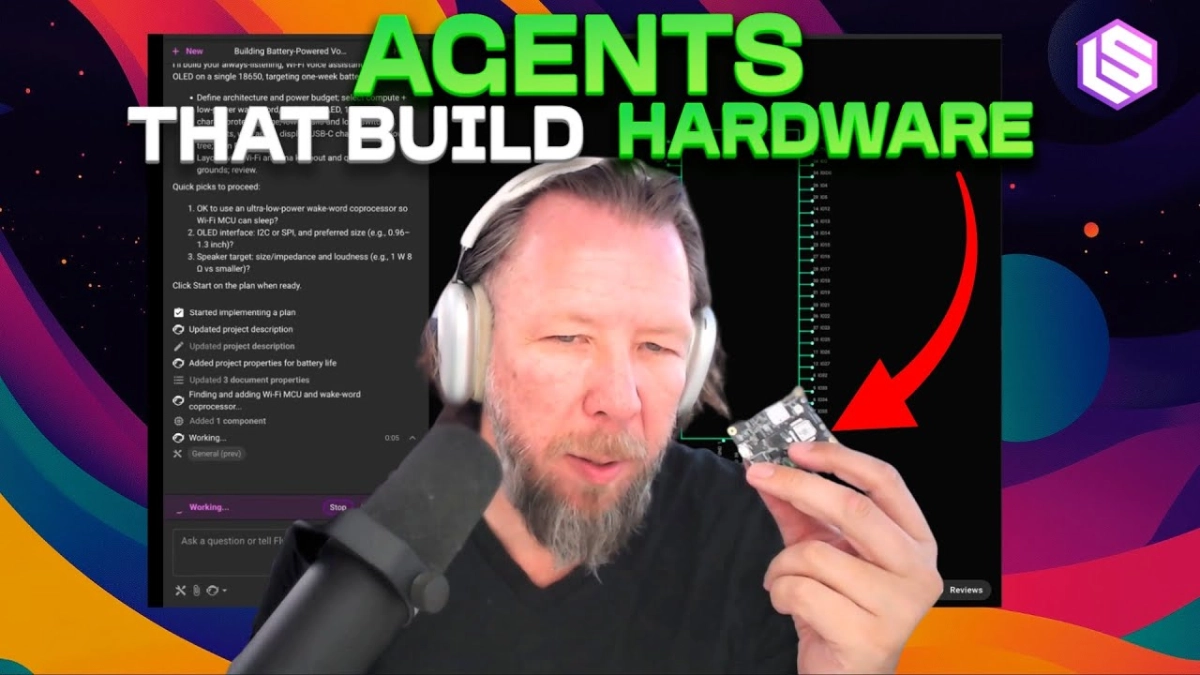
Artificial intelligence is not merely writing code; it is now designing the very circuits that power our physical world. This profound shift, long overdue in the hardware domain, is at the heart of Flux's mission, spearheaded by co-founder and CEO Matthias Wagner. Wagner, in a recent interview on Latent Space, illuminated how Flux is leveraging AI agents to bridge a decades-long tooling gap, transforming product briefs into manufacturable printed circuit board (PCB) designs in under 30 minutes.
Wagner's journey to founding Flux in 2019 began with a stark realization during a summer sabbatical working on Burning Man projects: while software development tools had undergone a "bonkers" evolution, hardware design tools remained largely stagnant. He observed, "The tooling to make hardware had not improved in my lifetime... the tooling to make software is unrecognizable." Despite the supply chain evolving to allow individuals to manufacture almost anything, the design tools had not kept pace. Flux was born from this frustration, initially building a browser-based, collaborative CAD tool from scratch, architected from day one as a reinforcement learning environment for AI agents.
The advent of Large Language Models (LLMs) in 2022 served as a "turbocharge" for Flux's ambitious vision. Wagner proudly stated, "I think we were the first engineering tool or design tool that had an AI chat in it... a month or two before GPT-4 became publicly available." This early adoption, particularly the maturation of tool calling capabilities about a year ago, proved to be a critical inflection point. Tool calling enabled Flux's agents to autonomously interact with external systems, searching component libraries, checking real-time pricing and availability across distributors like DigiKey and Arrow, and executing complex design tasks.
This innovative approach culminates in what Wagner calls "the AI hardware engineer," a product capable of designing intricate devices with remarkable speed and accuracy. During a live demonstration, Flux designed a custom Alexa-like device, complete with an ESP32 microcontroller, beamforming microphones, an OLED display, speaker, battery management, and Wi-Fi connectivity. The AI agent not only selected millions of components, verified compatibility, and generated a manufacturable design, but also explained its decisions and accepted user feedback in real-time, showcasing a truly collaborative paradigm.
The technical architecture underpinning this capability is sophisticated, layering multiple specialized agents orchestrated using frameworks like LangGraph and LangChain. Prompt management, a significant challenge with numerous sub-agents, is handled externally in Langsmith, allowing for rapid iteration. While some tasks are hardened with formal evaluations, Wagner admitted that much of the development still relies on "vibe checking," prioritizing iteration speed in this nascent field. The average user session runs 25 minutes, with agents managing everything from initial component selection to routing optimization.
