

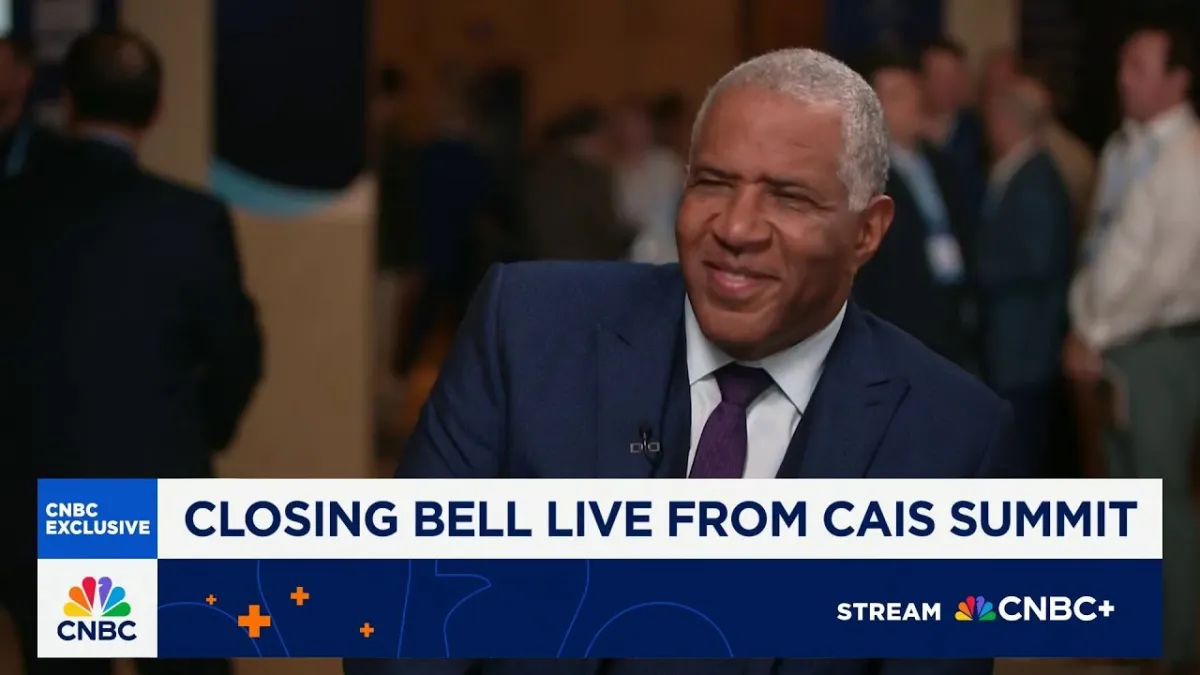
Robert Smith, the astute founder, chairman, and CEO of Vista Equity Partners, articulated a compelling vision for the future of artificial intelligence in enterprise software, contending that the true economic value is yet to be fully realized. During a recent interview with Scott Wapner on CNBC's "Closing Bell," broadcast live from the CAIS Summit in Beverly Hills, Smith dissected the prevailing anxieties surrounding an "AI bubble" and offered a nuanced perspective, emphasizing the profound opportunity that lies ahead for businesses adept at harnessing agentic AI. His insights cut through the speculative fervor, focusing instead on the tangible shifts AI will induce within the enterprise software landscape, particularly for companies that command their specialized data and workflows.
The current discourse often draws parallels between the nascent AI boom and the dot-com era, with figures like Paul Tudor Jones and Ken Griffin noting "obvious echoes" of 1999. Smith acknowledges the complexity of the ecosystem, observing that while some segments of the market might indeed be experiencing exaggerated valuations, many critical areas have yet to feel the full impact of AI's transformative promise. He posits a three-wave progression for new technologies: initially hardware vendors, followed by hyperscalers, and finally, the application users who leverage the technology to empower their businesses. This third wave, according to Smith, is where the "massive opportunity" in enterprise software, specifically "agentic enterprise software," will materialize, driving unprecedented growth and profitability.
Smith’s core thesis centers on the idea that "AI is going to enable enterprise software to eat services." This provocative statement underscores a fundamental shift where AI-powered software will automate and optimize tasks traditionally performed by human-driven services. This transition will foster the emergence of "agentic workers", autonomous software agents capable of executing tasks at higher frequencies, lower costs, and with greater efficiency and precision than human counterparts. The implications for operational streamlining and cost reduction across industries are immense, signaling a new paradigm for productivity and value creation within the enterprise.
A crucial, yet often overlooked, aspect of this transformation, Smith highlights, is the current disparity in data integration. He reveals a striking statistic: "The vast majority of enterprise data and workflows actually isn't part of these foundational models... We're seeing less than 1% in our portfolio of our data actually a part of these foundational models." This insight is critical for founders and VCs, as it points to an enormous untapped potential within proprietary enterprise data. Unlike consumer data, which has largely fueled the development of current foundational AI models, enterprise-specific data remains largely siloed and underutilized, representing a rich vein for future AI innovation and application.
The key differentiator for enterprise software companies in this evolving landscape will be their "sovereignty and dominion" over their unique workflows and data sets. Those that can effectively "agentify" their systems, integrating AI with their specialized, high-precision data, will be positioned to empower their customers to achieve greater profitability, accelerated growth, and enhanced operational efficiency. This isn't merely about adopting AI; it's about deeply embedding it into the core operational fabric with a level of precision that far exceeds general-purpose AI models, which Smith notes often offer only around "93% precision," insufficient for enterprise-grade applications.