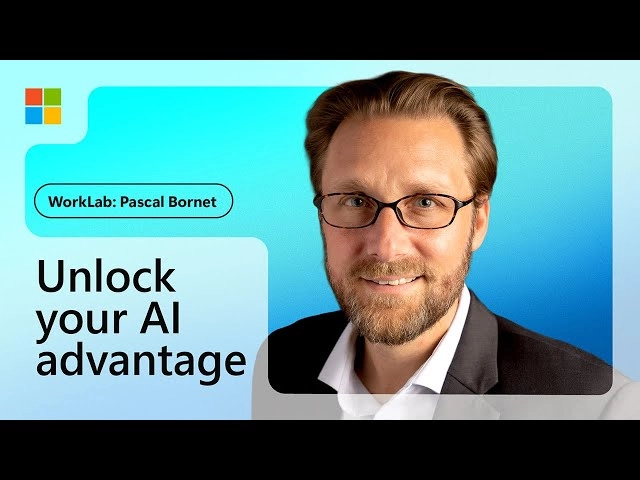
The future of business, as illuminated by AI expert Pascal Bornet, hinges not merely on the deployment of advanced artificial intelligence, but on a profound, human-centric transformation. As Bornet succinctly states, "The companies that succeed are only the ones that put the people in the center of their transformation." This philosophy underpins the advent of agentic artificial intelligence, a paradigm shift poised to redefine work and competitive advantage.

During a recent discussion on Microsoft’s WorkLab podcast with host Molly Wood, Bornet, an author and globally recognized authority in AI and intelligent automation, shared insights gleaned from over two decades of experience implementing these technologies at firms like McKinsey and EY. The conversation centered on the evolution from traditional automation to sophisticated AI agents, emphasizing how businesses can strategically harness these tools to empower their workforce and sharpen their competitive edge.
Bornet traces the lineage of intelligent automation from early robotic process automation (RPA) and script automation, which he refers to as "old kind of agents" designed to perform autonomous, predefined actions for humans. The recent explosion of generative AI, exemplified by large language models (LLMs) like ChatGPT, brought a new level of intelligence. These models excel at understanding context, answering questions, being creative, and planning complex scenarios. Yet, Bornet highlights a critical limitation: "They can't do anything, they can just suggest things." This gap between insightful information and actionable execution creates a significant "frustration" for users, underscoring that "we have information, but we still need action."
This is precisely where agentic AI steps in. Unlike generative AI that merely suggests, AI agents are designed to "understand context, that can understand goals, that can plan actions and that can learn from the outcome of those actions and improve themselves in time." Bornet outlines a "SPA" framework for these agents: they Sense their environment, Plan actions based on goals, Act to execute those plans, and Reflect on the outcomes to learn and improve. This mirrors human cognitive processes, moving beyond simple task automation to intelligent, adaptive execution.
The real-world applications of agentic AI are already demonstrating significant impact across diverse industries. Bornet cited Pets at Home, the UK's largest pet care company, which achieved 99% accuracy in transcribing veterinary consultations using an ambient digital scribe. This agent not only records but also performs transactional work, connecting with patient data and preparing necessary documentation, freeing veterinarians to focus on patient care. Other examples include fraud detection agents that identify patterns invisible to the human eye, insurance integration agents that check policy coverage in real-time, and store colleague assistants that provide personalized guidance to staff. Beyond these, Bornet notes examples like JP Morgan reducing fraud by 70% and McKinsey cutting client onboarding lead times by 90% through intelligent automation. These diverse use cases underscore that the potential of agentic AI is "unlimited" and applicable to "any function and any industry."
At the heart of this revolution is the crucial role of humans. Bornet emphasizes that successful companies prioritize their people, fostering what he terms "Humics", uniquely human abilities that machines cannot fully replicate. These include genuine creativity, which generates truly original ideas rather than merely recombining existing ones; critical thinking, involving nuanced judgment, questioning assumptions, and navigating complex ethical dilemmas; and social authenticity, building deep, trust-based relationships through empathy and shared consciousness. AI can simulate these, but never authentically replicate them.
Related Reading
- Unlocking Enterprise AI: Integrating and Governing Unstructured Data for Smarter Agents
- Box CEO: AI Agents Redefine Enterprise Productivity
- Agentic AI: The Concierge Revolution and the Compute Bottleneck
For business leaders, the transition means becoming "orchestrators" of human-agent workflows. The focus shifts from assigning tasks to setting goals and defining boundaries for agents, allowing humans to leverage their unique skills. Leaders must invest in their people, providing the time and resources for them to develop these Humics. This involves fostering a culture of experimentation, where employees are empowered to try new technologies, learn from failures, and continuously build new skills in collaboration with AI. This gradual, trust-building approach is vital.
The long-term competitive advantage lies in building "compounding intelligence advantages." Early adopters are not just gaining temporary benefits; they are creating competitive moats by generating data through agent interactions that continuously improves their entire agent ecosystem. In a future where AI becomes a commodity, businesses differentiating themselves through the unique combination of human capabilities and agentic systems will thrive. This requires a strategic vision from the top, C-levels and boards must understand how AI can transform their companies, not just automate existing processes. It is about reinventing, not just replicating.