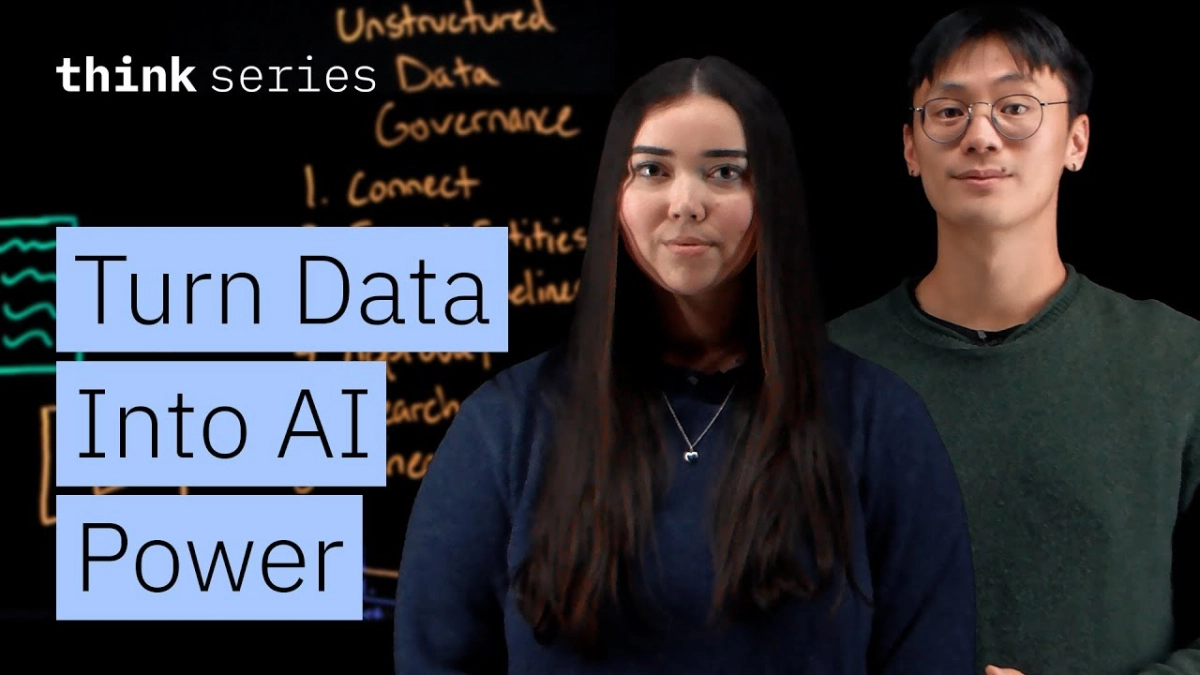
The prevailing wisdom that artificial intelligence models fail due to inherent weaknesses is often a misdirection; the true culprit frequently lies in the quality and accessibility of the data fueling them. This critical insight formed the bedrock of a recent presentation by IBM’s Caroline Garay, Product MCC, and Adrian Lee, Product Manager, who illuminated the profound impact of unstructured data on the efficacy of AI agents. They articulated a compelling vision for leveraging the vast, untapped reserves of enterprise unstructured data through robust integration and governance pipelines, a narrative particularly resonant with founders, VCs, and AI professionals navigating the evolving AI landscape.
Garay and Lee spoke about unlocking smarter AI agents with unstructured data, Retrieval Augmented Generation (RAG), and vector databases, highlighting how IBM's solutions are addressing this critical challenge. They emphasized that over 90% of enterprise data is unstructured, comprising contracts, PDFs, emails, audio, and video, yet less than 1% of it currently makes its way into generative AI projects. This disparity is not merely an inefficiency; it’s a significant impediment.
The inherent difficulty in leveraging unstructured data stems from its fragmented nature. As Caroline Garay pointed out, "The challenge with unstructured data is that it's scattered across systems, inconsistent in format, and often full of sensitive information. So, handing it straight to an AI agent risks hallucinations, inaccurate answers, or even leaks." This scattering across disparate systems, coupled with format inconsistencies and the presence of sensitive details, necessitates tedious manual intervention by data engineering teams. They often resort to sifting through countless documents, painstakingly stripping out confidential information, and stitching together custom scripts, a process that can consume weeks and leave engineers frustrated. This manual overhead not only slows development but also introduces potential errors and compliance risks, directly impacting the reliability and trustworthiness of AI outputs.
The solution, as presented by Garay and Lee, lies in two essential concepts: Unstructured Data Integration (UDI) and Unstructured Data Governance (UDG). These frameworks are designed to transform raw, messy content into AI-ready knowledge, making it both usable and trustworthy.
Unstructured Data Integration extends the familiar principles of structured data ETL (Extract, Transform, Load) pipelines to the complex realm of unstructured content. Adrian Lee elaborated on this, stating, "Unstructured data integration creates repeatable pipelines that ingest, process, and prepare high volumes of content... users can automate in minutes what previously required weeks of custom scripting and maintenance." This process begins with ingesting data from diverse sources like SharePoint, Box, Slack, and file stores using pre-built connectors. The data then undergoes a series of transformations utilizing pre-built operators for tasks such as text extraction, deduplication, language annotation, personally identifiable information (PII) removal, and chunking content into manageable segments. Finally, these segments are vectorized into embeddings and loaded into a vector database, becoming the fuel for RAG and other AI applications. Crucially, this integration supports incremental updates, meaning only changes (deltas) are processed, avoiding costly full reprocessing and keeping pipelines current at scale. Furthermore, native access control lists (ACLs) ensure that document-level permissions are preserved, guaranteeing that AI agents and users only access authorized information, thereby maintaining compliance and trust.
While integration makes unstructured data usable, it is governance that renders it truly trustworthy. Unstructured Data Governance is purpose-built to tackle the unique complexities of unstructured information, ensuring it is discoverable, organized, and reliable. The governance process unfolds in several key steps: first, connecting to unstructured assets across the enterprise; second, extracting key entities like names, dates, and topics to transform raw files into structured, analyzable data. Next, enrichment pipelines classify content, assess its quality, and add contextual metadata, tagging documents with relevant topics, people, or sentiment. This metadata then facilitates validation through configurable rules and alerts for low-confidence data, bolstering accuracy and trust.
Related Reading
- Google Cloud's Vertex AI Agent Engine Bridges the Production Gap for AI Agents
- Model Context Protocol: Streamlining AI Agent Interaction with Cloud Tools
- Box CEO: AI Agents Redefine Enterprise Productivity
Subsequently, these assets move through approval workflows into a central catalog, significantly enhancing their organization and discoverability. With robust technical and contextual metadata in place, users can intelligently search and filter across all assets. The final, critical component is data lineage, which meticulously tracks how documents move from source to target. This provides full visibility, compliance, and auditability, establishing a transparent and accountable data lifecycle.
The combined force of Unstructured Data Integration and Unstructured Data Governance closes what Garay and Lee refer to as the "reliability gap." As Caroline Garay succinctly put it, "Integration makes the data usable, and governance makes it trustworthy. But together, they unlock the 90% of enterprise data that's historically been out of reach." This synergy provides AI agents with high-quality, contextualized domain knowledge, leading to more accurate RAG outputs, smarter co-pilots, and highly effective domain-specific assistants. The benefits extend beyond AI agents, supporting high-value use cases such as advanced analytics and reporting. Teams can mine customer calls for sentiment trends, scan contracts for compliance risks, or analyze field reports to uncover operational insights, all without the arduous task of manually sifting through thousands of files. This represents a fundamental shift in how enterprises approach AI, enabling them to transition projects from experimental prototypes to scalable, production-grade systems, fully harnessing the intelligence hidden within their vast stores of unstructured information.