

AMD drops 7% on Q2 sell-the-news reaction, NVIDIA gains 3.4% for its fourth straight session

Advanced Micro Devices fell 7% on Wednesday despite beating second-quarter estimates, while NVIDIA Corp. surged 3.4% for its fourth consecutive session, splitting the AI chip sector. SOXX slid 2.1%, the Nasdaq fell 0.8%, and the S&P 500 dipped 0.2%.

9 min read
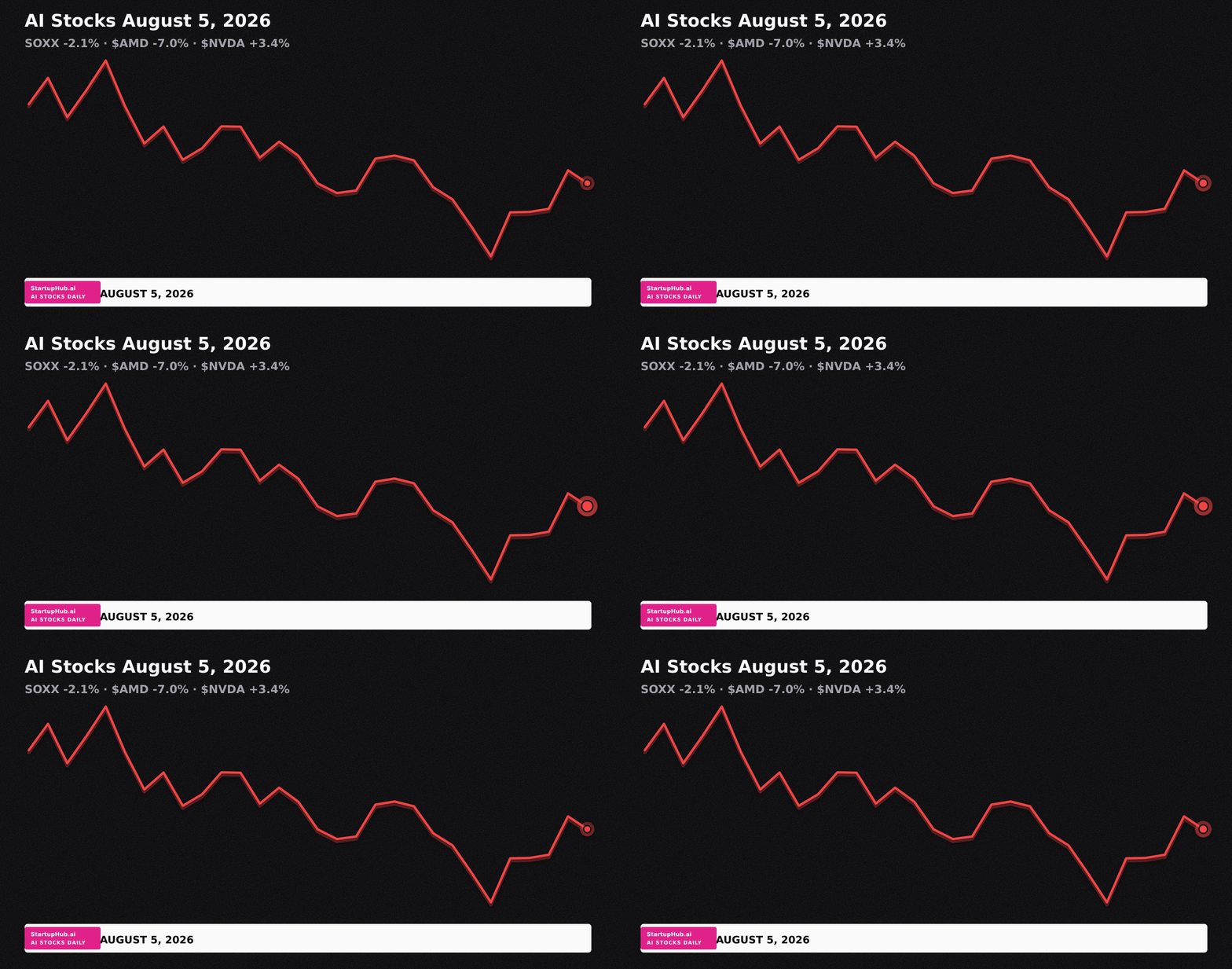
AI stocks daily line chart August 5, 2026: SOXX -2.1%, $AMD -7.0%, $NVDA +3.4%

Advanced Micro Devices fell 7% Wednesday despite beating second-quarter estimates, sending a sharp reminder that good numbers are not always enough: NVIDIA Corp. surged 3.4% for its fourth straight session, splitting the AI chip trade into two distinct camps. The Philadelphia Semiconductor ETF SOXX slid 2.1%, the Nasdaq fell 0.8%, and the S&P 500 dipped 0.2% to 7,723 - while the Dow Jones Industrial Average climbed 0.5% to a fresh all-time high as money rotated out of tech and into industrials and financials.

Top AI stocks today: August 5, 2026

Ticker Close Day 1mo YTD
$NVDA $219.22 +3.43% +7.40% +16.08%
$CRM $192.98 +1.04% +15.85% -23.91%
$META $588.77 +0.14% -2.38% -9.48%
$MU $893.19 +0.06% -5.86% +183.17%
$AVGO $418.28 +0.03% +7.61% +20.33%
$AMD $482.05 -7.04% -6.83% +115.71%
$OUST $45.12 -5.69% +3.94% +93.07%
$SMCI $30.32 -4.32% +7.63% -2.07%
$GOOGL $362.43 -4.03% +0.14% +15.00%
$TER $389.39 -3.51% +10.76% +87.60%

AMD drops 7% on Q2 sell-the-news reaction

Advanced Micro Devices Inc. (NASDAQ: AMD) reported second-quarter earnings of $1.66 per share on revenue of $11.54 billion, beating consensus estimates of $1.55 per share and $11.28 billion respectively - and the stock still fell 7%. The dynamic is familiar in high-multiple technology: expectations had been bid up aggressively in the days before the print, AMD rose roughly 8% on Tuesday alone, and investors used Wednesday to collect gains. CNBC reported that CEO Lisa Su addressed reports of Elon Musk redirecting AI spending toward Nvidia, calling the competitive landscape manageable. Despite the drop, AMD still carries a YTD gain of more than 115%. Wells Fargo analyst Aaron Rakers raised his price target to $700 from $615 with an Overweight rating, citing AMD's guidance for 80% year-over-year server revenue growth in the second half of 2026. Bank of America maintained a Buy with a $620 target. AMD remains central to the thesis for diversified AI chip stocks 2026 exposure, but the session underscored how little earnings beats mean when positioning is already stretched.

NVIDIA gains 3.4% for its fourth straight session

NVIDIA Corp. (NASDAQ: NVDA) closed at $219.22, up 3.4% on heavy volume of 156 million shares. The move extends a four-day run and positions NVDA as the clearest beneficiary of any concern that AMD is losing ground in the GPU competition. Per S&P Global data cited by analysts, 61 firms cover Nvidia with a consensus Strong Buy and an average price target of $302.83, representing roughly 38% upside from current levels. NVDA is now a key dividing line in portfolios focused on best AI stocks to buy in the near term: those who believe training-cluster demand remains the primary driver favor NVDA; those betting on AMD''s CPU-GPU crossover thesis were burned today. StartupHub.ai data shows 416 companies active in the AI Hardware space globally, reflecting how deep the silicon ecosystem runs beneath the two headline names - and why a single earnings day can realign capital so sharply between them.

Ouster slips 5.7% ahead of tomorrow''s earnings call

Ouster Inc. (NASDAQ: OUST) fell 5.7% to $45.12, giving back part of a 27% five-day run as traders trimmed exposure ahead of the company''s second-quarter earnings call scheduled for Thursday, August 6 at 5:00 PM EDT. Oppenheimer raised its price target on OUST to $57 from $42 and maintained an Outperform rating, citing improving LIDAR commercialization across automotive and industrial verticals. The stock is up 93% year-to-date, making it one of the stronger performers among AI-adjacent names in 2026. A miss tomorrow could unwind more of that gain quickly; a beat on volume or margin guidance could take it through Oppenheimer''s new target.

Alphabet falls 4% as Magnificent 7 AI stocks face rotation pressure

Alphabet Inc. (NASDAQ: GOOGL) dropped 4% to $362.43 on above-average volume, the steepest single-day loss among hyperscalers and the largest drag from the Magnificent 7 AI stocks cohort on the session. The move had little company-specific catalyst and reads primarily as sentiment contagion from the AMD selloff: when chips fall sharply on good numbers, investors question whether the entire AI capex cycle is priced for perfection. Google''s AI infrastructure spending - which management has committed to maintain through 2026 - becomes a liability narrative on days like this, even though the underlying cloud and search businesses remain intact.

Super Micro slides 4.3% as AI infrastructure stocks retreat

Super Micro Computer Inc. (NASDAQ: SMCI) fell 4.3% to $30.32, continuing its pattern of sharp moves tied to server build-out sentiment. SMCI is closely correlated with NVDA GPU deployment cycles, so AMD''s post-earnings doubt about near-term data center spend hit SMCI harder than most. The stock is still up 7.6% over the past month, suggesting the sell today is tactical rather than structural among active AI infrastructure stocks positions.

Notable but quieter

Palantir Technologies (NYSE: PLTR) fell 2.6% to $158.43, pulling back after a remarkable 29.6% five-day run. The PLTR trade has become one of the highest-conviction AI software plays among retail and institutional investors alike in 2026; the one-day dip looks like profit-taking rather than a shift in the underlying government-and-enterprise AI agent thesis.

Salesforce Inc. (NYSE: CRM) gained 1.04% to $192.98, the second-best performer in our universe today. Agentforce adoption commentary has supported CRM in recent weeks even as the stock remains 24% below where it started the year; the relative strength on a down tape is a constructive signal worth watching.

Cloudflare Inc. (NYSE: NET) fell 2.8% to $292.96, in line with broader security and networking names that moved on chip-sector sentiment. NET is up 49% year-to-date and remains a key AI infrastructure stocks proxy for edge compute and inference delivery.

Lam Research Corp. (NASDAQ: LRCX) slid 3.25% to $307.42 alongside chip equipment peers. At 66% YTD, LRCX remains a core position for anyone building exposure to top AI stocks 2026 through the semiconductor tooling supply chain rather than chip designers directly.

What to watch tomorrow

Ouster (OUST) reports second-quarter results after the close Thursday, August 6 at 5:00 PM EDT. Baidu Inc. (NASDAQ: BIDU) is scheduled to report its second-quarter 2026 financial results before U.S. market open on August 18. AMD''s earnings call transcript and analyst day commentary from today will continue to generate upgrades and target revisions through the rest of the week, and the tape will be watching closely for any AMD-specific read-throughs into TSM, NVDA, and AMAT. No major Fed speakers are scheduled Thursday. The AI stocks to watch into next week include any name with direct server or ASIC exposure, as AMD''s guidance for 80% second-half server revenue growth is either the most bullish data point in the sector or the one most priced in - and the tape has not yet decided which.

What are the top AI stocks to buy in August 2026?

Across hardware, hyperscale cloud, and enterprise software, the consensus top AI stocks in August 2026 include NVIDIA (NVDA), Advanced Micro Devices (AMD), and Broadcom (AVGO) on the chip and AI hardware side; Alphabet (GOOGL) and Microsoft (MSFT) for hyperscale AI infrastructure; and Palantir (PLTR) and Salesforce (CRM) for enterprise AI software monetization. Wall Street''s 2026 focus has shifted from training-cluster buildout to inference economics and AI-agent monetization, which is reshuffling which names lead each session and why a single post-earnings selloff in AMD can simultaneously lift NVDA and pressure the entire AI chip stocks complex.

Core watchlist

Chips

Broadcom (AVGO): +0.03% on light volume. Custom ASIC demand from hyperscaler customers steady; next catalyst is Q3 earnings in September.

Taiwan Semiconductor Manufacturing Co. (NYSE: TSM): -0.76% on light volume. AMD''s guidance for 80% H2 server revenue growth is a forward buy for TSM capacity; near-term watching monthly WSTS shipment data.

Hyperscalers

Microsoft Corp. (NASDAQ: MSFT): -1.09% on average volume. Azure AI revenue mix the Q1 FY2027 question; Copilot attach rate the next catalyst at the October print.

Meta Platforms Inc. (NASDAQ: META): +0.14% on light volume. Llama open-weight strategy keeps Meta from paying Nvidia rack rates; next catalyst is Q3 earnings in late October.

Amazon.com Inc. (NASDAQ: AMZN): -1.72% on heavy volume. AWS Trainium and Bedrock investment cycle steady; watching re:Invent for inference pricing commentary.

Alphabet Inc. (GOOGL): -4.03% on heavy volume. Covered in main movers above; Cloud Next and Q3 earnings the next major catalysts.

Enterprise SaaS

Oracle Corp. (NYSE: ORCL): -0.93% on average volume. Cloud database infrastructure for AI training workloads the multi-year narrative; next print due mid-September.

Salesforce Inc. (CRM): +1.04% on average volume. Agentforce monetization the primary thesis; positive outlier on a tough tape.

ServiceNow Inc. (NYSE: NOW): -0.78% on light volume. Workflow-AI agent rollout still the core carrier; next catalyst is Q3 print on October 29.

monday.com Ltd. (NASDAQ: MNDY): -2.51% on average volume. mondayAI suite expansion the multi-quarter narrative; watching the next quarterly print for updated FY guide.

Vol / retail

Palantir Technologies (PLTR): -2.60% on heavy volume. Pulling back after a 29.6% five-day run; AI software government contract pipeline the structural story, short-term positioning the near-term risk.

Tesla Inc. (NASDAQ: TSLA): -1.77% on average volume. Robotaxi network expansion and FSD v13 rollout the near-term catalysts; autonomy revenue mix the multi-year thesis.

Snowflake Inc. (NYSE: SNOW): +0.02% roughly flat on light volume. Cortex AI data workload migration pipeline the carrier; watching Q3 consumption data for acceleration signals.

Not investment advice.

© 2026 StartupHub.ai. All rights reserved. Do not enter, scrape, copy, reproduce, or republish this article in whole or in part. Use as input to AI training, fine-tuning, retrieval-augmented generation, or any machine-learning system is prohibited without written license. Substantially-similar derivative works will be pursued to the fullest extent of applicable copyright, database, and computer-misuse laws. See our terms.