OpenAI's Vinoth Govindarajan on Agent Failures and Harness Design

Vinoth Govindarajan from OpenAI explains that AI agent failures often stem from poorly designed 'harnesses' rather than the agents themselves.

9 min read
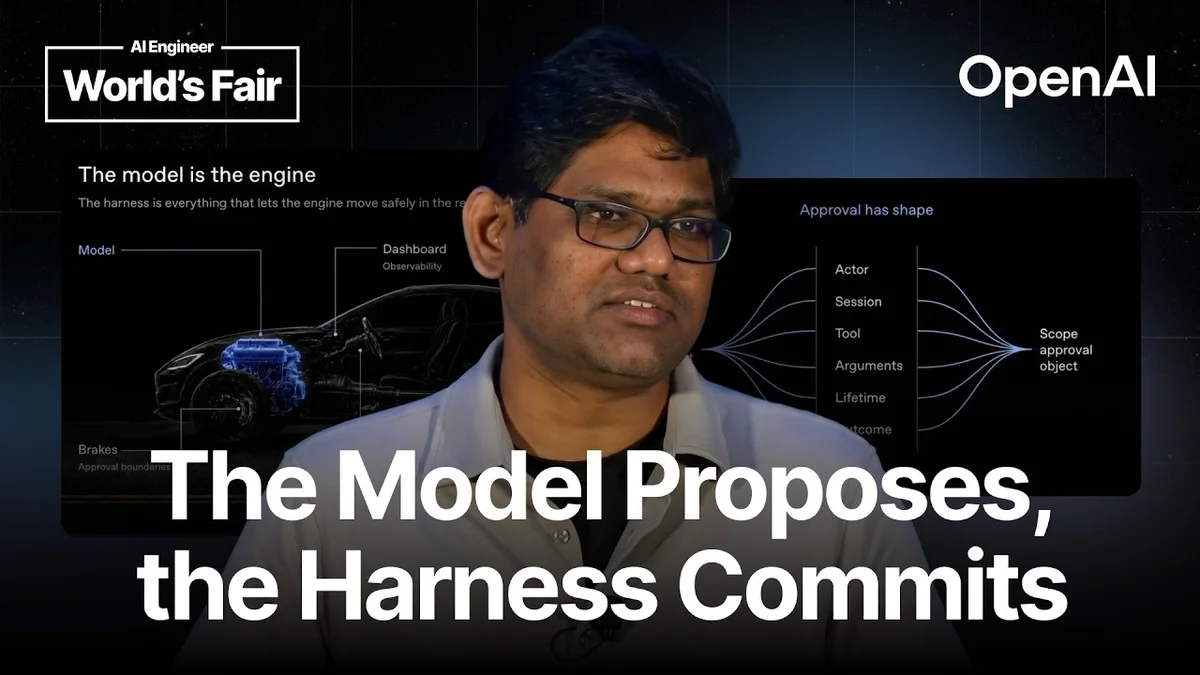
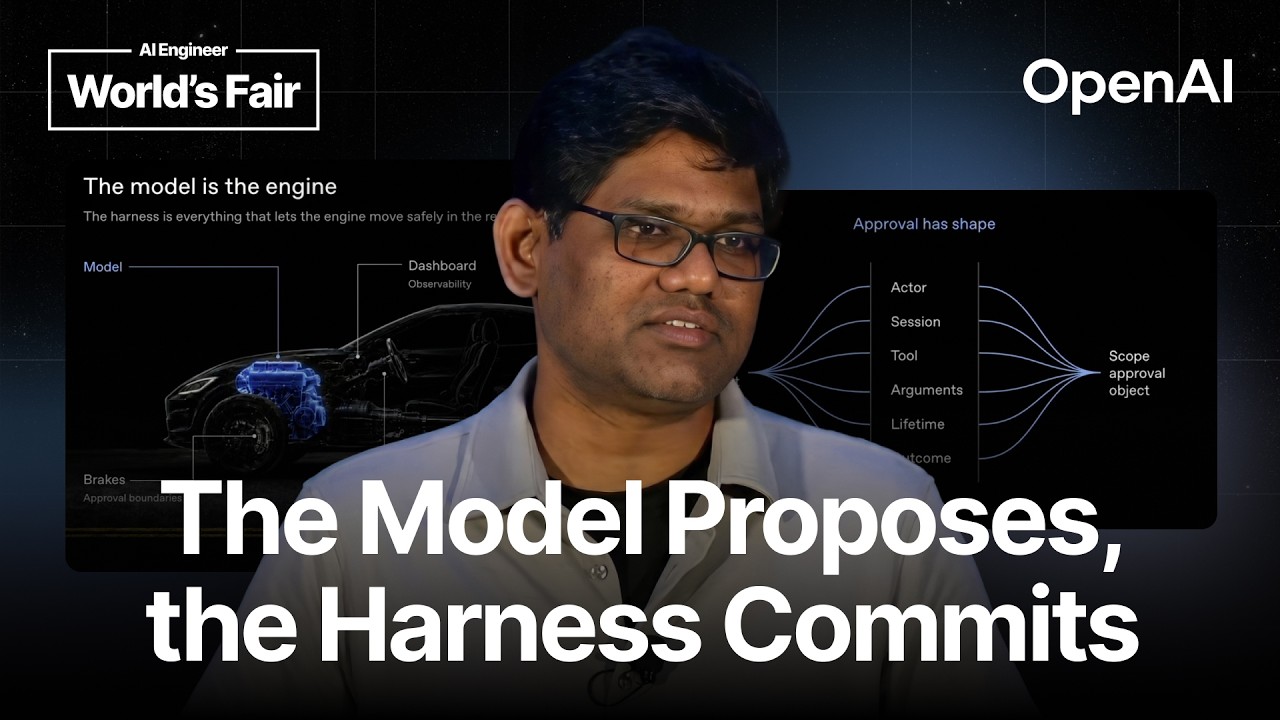
Vinoth Govindarajan from OpenAI speaking about AI agent harness design at a conference.
Vinoth Govindarajan discusses the critical role of harness design in AI agent performance.· AI Engineer

Visual TL;DR. Vinoth Govindarajan explains AI Agent Failures. AI Agent Failures stem from Poor Harness Design. Poor Harness Design highlights Harness Critical Role. Poor Harness Design requires Beyond Agent Itself. Harness Critical Role enables Effective Harness Design. Beyond Agent Itself informs Effective Harness Design. Effective Harness Design leads to Improved AI Debugging. Effective Harness Design results in Better AI Deployment.

  1. Vinoth Govindarajan: prominent figure at OpenAI, advancing AI agent capabilities and practical applications
  2. AI Agent Failures: often appear to fail, challenging conventional debugging approaches and system re-evaluation
  3. Poor Harness Design: fault frequently lies with surrounding infrastructure, not the agent itself
  4. Harness Critical Role: orchestrates agent operation, managing and guiding AI systems effectively
  5. Beyond Agent Itself: understanding agent failure requires looking at the entire operational environment
  6. Effective Harness Design: key to successful AI deployment, preventing misattribution of failures
  7. Improved AI Debugging: systemic re-evaluation of how we build and deploy AI systems
  8. Better AI Deployment: leads to more robust and reliable AI agent operation in practice
Visual TL;DR
Visual TL;DR, startuphub.ai Vinoth Govindarajan explains AI Agent Failures. AI Agent Failures stem from Poor Harness Design. Effective Harness Design results in Better AI Deployment explains stem from results in Vinoth Govindarajan AI Agent Failures Poor Harness Design Effective Harness Design Better AI Deployment From startuphub.ai · The publishers behind this format
Visual TL;DR, startuphub.ai Vinoth Govindarajan explains AI Agent Failures. AI Agent Failures stem from Poor Harness Design. Effective Harness Design results in Better AI Deployment explains stem from results in VinothGovindarajan AI Agent Failures Poor HarnessDesign Effective HarnessDesign Better AIDeployment From startuphub.ai · The publishers behind this format
Visual TL;DR, startuphub.ai Vinoth Govindarajan explains AI Agent Failures. AI Agent Failures stem from Poor Harness Design. Effective Harness Design results in Better AI Deployment explains stem from results in Vinoth Govindarajan prominent figure at OpenAI, advancing AIagent capabilities and practicalapplications AI Agent Failures often appear to fail, challengingconventional debugging approaches andsystem re-evaluation Poor Harness Design fault frequently lies with surroundinginfrastructure, not the agent itself Effective Harness Design key to successful AI deployment,preventing misattribution of failures Better AI Deployment leads to more robust and reliable AI agentoperation in practice From startuphub.ai · The publishers behind this format
Visual TL;DR, startuphub.ai Vinoth Govindarajan explains AI Agent Failures. AI Agent Failures stem from Poor Harness Design. Effective Harness Design results in Better AI Deployment explains stem from results in VinothGovindarajan prominent figure atOpenAI, advancingAI agent… AI Agent Failures often appear tofail, challengingconventional… Poor HarnessDesign fault frequentlylies withsurrounding… Effective HarnessDesign key to successfulAI deployment,preventing… Better AIDeployment leads to morerobust and reliableAI agent operation… From startuphub.ai · The publishers behind this format
Visual TL;DR, startuphub.ai Vinoth Govindarajan explains AI Agent Failures. AI Agent Failures stem from Poor Harness Design. Poor Harness Design highlights Harness Critical Role. Poor Harness Design requires Beyond Agent Itself. Harness Critical Role enables Effective Harness Design. Beyond Agent Itself informs Effective Harness Design. Effective Harness Design leads to Improved AI Debugging. Effective Harness Design results in Better AI Deployment explains stem from highlights requires enables informs leads to results in Vinoth Govindarajan prominent figure at OpenAI, advancing AIagent capabilities and practicalapplications AI Agent Failures often appear to fail, challengingconventional debugging approaches andsystem re-evaluation Poor Harness Design fault frequently lies with surroundinginfrastructure, not the agent itself Harness Critical Role orchestrates agent operation, managing andguiding AI systems effectively Beyond Agent Itself understanding agent failure requireslooking at the entire operationalenvironment Effective Harness Design key to successful AI deployment,preventing misattribution of failures Improved AI Debugging systemic re-evaluation of how we build anddeploy AI systems Better AI Deployment leads to more robust and reliable AI agentoperation in practice From startuphub.ai · The publishers behind this format
Visual TL;DR, startuphub.ai Vinoth Govindarajan explains AI Agent Failures. AI Agent Failures stem from Poor Harness Design. Poor Harness Design highlights Harness Critical Role. Poor Harness Design requires Beyond Agent Itself. Harness Critical Role enables Effective Harness Design. Beyond Agent Itself informs Effective Harness Design. Effective Harness Design leads to Improved AI Debugging. Effective Harness Design results in Better AI Deployment explains stem from highlights requires enables informs leads to results in VinothGovindarajan prominent figure atOpenAI, advancingAI agent… AI Agent Failures often appear tofail, challengingconventional… Poor HarnessDesign fault frequentlylies withsurrounding… Harness CriticalRole orchestrates agentoperation, managingand guiding AI… Beyond AgentItself understanding agentfailure requireslooking at the… Effective HarnessDesign key to successfulAI deployment,preventing… Improved AIDebugging systemicre-evaluation ofhow we build and… Better AIDeployment leads to morerobust and reliableAI agent operation… From startuphub.ai · The publishers behind this format

In a recent presentation, Vinoth Govindarajan from OpenAI shed light on a critical, often overlooked aspect of AI agent deployment: the 'harness' that orchestrates their operation. Govindarajan argued that when AI agents appear to fail, the fault frequently lies not with the agent itself, but with the surrounding infrastructure designed to manage and guide it. This insight challenges conventional debugging approaches, suggesting a systemic re-evaluation of how we build and deploy AI systems.

OpenAI's Vinoth Govindarajan on Agent Failures and Harness Design - AI Engineer
OpenAI's Vinoth Govindarajan on Agent Failures and Harness Design — from AI Engineer

Who Is Vinoth Govindarajan

Vinoth Govindarajan is a prominent figure at OpenAI, a leading artificial intelligence research and deployment company. His work focuses on advancing the capabilities and practical applications of AI, particularly in the realm of intelligent agents. His expertise lies in understanding the complex interactions between AI models and their operational environments, offering a unique perspective on the challenges and solutions in deploying sophisticated AI systems.
The Critical Role of the AI Harness

Govindarajan's central thesis revolves around the concept of the 'harness.' This term describes the entire ecosystem that an AI agent operates within. It includes the objective functions given to the agent, the tools and APIs it can access, the monitoring systems, error handling mechanisms, and the feedback loops that inform its behavior. He posits that developers often focus solely on refining the agent's internal logic or model, while neglecting the broader context that dictates its success or failure.

He explained that a poorly designed harness can constrain even a highly capable agent, leading to perceived failures. For example, if an agent's objective function is ambiguous, or if it lacks the necessary tools to complete a task, its performance will suffer regardless of its intrinsic intelligence. This perspective shifts the burden of failure from the agent's 'intelligence' to the engineering and design of its operational environment.

Understanding Agent Failure Beyond the Agent Itself

One of the key points Govindarajan made is the misattribution of failure. When an agent produces an undesirable outcome, the immediate reaction is often to blame the agent's underlying model or its decision-making process. However, Govindarajan suggests a more nuanced approach. He urges practitioners to consider whether the agent was given clear instructions, adequate resources, and a resilient framework to recover from unexpected situations.

"Your agent didn't fail. Your harness did," Govindarajan stated, encapsulating his core message. This assertion implies that many problems attributed to agent 'hallucinations' or 'errors' could be mitigated or even eliminated by improving the external systems that support the agent's work. This includes refining prompt engineering, ensuring robust data pipelines, and implementing sophisticated state management.

Designing Effective Agent Harnesses

To prevent these 'harness failures,' Govindarajan outlined several principles for effective harness design:

  • Clear Objective Functions: Agents need unambiguous goals and success criteria. Vague objectives can lead to agents pursuing suboptimal paths or failing to identify when a task is complete.
  • Robust Tooling and API Access: The harness must provide the agent with the right tools and ensure these tools are reliable and accessible. Failures in tool integration or API responses can directly impact agent performance.
  • Comprehensive Error Handling: Systems should anticipate potential failures and provide mechanisms for agents to recover gracefully, retry operations, or escalate issues. This moves beyond simple error messages to proactive problem-solving within the harness.
  • Iterative Refinement and Feedback Loops: The harness should allow for continuous monitoring of agent performance and provide clear feedback channels for developers to identify and address weaknesses in the system. This includes logging agent actions, observations, and decisions.
  • Environmental Context Management: The harness needs to effectively manage the agent's understanding of its operating environment, providing relevant context and filtering out noise. This helps agents make more informed decisions.

Govindarajan's insights are particularly relevant as the industry moves towards more autonomous and complex AI agents. The success of these agents will increasingly depend not just on their internal capabilities, but on the sophistication and resilience of the systems that empower them to act in the real world.

Implications for AI Development and Debugging

This perspective has significant implications for how AI systems are developed, tested, and debugged. Instead of solely focusing on model retraining or prompt tuning, developers must allocate more resources to building and validating the agent's surrounding infrastructure. This involves a shift towards a more holistic, systems-level approach to AI engineering.

Debugging agent failures will require a deeper investigation into the entire operational flow, from initial input to final output, scrutinizing every component of the harness. This could involve examining logging data for tool call failures, evaluating the clarity of objective definitions, and testing the resilience of error recovery mechanisms. Ultimately, Govindarajan's message serves as a crucial reminder that the intelligence of an AI agent is only as effective as the environment in which it operates.

© 2026 StartupHub.ai. All rights reserved. Do not enter, scrape, copy, reproduce, or republish this article in whole or in part. Use as input to AI training, fine-tuning, retrieval-augmented generation, or any machine-learning system is prohibited without written license. Substantially-similar derivative works will be pursued to the fullest extent of applicable copyright, database, and computer-misuse laws. See our terms.