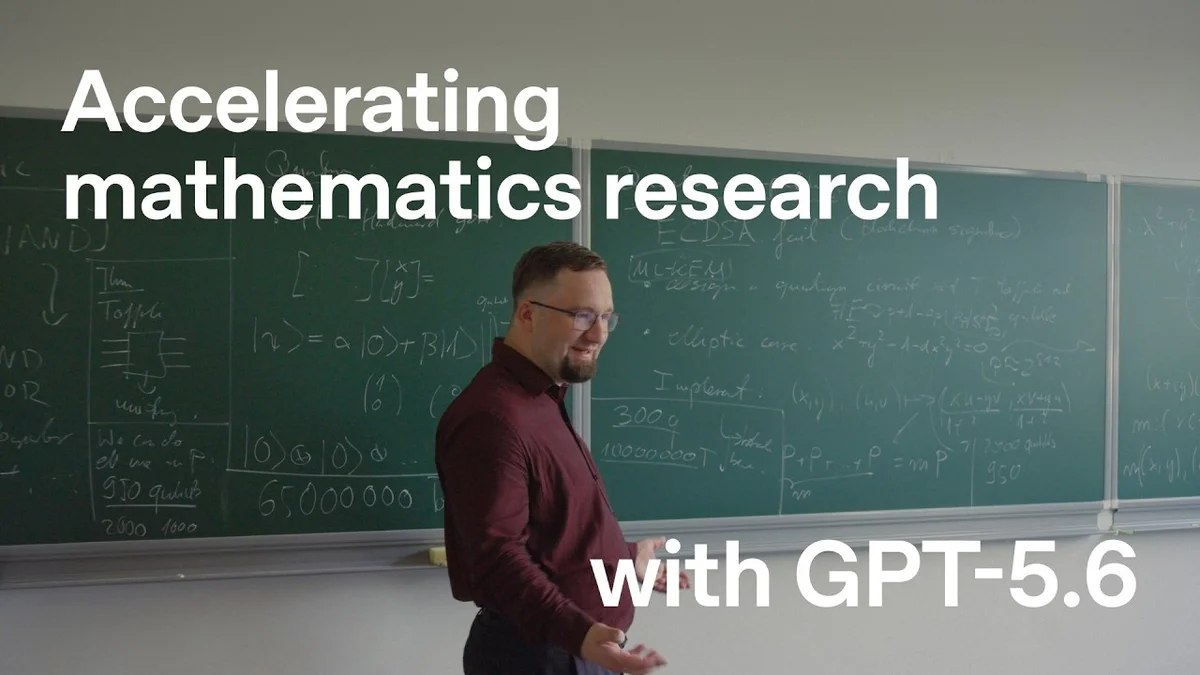
Mathematician Uses GPT-5.6 to Solve Unsolvable Problems

Mathematician Bartosz Naskręcki uses GPT-5.6 to solve previously unsolvable math problems, disproving a conjecture in algebraic geometry and accelerating research.

5 min read
Bartosz Naskręcki, a computational mathematician, sits in front of bookshelves.
OpenAI Youtube
Visual TL;DR
Unsolvable Math ProblemsDriver
long-standing challenges in fields like algebraic geometry
Bartosz NaskręckiCore
computational mathematician at Adam Mickiewicz University
From the article 9 mentionsIn a demonstration of the accelerating power of artificial intelligence in fundamental research, computational mathematician Bartosz Naskręcki is employing GPT-5.6 to solve complex mathematical problems that have long eluded human solvers.
GPT-5.6 AI ModelCore
advanced large language model used for exploration
From the article 9+ mentionsThe video showcases Naskręcki's experience with GPT-5.6, a version of the language model that he found particularly effective.
AI Research AcceleratorEffect
significantly reduces time and effort for discovery
From the article 4 mentionsNaskręcki's research over the past three years has focused on applying AI, specifically large language models, to these difficult areas.
Disproved ConjectureOutcome
solved a previously unproven conjecture in algebraic geometry
From the article 3 mentionsThis led to the disproof of a conjecture in algebraic geometry that he had been working on for three years.
Accelerated DiscoveryEffect
speeds up exploration in mathematics and quantum computing
From the article 2 mentionsNaskręcki emphasizes that AI tools are not just for generating code or text but can be powerful partners in scientific discovery.
Future of AIContext
potential for AI in fundamental problem solving
From the articleThis collaborative approach, he suggests, is the future of scientific research, enabling breakthroughs that were previously unimaginable due to computational limitations.
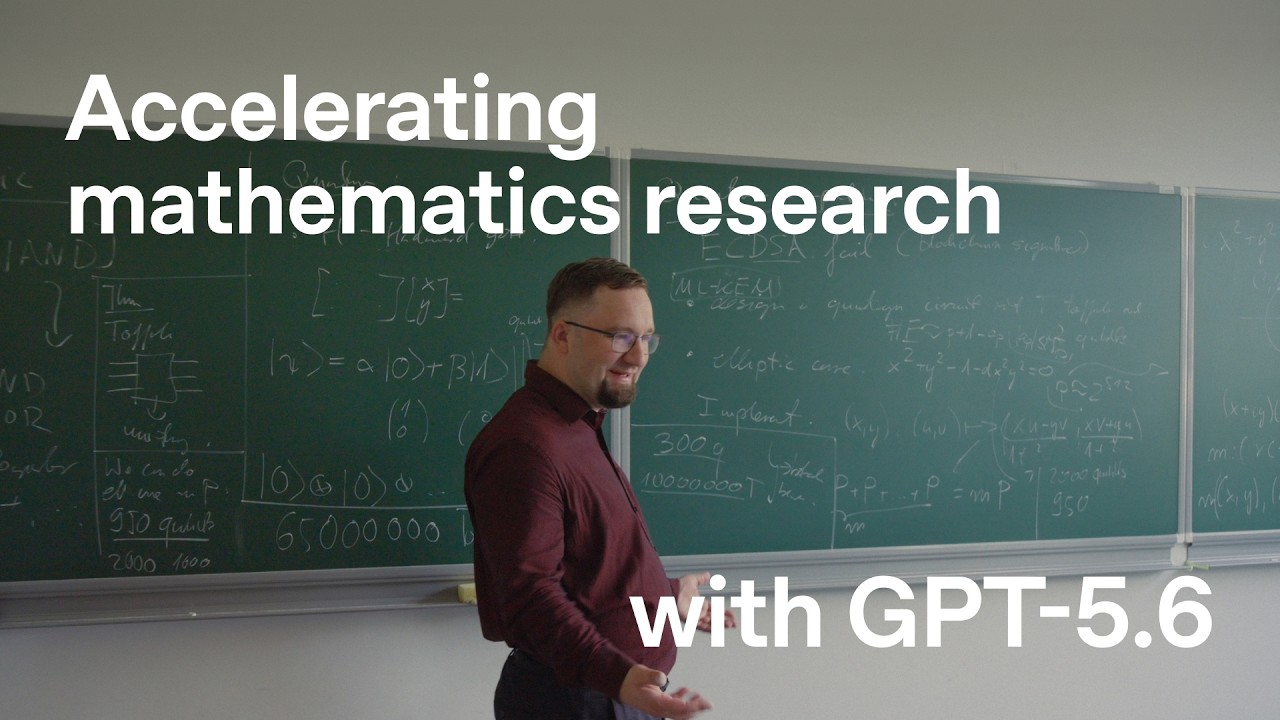
In a demonstration of the accelerating power of artificial intelligence in fundamental research, computational mathematician Bartosz Naskręcki is employing GPT-5.6 to solve complex mathematical problems that have long eluded human solvers. Naskręcki, affiliated with Adam Mickiewicz University and CCAI Warsaw, has found that advanced AI models can significantly reduce the time and effort required for exploration and discovery in fields like algebraic geometry and quantum computing.

Bartosz Naskręcki's Research Approach

Naskręcki's work involves leveraging AI to tackle challenging mathematical questions. He describes a personal journey that began with a childhood fascination for mathematics and computing. Traditional methods of problem-solving, which often involve extensive paper-and-pencil calculations or complex coding, can take weeks or even months for certain problems. Naskręcki's research over the past three years has focused on applying AI, specifically large language models, to these difficult areas.

The full discussion can be found on OpenAI Youtube's YouTube channel.

Meet a mathematician solving previously unsolvable math problems with GPT-5.6 - OpenAI Youtube
Meet a mathematician solving previously unsolvable math problems with GPT-5.6, from OpenAI Youtube

GPT-5.6 as a Research Accelerator

The video showcases Naskręcki's experience with GPT-5.6, a version of the language model that he found particularly effective. He recounts attempting to solve problems with previous AI models without significant success. However, upon switching to GPT-5.6, he discovered a new capability that allowed him to generate entirely new ideas and approaches. This led to the disproof of a conjecture in algebraic geometry that he had been working on for three years.

Naskręcki explains that the AI was able to propose solutions and identify counterexamples with remarkable speed. He specifically mentions how the model helped him disprove a conjecture related to the ratio of certain geometric invariants. The conjecture, which stated that a particular ratio should be less than or equal to 2/3, was found to be false, with GPT-5.6 providing an example where the ratio was 14/5, demonstrating the conjecture's falsehood.

Applications in Mathematics and Beyond

Beyond algebraic geometry, Naskręcki also touches upon the potential of AI in quantum computing. He illustrates concepts like quantum gates and states, and how AI could be used to design and optimize quantum circuits. The ability of models like GPT-5.6 to process vast amounts of information and identify complex patterns is crucial for making progress in these advanced scientific domains.

Naskręcki emphasizes that AI tools are not just for generating code or text but can be powerful partners in scientific discovery. He notes that the AI can autonomously generate sub-agents and perform computations, freeing up human researchers to focus on higher-level thinking and interpretation. This collaborative approach, he suggests, is the future of scientific research, enabling breakthroughs that were previously unimaginable due to computational limitations.
The Future of AI in Problem Solving

The mathematician expresses excitement about the potential of such AI models to democratize advanced research. By lowering the barrier to entry for complex computations and analyses, AI can empower more individuals to contribute to scientific advancement. Naskręcki's work with GPT-5.6 serves as a compelling example of how AI is not just augmenting human capabilities but actively pushing the boundaries of what is possible in fields like mathematics.

© 2026 StartupHub.ai. All rights reserved. Do not enter, scrape, copy, reproduce, or republish this article in whole or in part. Use as input to AI training, fine-tuning, retrieval-augmented generation, or any machine-learning system is prohibited without written license. Substantially-similar derivative works will be pursued to the fullest extent of applicable copyright, database, and computer-misuse laws. See our terms.