

Google DeepMind VP on AI's Role in Coding's Future

Google DeepMind's Benoit Schillings discusses how AI is reshaping software engineering, from code generation to scientific discovery.

7 min read
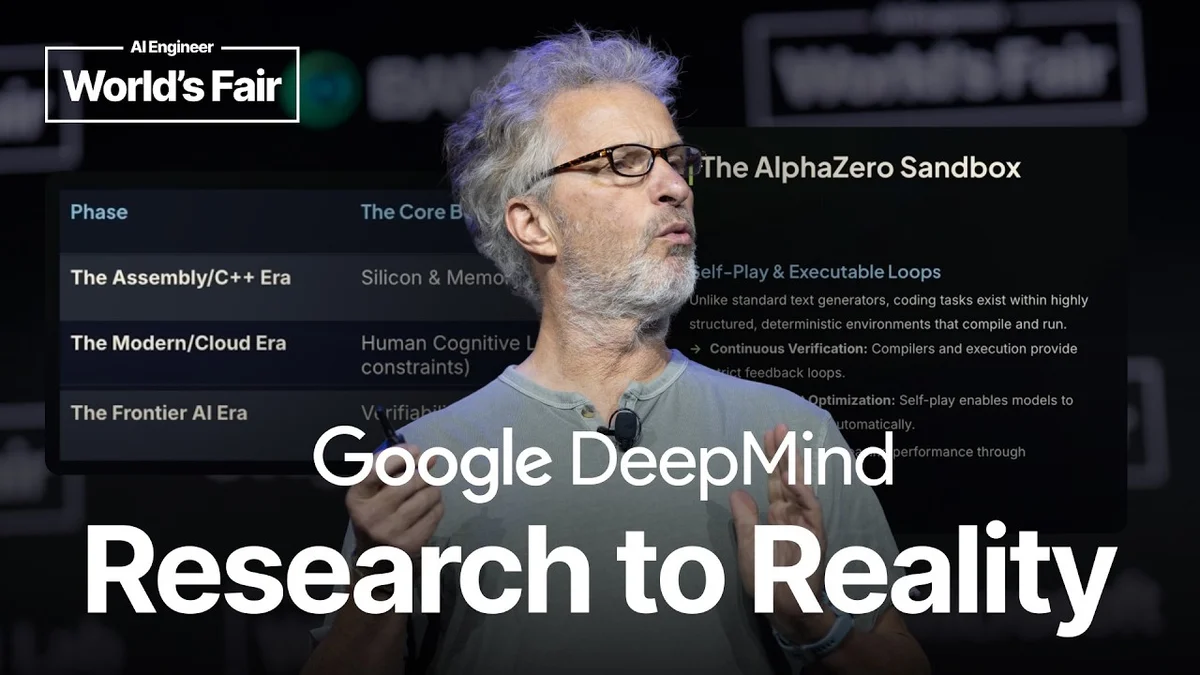
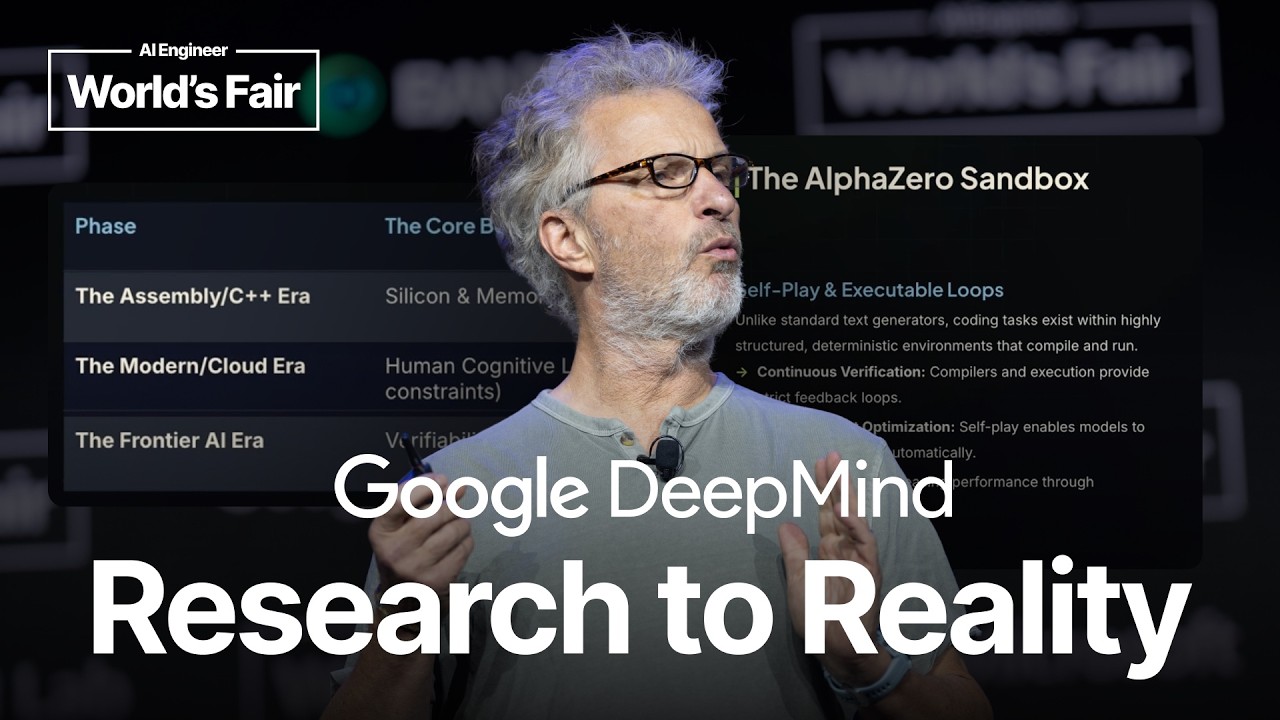
Benoit Schillings speaking on stage at AI Engineer World's Fair
AI Engineer
Visual TL;DR
AI Reshaping SoftwareCore
From the article 8 mentionsBenoit Schillings, Vice President of Research at Google DeepMind, shared insights into the evolving role of AI in software engineering at the AI Engineer World's Fair.
Evolution of CodingContext
From the article 3 mentionsSchillings traced the evolution of software development through different eras, noting how the core bottleneck shifted from hardware constraints in the assembly/C++ era to human cognitive load in the modern cloud era.
Bottleneck ShiftsDriver
from hardware constraints to human cognitive load, now to AI code verification
From the article 4 mentionsHe predicts that the current AI frontier era will see the bottleneck shift to verifying and ensuring the intent of AI-generated code.
AI Generates CodeEffect
AI is transforming code creation, moving from writing to higher-level concerns
From the article 7 mentionsSchillings pointed out that models can generate localized code rapidly but face challenges in creating cohesive systems, designing architectures, and predicting security flaws.
Focus on VerificationOutcome
ensuring the intent of AI-generated code becomes the new primary challenge
From the article 2 mentionsThis shift necessitates a greater focus on design, reliability, and security.
Higher-Level ConcernsEffect
software engineers shift to design, architecture, and verification tasks
From the articleSchillings, who previously worked at Google X on projects like Waymo, highlighted how AI is transforming the way software is created, moving from the intricacies of code writing to higher-level concerns like design, architecture, and verification.
Developers AdaptContext
Schillings' journey from assembly to Python and 'vibe coding' exemplifies adaptation
From the articleHe also reflected on his own journey, from writing assembly language to embracing Python and what he calls "vibe coding," emphasizing that even experienced developers must adapt to new tools and methodologies.
Future of EngineeringOutcome
AI's role extends to scientific discovery, beyond just code generation
From the article 4 mentionsIn his DeepMind role he focuses on AI's applications in software engineering and scientific discovery.
Contents(4)

Benoit Schillings, Vice President of Research at Google DeepMind, shared insights into the evolving role of AI in software engineering at the AI Engineer World's Fair. Schillings, who previously worked at Google X on projects like Waymo, highlighted how AI is transforming the way software is created, moving from the intricacies of code writing to higher-level concerns like design, architecture, and verification.

Google DeepMind VP on AI's Role in Coding's Future - AI Engineer
Google DeepMind VP on AI's Role in Coding's Future, from AI Engineer

Last updated: August 2026

Google DeepMind scores 82 out of 100 in StartupHub.ai's AI company rankings, one of the highest scores among research-focused labs we track, reflecting its role as Alphabet's flagship AI research organization.

From Assembly to vibe coding: A Technical Roadmap

Schillings traced the evolution of software development through different eras, noting how the core bottleneck shifted from hardware constraints in the assembly/C++ era to human cognitive load in the modern cloud era. He predicts that the current AI frontier era will see the bottleneck shift to verifying and ensuring the intent of AI-generated code. He also reflected on his own journey, from writing assembly language to embracing Python and what he calls "vibe coding," emphasizing that even experienced developers must adapt to new tools and methodologies.

The Limitations and Potential of AI in software engineering

The presentation touched upon the current state of AI in software engineering, noting that while AI excels at super-human syntax generation (achieving 95% proficiency), it still struggles with multi-step codebase planning (45%) and architectural system decisions (28%). Schillings pointed out that models can generate localized code rapidly but face challenges in creating cohesive systems, designing architectures, and predicting security flaws.

A significant challenge discussed was the depletion of training data, as an estimated 80% of new code on platforms like GitHub is now machine-generated. Schillings highlighted the potential of self-play, inspired by AlphaZero's success in games like Go, as a method for AI models to generate their own challenges and improve performance autonomously.

The Shifting Economics of Code and Future Frontiers

The marginal cost of code is approaching zero, leading to an explosion in code production. This shift necessitates a greater focus on design, reliability, and security. Schillings emphasized that humans will play a crucial role in defining system correctness, auditing boundaries, and specifying precise constraints. He also touched upon the need for new programming languages designed for AI models, potentially prioritizing rigorous specification over human readability.

Beyond coding, Schillings explored AI's impact on physical sciences, citing computational chemistry and complex biology as areas ripe for AI-driven discovery. He noted that AI can help scientists understand complex systems, like molecules with many atoms or biological processes, that are beyond human comprehension. This ability to process vast amounts of data and identify elusive patterns is key to unlocking new scientific breakthroughs.

Schillings concluded by emphasizing the human capacity for inductive reasoning and pattern recognition, which will remain vital in guiding AI development. He believes that AI offers a fresh perspective, revealing solutions that might have been overlooked by human intuition alone, leading to unforeseen advancements.

Frequently Asked Questions

Who is Benoit Schillings and what is his role at Google DeepMind?

Benoit Schillings is Vice President of Research at Google DeepMind. Before joining DeepMind, he worked at Google X on projects including Waymo, the autonomous vehicle initiative. In his DeepMind role he focuses on AI's applications in software engineering and scientific discovery.

What did Google DeepMind's VP say about AI replacing programmers?

Schillings' view is nuanced: AI is transforming how software is created and maintained, but human capacities for inductive reasoning and pattern recognition remain central to guiding AI development. He sees AI as revealing solutions that human intuition alone might overlook, rather than replacing programmers outright.

How is AI changing software engineering according to Google DeepMind?

According to Schillings' AI Engineer World's Fair talk, AI is shifting software engineering from writing code manually toward directing and reviewing AI-generated code. The bottleneck moves from implementation to specification: programmers increasingly define what software should do, verify that AI output meets that spec, and maintain the overall system architecture.

What is Google DeepMind's research focus in 2026?

Google DeepMind's research in 2026 spans large-scale language and multimodal models, AI for scientific discovery (including protein structure prediction and materials science), and applied AI for Alphabet products. Schillings highlighted pattern recognition at scale as a key area, particularly for identifying scientific relationships that would be difficult for humans to find in large datasets.

© 2026 StartupHub.ai. All rights reserved. You may not republish this article in full without a license. Search engines and AI research tools may crawl and summarize for reference. Bulk reproduction or model training requires a license. See our terms.