

Benchmarking AI Agents: Snorkel AI's Vincent Chen Explains

Vincent Chen from Snorkel AI explores the art and science of benchmarking AI agents, detailing the complexities and methodologies involved in evaluation.

6 min read
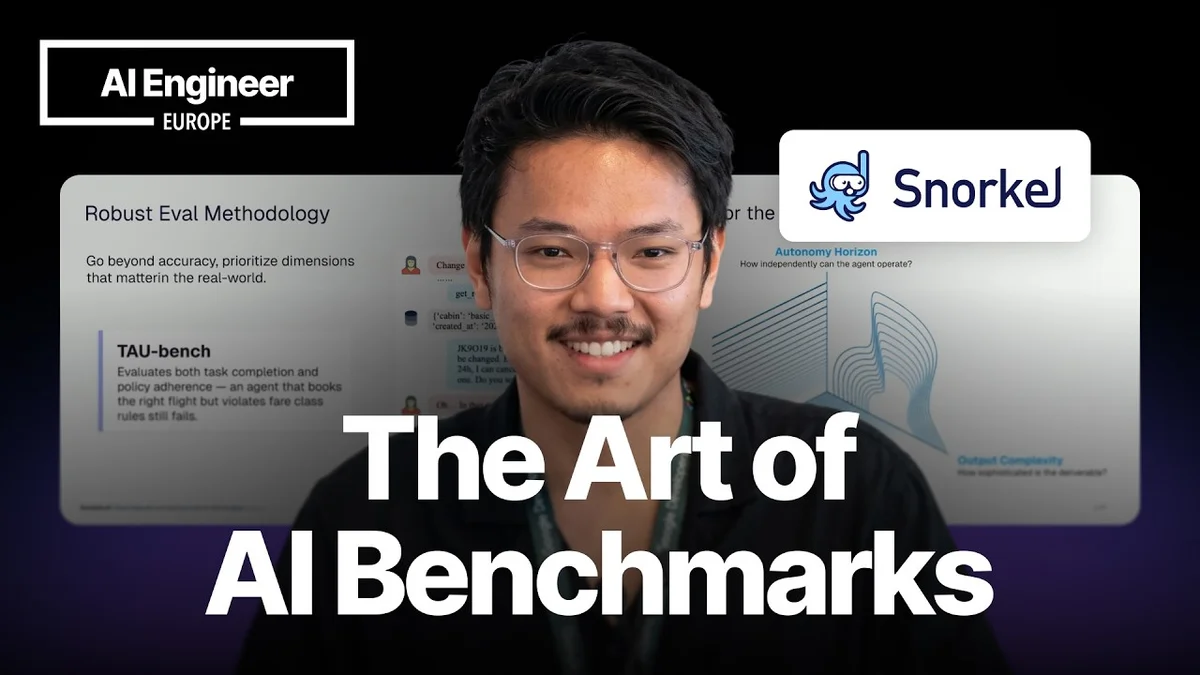
Vincent Chen speaking at a presentation on AI agent benchmarking
AI Engineer

Vincent Chen of Snorkel AI recently discussed the intricate process of benchmarking AI agents. The presentation, titled "The Art & Science of Benchmarking Agents," highlights the challenges and methodologies involved in evaluating the performance of sophisticated AI systems. Understanding how to accurately measure and compare these agents is critical for their development and deployment.

Benchmarking AI Agents: Snorkel AI's Vincent Chen Explains - AI Engineer
Benchmarking AI Agents: Snorkel AI's Vincent Chen Explains — from AI Engineer

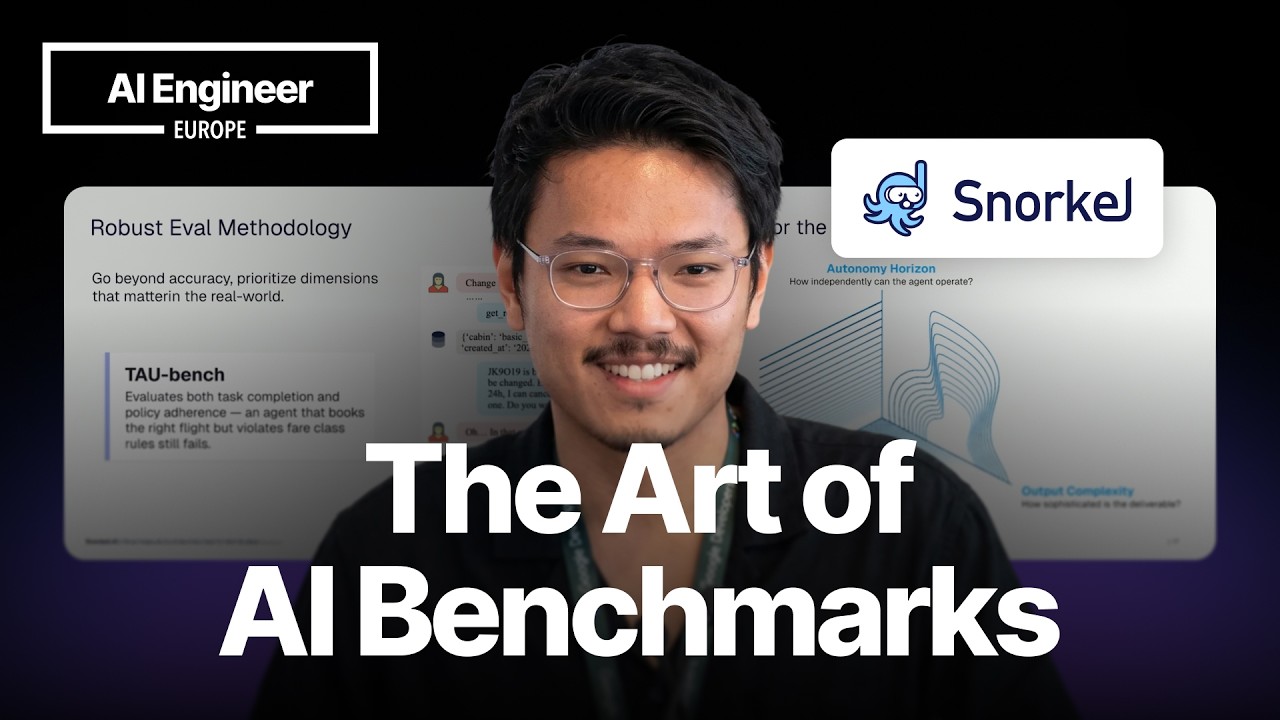
Visual TL;DR. Benchmarking AI Agents faces Challenges in Evaluation. Challenges in Evaluation requires Dual Nature. Dual Nature includes Science Component. Dual Nature includes Art Component. Defining Objectives leads to Accurate Measurement. Defining Metrics leads to Accurate Measurement. Art Component informs Accurate Measurement.

Related startups

  1. Benchmarking AI Agents: evaluating performance of sophisticated AI systems
  2. Dual Nature: involves scientific rigor and artistic interpretation
  3. Science Component: established methodologies, metrics, statistical analyses
  4. Art Component: nuanced qualitative assessments, emergent behaviors
  5. Challenges in Evaluation: complexities in measuring and comparing agents
  6. Defining Objectives: critical for accurate measurement and comparison
  7. Defining Metrics: essential for reproducible tests and objective data
  8. Accurate Measurement: enables development and deployment of AI agents
Visual TL;DR
Visual TL;DR — startuphub.ai Benchmarking AI Agents faces Challenges in Evaluation. Challenges in Evaluation requires Dual Nature. Dual Nature includes Art Component. Art Component informs Accurate Measurement faces requires includes informs Benchmarking AI Agents Dual Nature Art Component Challenges in Evaluation Accurate Measurement From startuphub.ai · The publishers behind this format
Visual TL;DR — startuphub.ai Benchmarking AI Agents faces Challenges in Evaluation. Challenges in Evaluation requires Dual Nature. Dual Nature includes Art Component. Art Component informs Accurate Measurement faces requires includes informs Benchmarking AIAgents Dual Nature Art Component Challenges inEvaluation AccurateMeasurement From startuphub.ai · The publishers behind this format
Visual TL;DR — startuphub.ai Benchmarking AI Agents faces Challenges in Evaluation. Challenges in Evaluation requires Dual Nature. Dual Nature includes Art Component. Art Component informs Accurate Measurement faces requires includes informs Benchmarking AI Agents evaluating performance of sophisticated AIsystems Dual Nature involves scientific rigor and artisticinterpretation Art Component nuanced qualitative assessments, emergentbehaviors Challenges in Evaluation complexities in measuring and comparingagents Accurate Measurement enables development and deployment of AIagents From startuphub.ai · The publishers behind this format
Visual TL;DR — startuphub.ai Benchmarking AI Agents faces Challenges in Evaluation. Challenges in Evaluation requires Dual Nature. Dual Nature includes Art Component. Art Component informs Accurate Measurement faces requires includes informs Benchmarking AIAgents evaluatingperformance ofsophisticated AI… Dual Nature involves scientificrigor and artisticinterpretation Art Component nuanced qualitativeassessments,emergent behaviors Challenges inEvaluation complexities inmeasuring andcomparing agents AccurateMeasurement enables developmentand deployment ofAI agents From startuphub.ai · The publishers behind this format
Visual TL;DR — startuphub.ai Benchmarking AI Agents faces Challenges in Evaluation. Challenges in Evaluation requires Dual Nature. Dual Nature includes Science Component. Dual Nature includes Art Component. Defining Objectives leads to Accurate Measurement. Defining Metrics leads to Accurate Measurement. Art Component informs Accurate Measurement faces requires includes includes leads to leads to informs Benchmarking AI Agents evaluating performance of sophisticated AIsystems Dual Nature involves scientific rigor and artisticinterpretation Science Component established methodologies, metrics,statistical analyses Art Component nuanced qualitative assessments, emergentbehaviors Challenges in Evaluation complexities in measuring and comparingagents Defining Objectives critical for accurate measurement andcomparison Defining Metrics essential for reproducible tests andobjective data Accurate Measurement enables development and deployment of AIagents From startuphub.ai · The publishers behind this format
Visual TL;DR — startuphub.ai Benchmarking AI Agents faces Challenges in Evaluation. Challenges in Evaluation requires Dual Nature. Dual Nature includes Science Component. Dual Nature includes Art Component. Defining Objectives leads to Accurate Measurement. Defining Metrics leads to Accurate Measurement. Art Component informs Accurate Measurement faces requires includes includes leads to leads to informs Benchmarking AIAgents evaluatingperformance ofsophisticated AI… Dual Nature involves scientificrigor and artisticinterpretation Science Component establishedmethodologies,metrics,… Art Component nuanced qualitativeassessments,emergent behaviors Challenges inEvaluation complexities inmeasuring andcomparing agents DefiningObjectives critical foraccuratemeasurement and… Defining Metrics essential forreproducible testsand objective data AccurateMeasurement enables developmentand deployment ofAI agents From startuphub.ai · The publishers behind this format

The Dual Nature of Agent Benchmarking

Chen emphasized that benchmarking AI agents is not a purely quantitative exercise. It involves both scientific rigor and an element of artistic interpretation. The 'science' component refers to the established methodologies, metrics, and statistical analyses used to assess performance. This includes defining reproducible tests and collecting objective data points. The 'art' aspect, however, acknowledges the nuanced qualitative assessments required. This can involve evaluating emergent behaviors, user experience, and alignment with human values, which are often harder to quantify directly.

Challenges in Evaluating Complex Agents

Modern AI agents can exhibit highly complex and sometimes unpredictable behaviors. This complexity presents significant challenges for traditional benchmarking approaches. Chen pointed out that agents are not static programs but dynamic systems that learn and adapt. Their performance can vary significantly based on the environment, the specific task, and even their internal state. Therefore, a single benchmark may not capture the full spectrum of an agent's capabilities or limitations. The need for dynamic and adaptive evaluation frameworks becomes apparent.

Defining Objectives and Metrics

A core tenet of effective benchmarking, according to Chen, is the meticulous definition of objectives and metrics. Before any testing begins, it is essential to establish what constitutes success for a given agent. This involves clearly articulating the desired outcomes and the specific tasks the agent is expected to perform. Once objectives are set, appropriate metrics must be chosen. These metrics should be sensitive enough to detect meaningful differences in performance but also interpretable. The selection of metrics can heavily influence the perceived success or failure of an agent, making this step a critical part of the 'art' of benchmarking.

© 2026 StartupHub.ai. All rights reserved. Do not enter, scrape, copy, reproduce, or republish this article in whole or in part. Use as input to AI training, fine-tuning, retrieval-augmented generation, or any machine-learning system is prohibited without written license. Substantially-similar derivative works will be pursued to the fullest extent of applicable copyright, database, and computer-misuse laws. See our terms.