AI Learns Faster by Predicting the Future

AI learns faster with Predictive Inverse Dynamics Models (PIDMs) by forecasting future states, making imitation learning more data-efficient than traditional methods.

Feb 6 at 11:48 AM6 min read
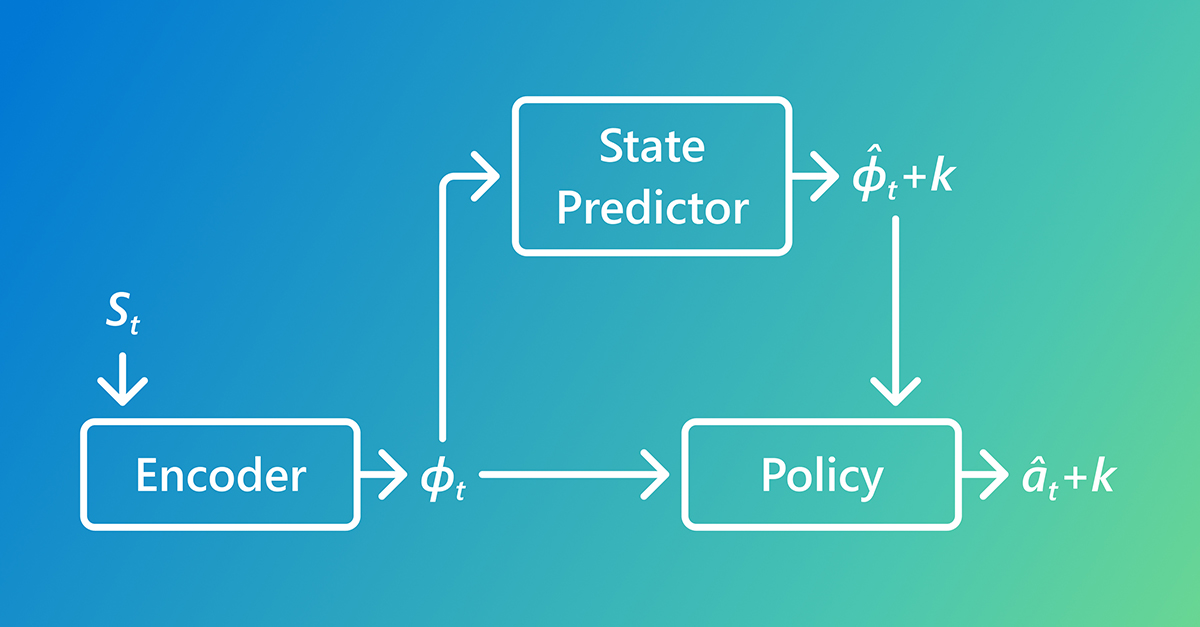
Flowchart illustrating the components of Predictive Inverse Dynamics Models (PIDM) and Behavior Cloning (BC) for AI imitation learning.
A comparison of Behavior Cloning and PIDM architectures, highlighting the state predictor in PIDMs. | Credit: Microsoft Research

Teaching AI agents to perform tasks by showing them human examples, a process known as imitation learning, typically relies on mapping current observations directly to actions. This common method, Behavior Cloning (BC), often requires vast datasets to account for human variability, a significant hurdle in real-world applications. A new approach, Predictive Inverse Dynamics Models (PIDMs), detailed in research from Microsoft Research, offers a more data-efficient path by fundamentally rethinking how AI learns from demonstrations.

Rethinking Imitation Learning

Instead of a direct state-to-action mapping, PIDMs break down imitation learning into two distinct stages. First, they employ a state predictor to forecast plausible future states. Second, an inverse dynamics model uses this predicted future state to infer the action required to transition from the current state towards that predicted future. This two-stage process reframes the core question from 'What action would an expert take?' to 'What is the expert trying to achieve, and what action leads there?'

This shift provides a crucial sense of direction, clarifying intent and reducing ambiguity in action selection. Even when predictions are imperfect, this directional guidance can significantly improve learning efficiency. PIDMs leverage this by grounding action selection in a predicted outcome, making them substantially more data-efficient than BC.

Figure 1. BC vs. PIDM architectures. (Top) Behavior Cloning learns how to perform a direct mapping from the current state to an action. (Bottom) PIDMs add a state predictor that predicts future states. They then use an inverse dynamics model to predict the action required to move from the current state towards that future state. Both approaches share a common latent representation through a shared state encoder.

Real-World Validation in Gameplay

To validate PIDMs, researchers trained agents on human gameplay demonstrations within a complex 3D video game. The agents operated directly from raw video input, processed at 30 frames per second, and handled real-time interactions, visual artifacts, and system delays. The model learned to predict future states and choose actions that advanced gameplay toward those predicted futures, all without relying on hand-coded game variables.

Experiments conducted on a cloud gaming platform, introducing further delays and visual distortions, showed PIDM agents consistently matching human play patterns and achieving high success rates. This demonstrates the robustness of the approach even under challenging, real-world conditions.
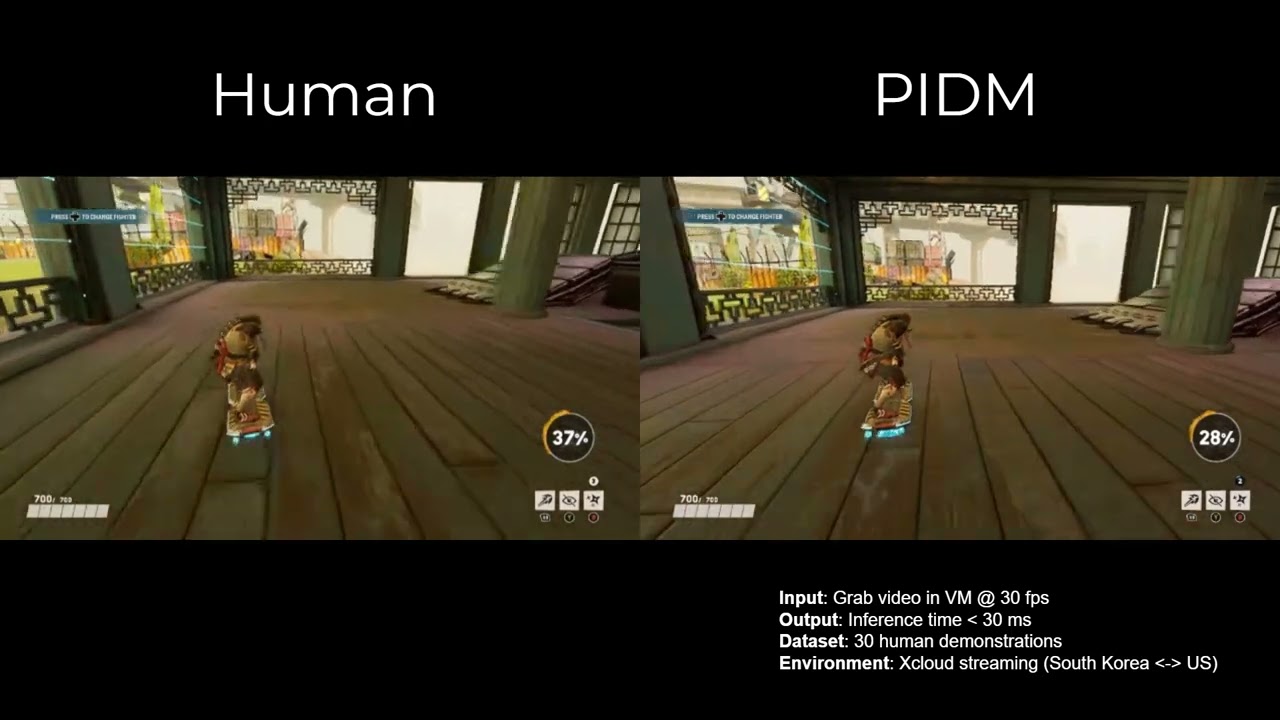
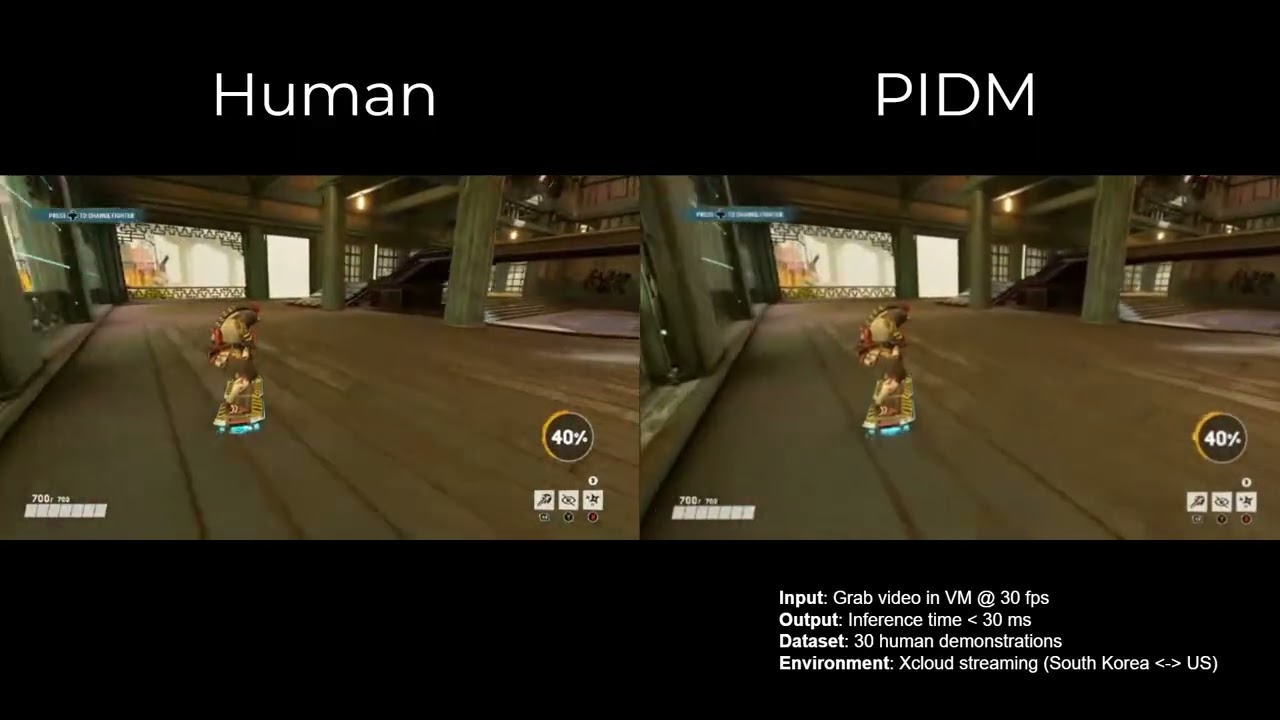
Video 1. A player (left) and a PIDM agent (right) side by side playing the game Bleeding Edge. Both navigate the same trajectory, jumping over obstacles and engaging with nonplayer characters. Despite network delays, the agent closely matches the player’s timing and movement in real time.

Why PIDMs Outperform BC

The core advantage of PIDMs lies in clarifying intent. By focusing on a plausible future, the model can better disambiguate actions in the present. While prediction errors can introduce some risk, the benefit of reduced ambiguity often outweighs this, particularly when predictions are reasonably accurate.

This is especially critical in scenarios where human behavior is variable or driven by long-term goals not immediately apparent from the current visual input. BC struggles here, requiring extensive data to interpret noisy demonstrations. PIDMs, by linking actions to intended future states, sharpen these demonstrations, enabling effective learning from significantly fewer examples.

Evaluation and Results

Experiments were conducted in both a simple 2D environment and a complex 3D game. PIDMs consistently achieved high success rates with fewer demonstrations compared to BC. In the 2D setting, BC required two to five times more data to match PIDM performance. In the 3D game, BC needed 66% more data to achieve comparable results.

Figure 2. Performance gains in the 2D environment. As the number of training demonstrations increases, PIDM consistently achieves higher success rates than BC across all four tasks. Curves show mean performance, with shading indicating variability across 20 experiments for reproducibility.

Takeaway: Intent Matters

The core insight is that making intent explicit through future prediction significantly enhances imitation learning. PIDMs shift the paradigm from simple mimicry to goal-oriented action. While highly unreliable predictions can hinder performance, reasonably accurate forecasts allow PIDMs to excel, especially in complex scenarios with limited or variable demonstration data.

This approach offers a powerful way to learn from fewer examples by focusing on the underlying purpose of actions rather than just their superficial execution. It highlights how understanding where an agent is trying to go can be more critical than perfectly replicating past movements.

Appendix: Visualizations and Results

A player, a naïve action-replay baseline, and a PIDM agent playing Bleeding Edge

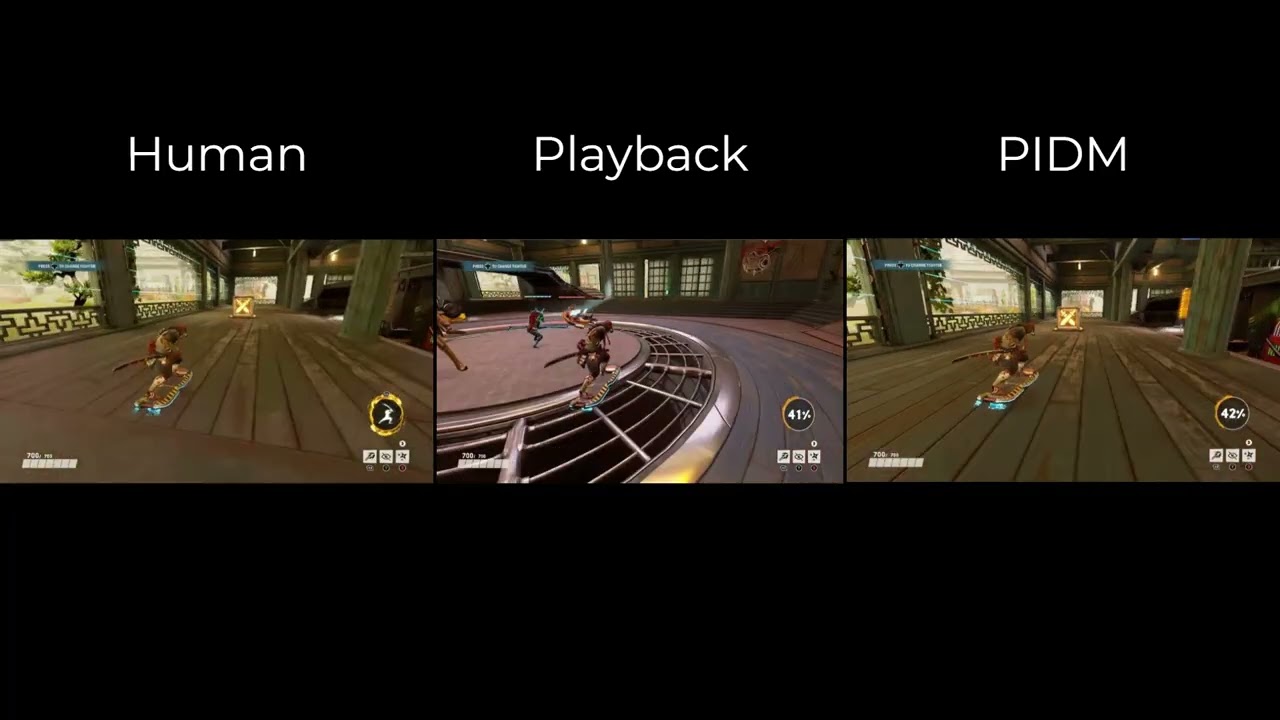
Video 2. (Left) The player completes the task under normal conditions. (Middle) The baseline replays the recorded actions at their original timestamps, which initially appears to work. Because the game runs on a cloud gaming platform, however, random network delays quickly push the replay out of sync, causing the trajectory to fail. (Right) Under the same conditions, the PIDM agent behaves differently. Instead of naively replaying actions, it continuously interprets visual input, predicts how the behavior is likely to unfold, and adapts its actions in real time. This allows it to correct delays, recover from deviations, and successfully reproduce the task in settings where naïve replay inevitably fails.

A player and a PIDM agent performing a complex task in Bleeding Edge

Video 3. In this video, the task exhibits strong partial observability: correct behavior depends on whether a location is being visited for the first or second time. For example, in the first encounter, the agent proceeds straight up the ramp; on the second, it turns right toward the bridge. Similarly, it may jump over a box on the first pass but walk around it on the second. The PIDM agent reproduces this trajectory reliably, using coarse future guidance to select actions in the correct direction.

Visualization of the 2D navigation environment

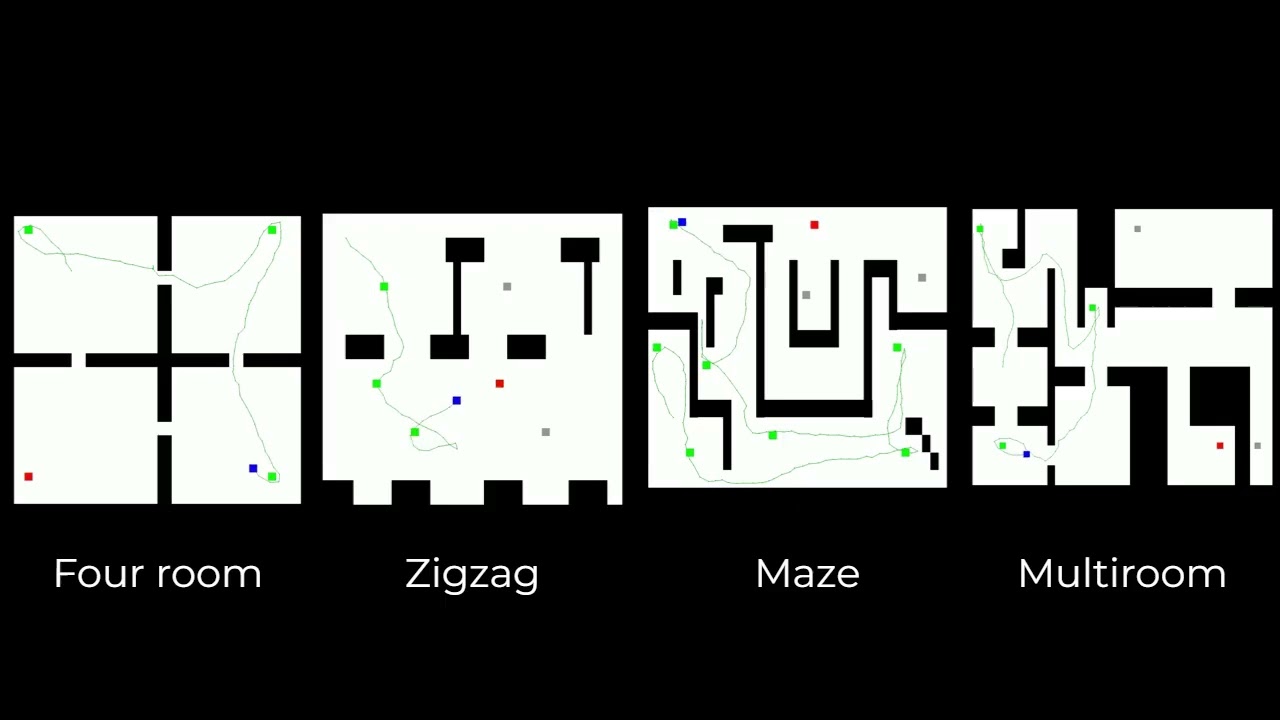
Video 4. These videos show ten demonstrations for each of four tasks: Four Room, Zigzag, Maze, and Multiroom. In all cases, the setup is the same: the character (blue box) moves through the environment and must reach a sequence of goals (red squares). The overlaid trajectories visualize the paths the player took; the models never see these paths. Instead, they observe only their character’s current location, the position of all goals, and whether each goal has already been reached. Because these demonstrations come from real players, no two paths are identical: players pause, take detours, or correct small mistakes along the way. That natural variability is exactly what the models must learn to handle.

PIDM vs. BC in a 3D environment

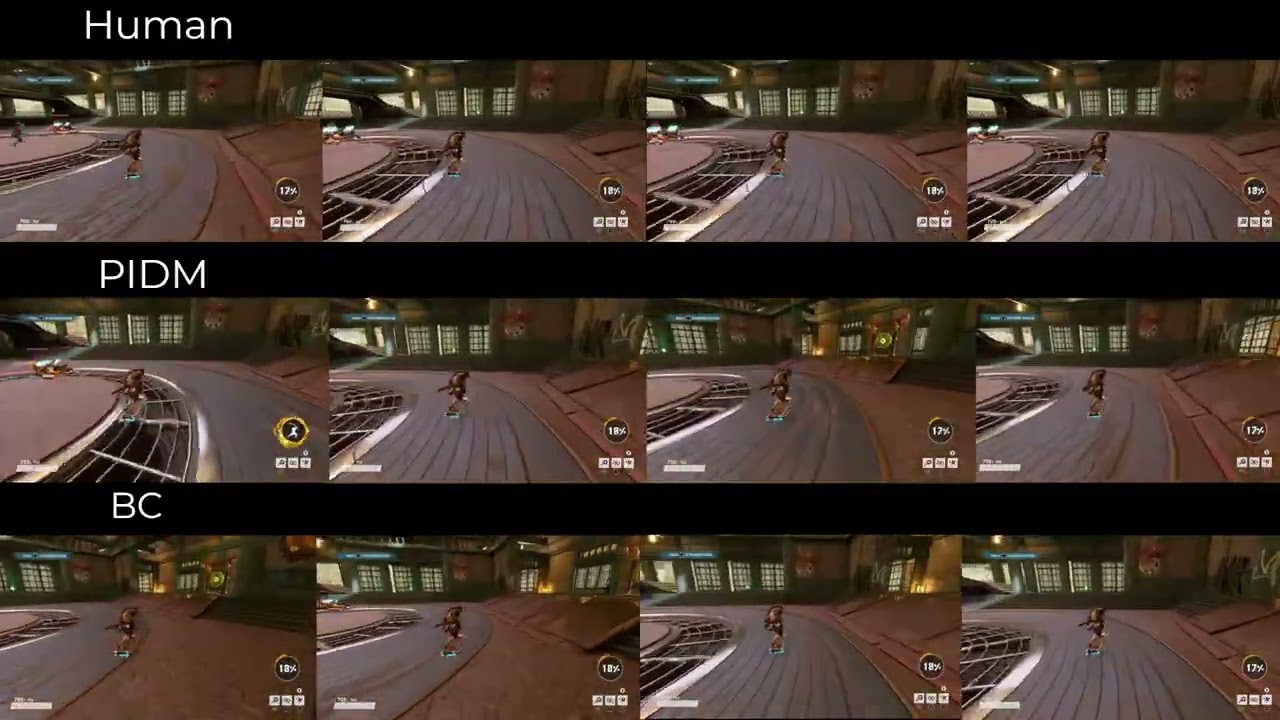
Video 5. The PIDM agent achieves an 85% success rate with only fifteen demonstrations used in training. The BC agent struggles to stay on track and levels off around 60%. The contrast illustrates how differently the two approaches perform when training data is limited.