

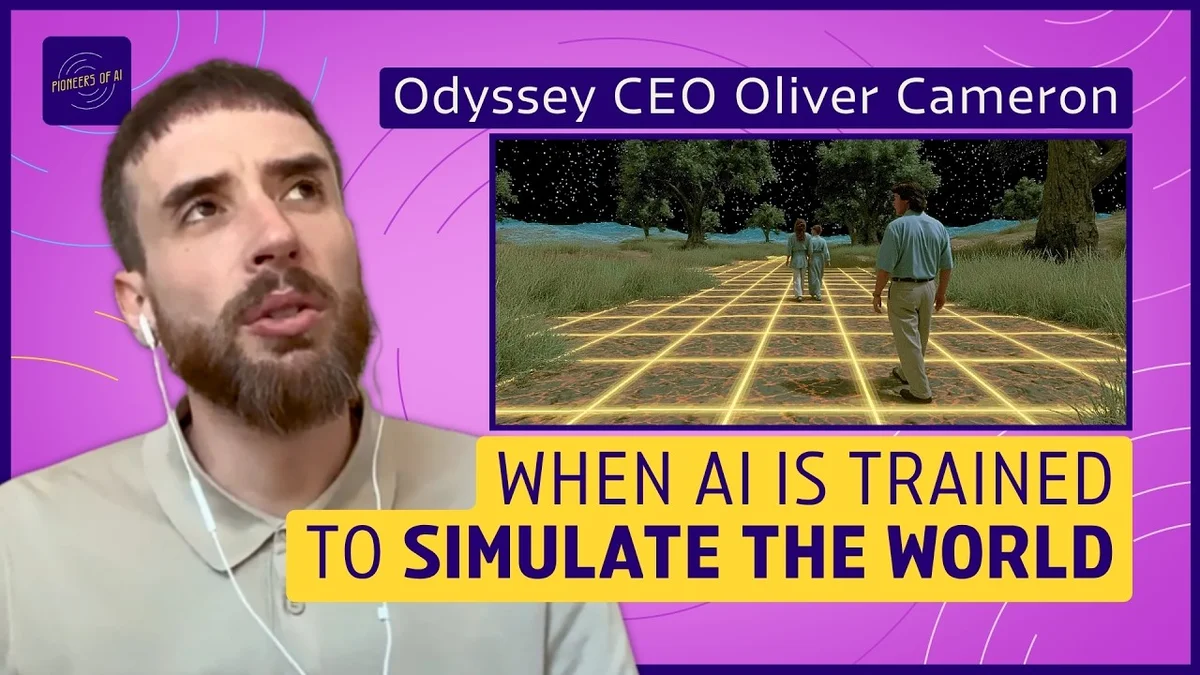
World Models: The Next Frontier Beyond LLMs

Odyssey CEO Oliver Cameron discusses the trillion-dollar opportunity in world models, their difference from LLMs, and applications in robotics and beyond.

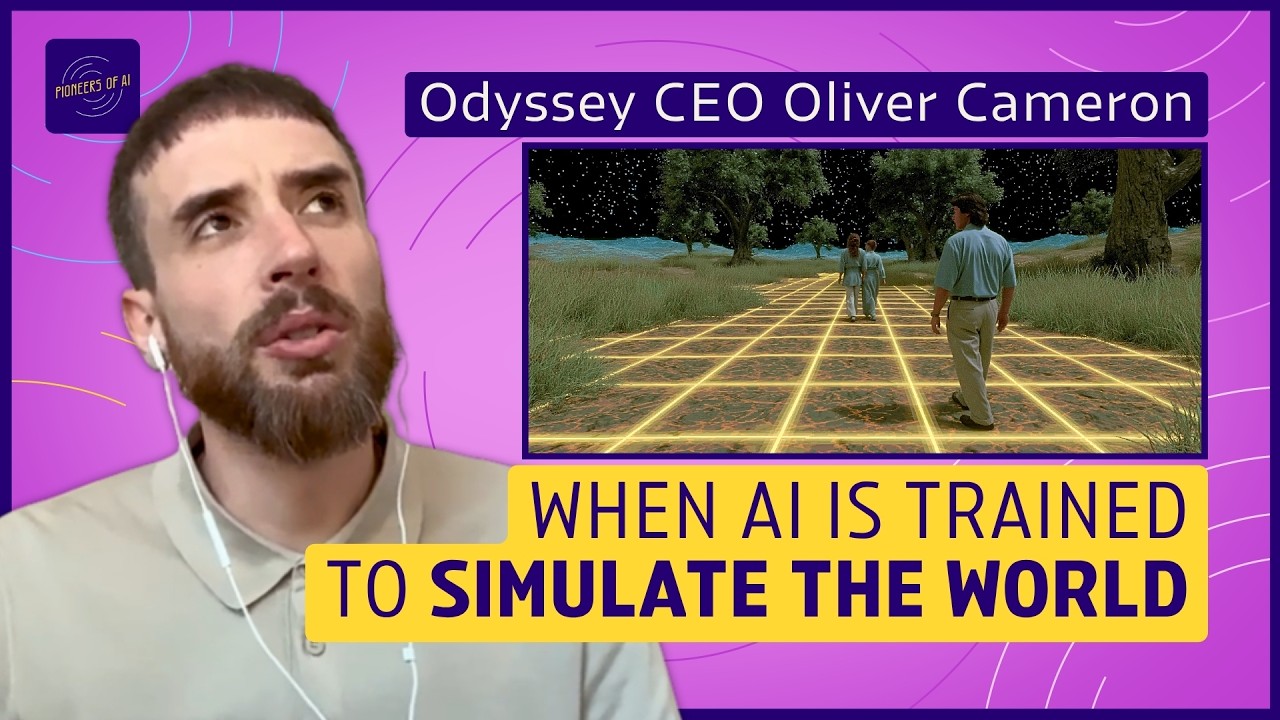
Pioneers of AI hosts Rana el Kaliouby and Oliver Cameron discussing world models.
Pioneers of AI
Visual TL;DR
LLMs are evolvingContext
AI landscape moves beyond text generation with new model types
From the article 4 mentionsThe AI landscape is constantly evolving, and following the explosion of large language models (LLMs) like ChatGPT, the next frontier is emerging: world models.
World Models EmergeCore
From the article 9+ mentionsThese models aim to develop a deeper, more holistic understanding of the world by learning from visual data, promising to unlock capabilities far beyond text generation.
$3B+ InvestmentDriver
From the article 2 mentionsIn the first half of 2026, investors have poured over $3 billion into startups building world models, signaling a significant shift in AI investment.
Beyond LLMsContext
world models offer holistic understanding, not just text generation
From the article 5 mentionsThe current surge in interest and investment in world models is attributed to two key factors: a perceived need for approaches beyond LLMs and a clear migration of talent.
Robots Need WMsDriver
essential for physical world interaction, not just language processing
Odyssey LeadsCore
CEO Oliver Cameron discusses trillion-dollar opportunity in foundational models
From the article 5 mentionsJoining us to discuss this exciting development is Oliver Cameron, co-founder and CEO of Odyssey.
Trillion-Dollar OpportunityOutcome
From the articleOdyssey is at the forefront of world model development, aiming to capture a trillion-dollar opportunity by creating foundational models that can be applied across numerous industries.
Contents(12)

The AI landscape is constantly evolving, and following the explosion of large language models (LLMs) like ChatGPT, the next frontier is emerging: world models. These models aim to develop a deeper, more holistic understanding of the world by learning from visual data, promising to unlock capabilities far beyond text generation.

The Rise of World Models

In the first half of 2026, investors have poured over $3 billion into startups building world models, signaling a significant shift in AI investment. Companies like Google DeepMind, Nvidia, and others are actively developing this technology.

Odyssey and the Trillion-Dollar Opportunity

Joining us to discuss this exciting development is Oliver Cameron, co-founder and CEO of Odyssey. Odyssey is at the forefront of world model development, aiming to capture a trillion-dollar opportunity by creating foundational models that can be applied across numerous industries.

The full discussion can be found on Pioneers of AI's YouTube channel.

What comes after large language models (Odyssey's Oliver Cameron) - Pioneers of AI
What comes after large language models (Odyssey's Oliver Cameron), from Pioneers of AI

Defining World Models vs. Language Models

Cameron explains that while language models excel at understanding and simulating language by ingesting vast amounts of text, language itself is a lossy and biased representation of reality. World models, on the other hand, train on visual observations, essentially, every possible video of the world. This allows them to deeply understand physics, dynamics, cause-and-effect, and human behavior in a way that text alone cannot capture.

"Language is a representation of the world that is lossy and is biased... there is so much information that is lost when we are transcribing our thoughts or our observations into text," Cameron stated. "To go further really what we want to train a model to do is to understand and simulate the world."

The Role of World Models in AGI and Beyond

Cameron believes that world models will play a crucial role in achieving artificial general intelligence (AGI) and superintelligence. He likens world models to learning environments where AI agents can adapt and improve, much like humans learn to survive and thrive in the real world. "It's very likely that a super intelligence is learning inside a world model," he noted.

Why the Urgency? Talent and Robotics

The current surge in interest and investment in world models is attributed to two key factors: a perceived need for approaches beyond LLMs and a clear migration of talent. Cameron points to the steep rise in mentions of "world models" in published papers, indicating where researchers are focusing their efforts. Furthermore, the maturation of robotics hardware, particularly humanoid robots, creates a clear demand for intelligent systems that world models can provide.

Robots Need World Models, Not Just LLMs

Cameron clarified why physical AI, like humanoid robots, necessitates world models over solely relying on LLMs. He explained that while LLMs can describe actions like grasping a coffee cup, there's a critical translation gap between text-based understanding and physical actuation. World models, by learning the "language of the world", physics, dynamics, lighting, are expected to be more performant and robust in physical interactions. This allows them to adapt to tasks with significantly fewer examples, as they grasp the underlying principles rather than just memorizing patterns.

Odyssey's Broad Exploration Strategy

Cameron shared Odyssey's intentional strategy to explore a wide range of applications, from driverless cars and robotics to gaming, defense, healthcare, and energy. He believes the company that wins in this space will be the one most willing to venture broadly, building a foundational model applicable across industries.

The "ChatGPT Moment" for World Models

When asked about the future, Cameron envisions the equivalent of ChatGPT's impact for world models as a single model capable of performing diverse tasks like driving a car, controlling a robot, flying a drone, generating games, and teaching children. He believes this landmark moment is very close, potentially even closer than anticipated.

Key Learnings from Self-Driving and the "Hardest Thing First" Philosophy

Cameron drew parallels between his experience in the self-driving car industry, including his previous company Voyage, and the current world model landscape. A key lesson learned was the importance of tackling the hardest problems first. He noted that companies focusing on complex environments like San Francisco for self-driving cars were ultimately more successful in achieving broader deployment.

The Data Pyramid and Model Architecture

The training of world models, Cameron explained, relies on a data pyramid starting with vast amounts of internet video. This is supplemented by expert data, including robotics and gaming data, with highly targeted video for specific applications at the very top. The state-of-the-art architecture involves auto-regressive diffusion transformers (ARDITs) that combine the sequential processing of language models with the pixel representation of diffusion models and the general learning capabilities of transformers.

The Rise of Data Marketplaces and Compute Access

Cameron highlighted the emergence of marketplaces that efficiently source diverse data, solving a critical bottleneck for robotics. He also emphasized the strategic advantage of secured access to compute, noting that Odyssey proactively secured significant compute deals during their recent funding round to avoid limitations.

Guardrails and Future Milestones

Addressing the topic of guardrails, Cameron acknowledged it's a less mature area but essential for systems operating in the physical world. He sees progress in "harnesses" for world models, which provide focus and rules, similar to how LLM harnesses guide models with prompts and code loops. The next milestone for Odyssey is achieving that single, foundational world model capable of diverse virtual and physical tasks, which he believes will be a landmark moment demonstrating the power of these new AI systems. Looking further ahead, he anticipates world models making significant scientific breakthroughs by uncovering new understandings of reality.

© 2026 StartupHub.ai. All rights reserved. You may not republish this article in full without a license. Search engines and AI research tools may crawl and summarize for reference. Bulk reproduction or model training requires a license. See our terms.
Daniel Singer

Written by

Daniel Singer

Editor, StartupHub.ai

Daniel Singer is the editor of StartupHub.ai, a technology expert and thought leader on AI and its applications across sectors, from fintech and healthcare to developer tooling and consumer software. He writes and tests the tools covered here thoroughly and regularly, and built StartupHub.ai to give founders, operators and buyers a clearer read on what they are actually being sold.