


TNG AI Chess: AI Explains Chess Like a Human Trainer

Stephan Steinfurt from TNG Technology Consulting discusses their AI agent that explains chess games like a human trainer, combining LLMs with specialized tools to create automated video analyses.

6 min read
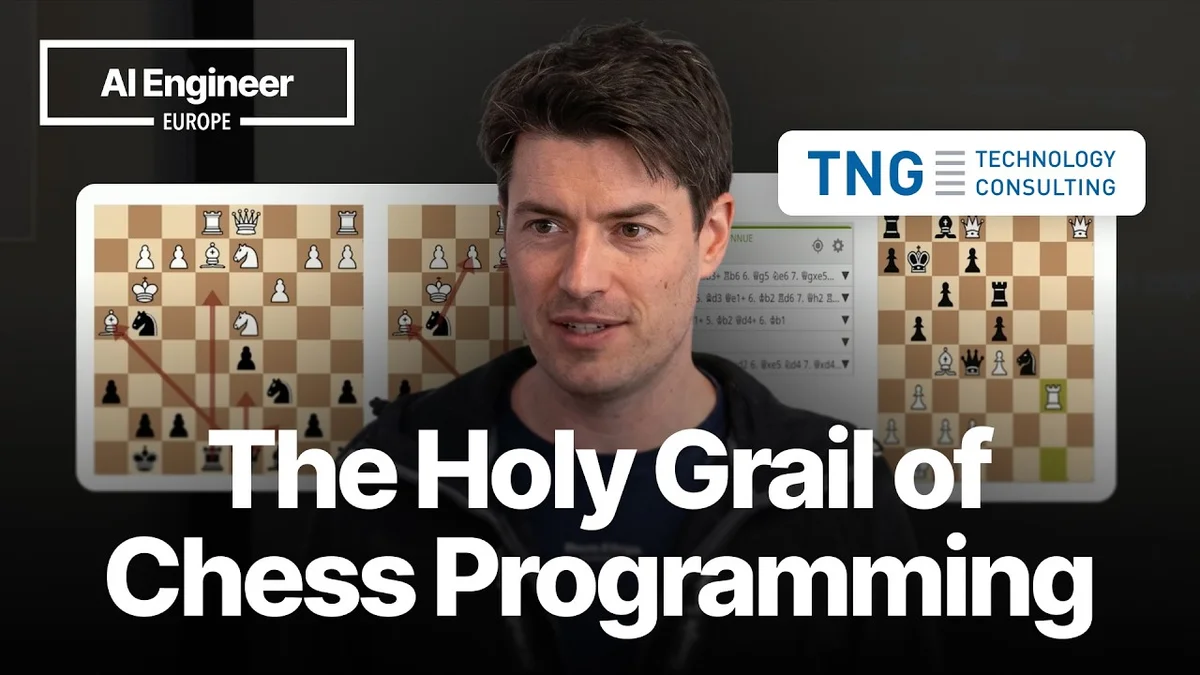
Stephan Steinfurt presenting TNG AI Chess project at AI Engineer Europe
AI Engineer
Visual TL;DR
Chess EnginesDriver
From the article 9+ mentionsSteinfurt highlighted the core problem: traditional chess engines excel at playing chess but struggle to explain their moves or thought processes.
LLMsDriver
From the article 2 mentionsConversely, Large Language Models (LLMs) are adept at generating descriptive text but cannot play chess effectively.
Gemini 1.5 ProCore
From the articleAccording to Steinfurt, the Google (NASDAQ:GOOGL) Gemini 1.5 Pro Preview model has been particularly effective, showing a deep understanding of chess reasoning, likely due to extensive post-training.
TNG AI AgentCore
integrates a powerful LLM with a suite of specialized tools to bridge the gap
From the article 9+ mentionsThe TNG AI Chess agent operates by pulling human chess games from Lichess daily.
Human-like ExplanationsEffect
explains chess games with the depth and nuance of a human trainer
From the article 4 mentionsThe agent utilizes several custom tools to achieve its human-like explanations:
Automated Video ProductionEffect
creates automated video analyses, combining LLMs with specialized tools
From the articleThe automated process allows TNG to create a high volume of videos.
Scaling Chess EducationOutcome
aims to make high-quality chess education accessible for everyone
From the articleChecks, Captures, Threats (CCT): A structured thinking method from chess education, enabling beginner-friendly explanations by focusing on fundamental tactical elements.
Holy Grail AchievedOutcome
From the articleIn a recent presentation at AI Engineer Europe, Stephan Steinfurt from TNG Technology Consulting unveiled a groundbreaking project aiming for nothing less than the "holy grail of chess programming." Steinfurt detailed their innovative AI agent that can explain chess games with the depth and nuance of a human trainer, a feat previously thought to be at least five years away by industry experts.
Contents(4)

In a recent presentation at AI Engineer Europe, Stephan Steinfurt from TNG Technology Consulting unveiled a groundbreaking project aiming for nothing less than the "holy grail of chess programming." Steinfurt detailed their innovative AI agent that can explain chess games with the depth and nuance of a human trainer, a feat previously thought to be at least five years away by industry experts.

TNG AI Chess: AI Explains Chess Like a Human Trainer - AI Engineer
TNG AI Chess: AI Explains Chess Like a Human Trainer, from AI Engineer

The Dual Challenge: Chess Engines vs. LLMs

Steinfurt highlighted the core problem: traditional chess engines excel at playing chess but struggle to explain their moves or thought processes. Conversely, Large Language Models (LLMs) are adept at generating descriptive text but cannot play chess effectively. The challenge, therefore, was to bridge this gap.

The solution lies in a sophisticated AI agent that integrates a powerful LLM with a suite of specialized tools. According to Steinfurt, the Google (NASDAQ:GOOGL) Gemini 1.5 Pro Preview model has been particularly effective, showing a deep understanding of chess reasoning, likely due to extensive post-training. This LLM acts as the brain, orchestrating the use of various tools to analyze and explain chess positions.

How the AI Agent Works

The TNG AI Chess agent operates by pulling human chess games from Lichess daily. These games are then analyzed in depth. The agent utilizes several custom tools to achieve its human-like explanations:

  • Legal Moves: Prevents the AI from suggesting illegal moves, a common pitfall for LLMs in complex environments.
  • Play Move: Allows the agent to explore different variations on a virtual chessboard.
  • Engine Evaluation: Integrates a traditional chess engine (like Stockfish, though not explicitly named as such) to provide objective evaluations of positions and moves.
  • Checks, Captures, Threats (CCT): A structured thinking method from chess education, enabling beginner-friendly explanations by focusing on fundamental tactical elements.
  • Web Search: For certain videos, this tool can provide historical context or information about specific games.

Steinfurt explained that while initial attempts relied on Python scripts to analyze positions and then feed data to an LLM for description, the advent of more advanced reasoning models allowed the agents to "think themselves about the positions." This shift empowered the AI to autonomously explore conflicting information from various tools, providing more nuanced and comprehensive explanations, including not just the best moves but also common human moves (potentially leveraging models like Maia, which predicts human play at different Elo ratings).

Automated Video Production and Quality Control

Once the analysis is complete, the information is converted into a special format, which is then used to generate a video. The system leverages ElevenLabs v3 for text-to-speech, incorporating audio tags to convey emotions like excitement. Crucially, the AI agent itself decides which squares to highlight, which arrows to draw, and whether a move qualifies as "brilliant" or a "blunder."

The automated process allows TNG to create a high volume of videos. Steinfurt noted that while they are still somewhat cautious about automatic uploads, the error rate is quite low, with only about 1 in 20 videos having a "weird description." He added that even these errors provide valuable feedback for further refinement.

Scaling Chess Education for Everyone

The primary motivation behind TNG AI Chess is to democratize high-quality chess analysis. Popular streamers like GothamChess provide excellent commentary, but they can't cover every game. This AI-powered approach allows TNG to generate personalized video analyses for any human game, enabling players to share detailed insights with friends and family.

Steinfurt emphasized that the focus remains on chess quality rather than artificial visual effects. The YouTube channel, TNG AI Chess, has already garnered over 520,000 views and 4,200 subscribers, with most growth occurring in the last month, indicating strong demand for this type of content.

When asked about costs, Steinfurt confirmed that the project is currently operating at a net loss, as they haven't yet reached monetization thresholds. However, the average cost per video is remarkably low, estimated at 20-30 cents, although longer videos can be more expensive. He noted that they are currently prioritizing detailed explanations over cost optimization, with potential for further efficiency improvements down the line.

The team is also exploring the possibility of tailoring explanations to different player strengths, from beginners needing basic checkmate explanations to advanced players seeking deeper insights. While they haven't ventured into other games yet, the underlying technology could potentially be extended.

© 2026 StartupHub.ai. All rights reserved. Do not enter, scrape, copy, reproduce, or republish this article in whole or in part. Use as input to AI training, fine-tuning, retrieval-augmented generation, or any machine-learning system is prohibited without written license. Substantially-similar derivative works will be pursued to the fullest extent of applicable copyright, database, and computer-misuse laws. See our terms.