The AI Periodic Table Mapping LLMs to Core Elements

3 min read
The AI Periodic Table Mapping LLMs to Core Elements

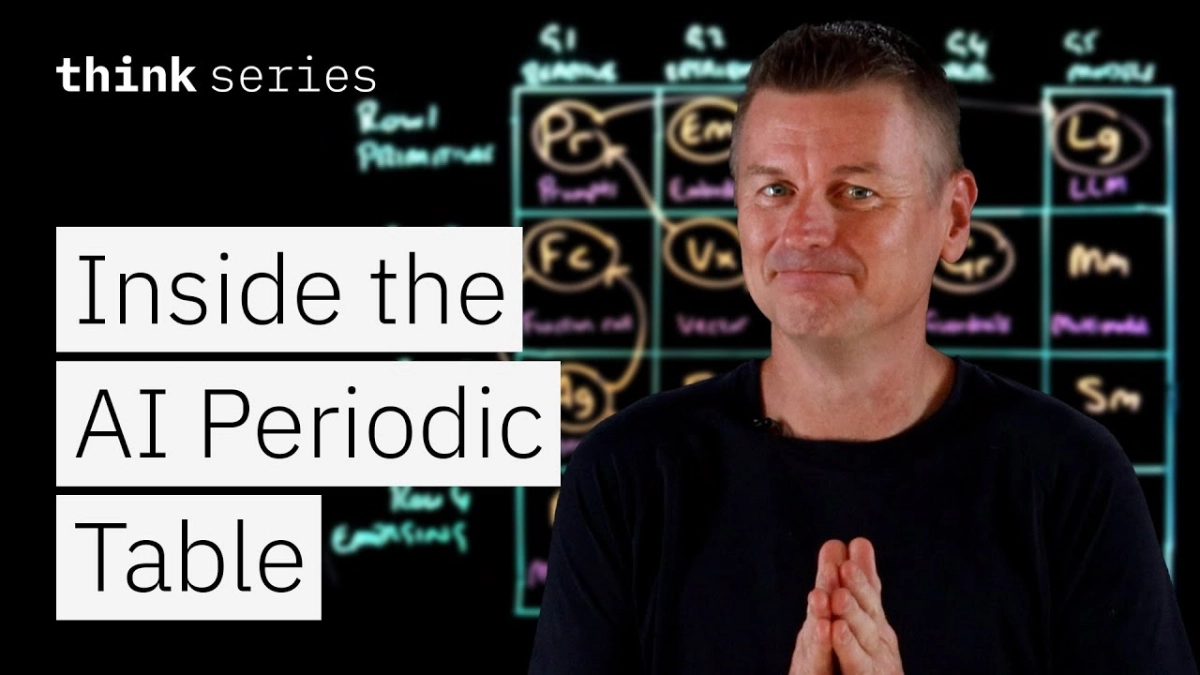
Martin Keen, a Master Inventor at IBM, recently introduced a compelling conceptual framework for understanding the rapidly expanding universe of Artificial Intelligence components: the AI Periodic Table. Keen spoke with IBM Tech about this structure, designed to map concepts like LLMs, RAG, and AI agent frameworks into a clear, organized taxonomy, much like the elements of chemistry. This approach is vital because, as Keen noted, "What if the world of AI felt a bit like this to you? A thousand terms flying around, everyone's talking about agents and RAG and embeddings..." The immediate utility of this table is providing a stable, predictable reaction structure to the chaos of modern AI terminology.

The structure Keen presented organizes AI components across two axes: rows representing the stage of maturity or development, and columns representing functional groupings. The rows are categorized as: Row 1: Primitives (the foundational elements), Row 2: Compositions (how primitives are combined), Row 3: Deployment (elements critical for production systems), and Row 4: Emerging (nascent concepts). The columns delineate primary functional families: Group 1: Reactive (S1), Group 2: Retrieval (S2), Group 3: Orchestration (S3), Group 4: Validation (S4), and Group 5: Models (S5).

The core insight here is that AI architectures are not random but follow predictable patterns of combination, much like chemical bonding. For instance, the most fundamental reactive primitive is the Prompt (Pr), which dictates instructions to an AI. This element sits at the intersection of the "Reactive" family and the "Primitives" row.


Related startups

Keen explicitly mapped the core building blocks of contemporary AI systems onto this grid. Under the "Reactive" column (S1), Row 1 is Prompt (Pr), Row 2 is Function Call (Fc), and Row 3 is Agent (Ag). The "Retrieval" column (S2) features Embeddings (Em) as the primitive, Vector databases (Vx) as the composition, and Finetuning (Ft) for deployment readiness. This organization immediately clarifies dependencies; for example, RAG (Rg) is clearly a composition of Retrieval (Em) and Orchestration (Rg).

A key principle underpinning this table is reactivity versus inertness. Keen observed that some elements, like Prompts, are highly reactive: "Because prompts are reactive, you change one word in your prompt, while you're going to get a completely different output." Conversely, elements in the Models column (S5), such as the Large Language Model (Lg/LLM), are more like noble gases, stable and foundational.

The framework elegantly situates Retrieval Augmented Generation (RAG) as a composition (Row 2) combining Embeddings (Em) from the Retrieval column (S2) with the Orchestration (Rg) column (S3). This positioning underscores that RAG is not a standalone primitive but a deliberate assembly of existing components to ground LLM outputs in specific, verifiable data.

The emergent row (Row 4) highlights areas where the field is currently innovating rapidly, such as Multi-agent systems (Ma) and Synthetic data (Sy). These are not yet fully standardized deployment components but represent the next wave of complexity and capability. For venture capitalists and founders, this table serves as an immediate diagnostic tool. When evaluating a new AI product, one can quickly identify which "elements" it utilizes and how they are combined, revealing the system’s sophistication and reliance on established versus cutting-edge techniques.

The explicit mapping of these concepts clarifies the relationships that often baffle newcomers. For instance, the Agent (Ag) primitive in Row 3, Deployment, is shown looping back to the Prompt (Pr) primitive, illustrating the Agent's ability to generate its own reasoning steps and prompts iteratively. This visual representation transforms a confusing array of buzzwords into a coherent, navigable architectural map.

© 2026 StartupHub.ai. All rights reserved. Do not enter, scrape, copy, reproduce, or republish this article in whole or in part. Use as input to AI training, fine-tuning, retrieval-augmented generation, or any machine-learning system is prohibited without written license. Substantially-similar derivative works will be pursued to the fullest extent of applicable copyright, database, and computer-misuse laws. See our terms.