


Siemens CEO: Industrial AI Is Key to Future Factories

Siemens CEO Roland Busch outlines the company's strategy to leverage AI for transforming industrial operations, highlighting the 'AI industrial agent' and its potential across key sectors.

4 min read
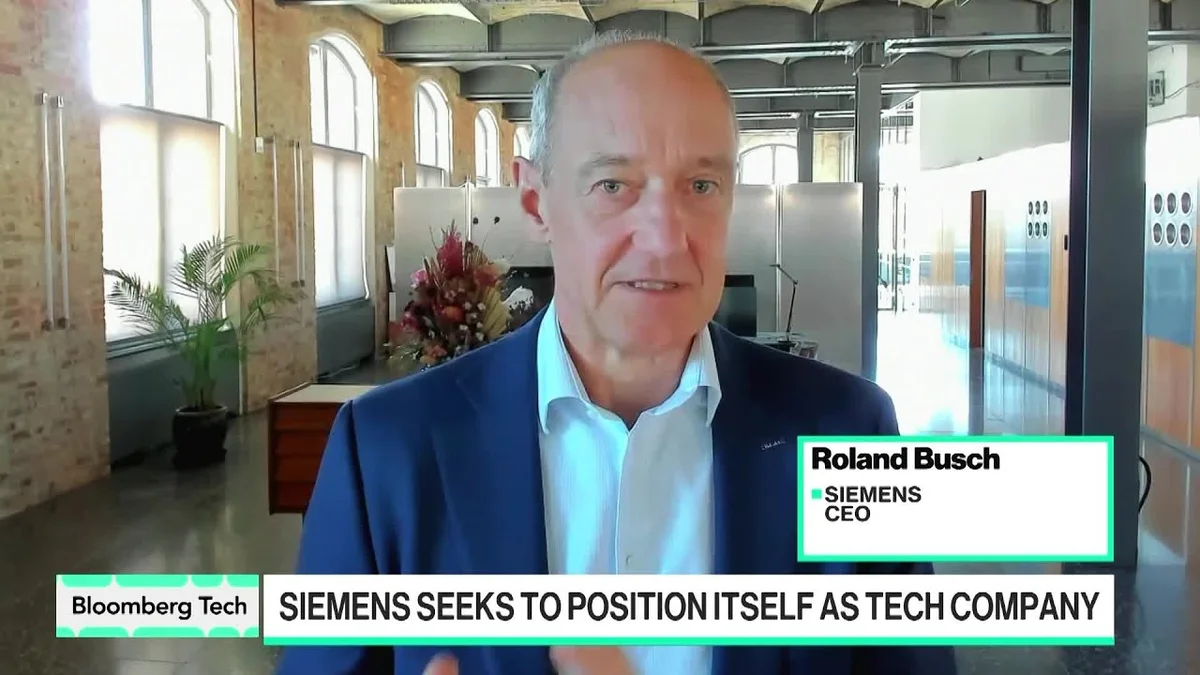
Siemens CEO Roland Busch speaking in an interview.
Siemens CEO Roland Busch discusses the future of industrial artificial intelligence.· Bloomberg Technology

The industrial sector is on the cusp of a significant AI-driven transformation, according to Roland Busch, CEO of Siemens AG (OTCMKTS:SIEGY). In a recent interview, Busch detailed Siemens' strategy to position itself as a leading technology company by embedding artificial intelligence across its industrial portfolio. This strategic shift is not merely about adopting new technologies but fundamentally rethinking how factories operate and how innovation is achieved.

Roland Busch on Siemens' AI Vision

Busch articulated a clear vision for the future of industry, one where AI plays a central role in enhancing productivity, efficiency, and flexibility. He highlighted the company's commitment to this vision, noting that Siemens has invested billions of euros over the past 15 years in building its software capabilities and AI infrastructure. This long-term investment is now bearing fruit as the company aims to double its digital revenue by 2025, driven by AI-powered solutions.
Related startups

The full discussion can be found on Bloomberg Technology's YouTube channel.

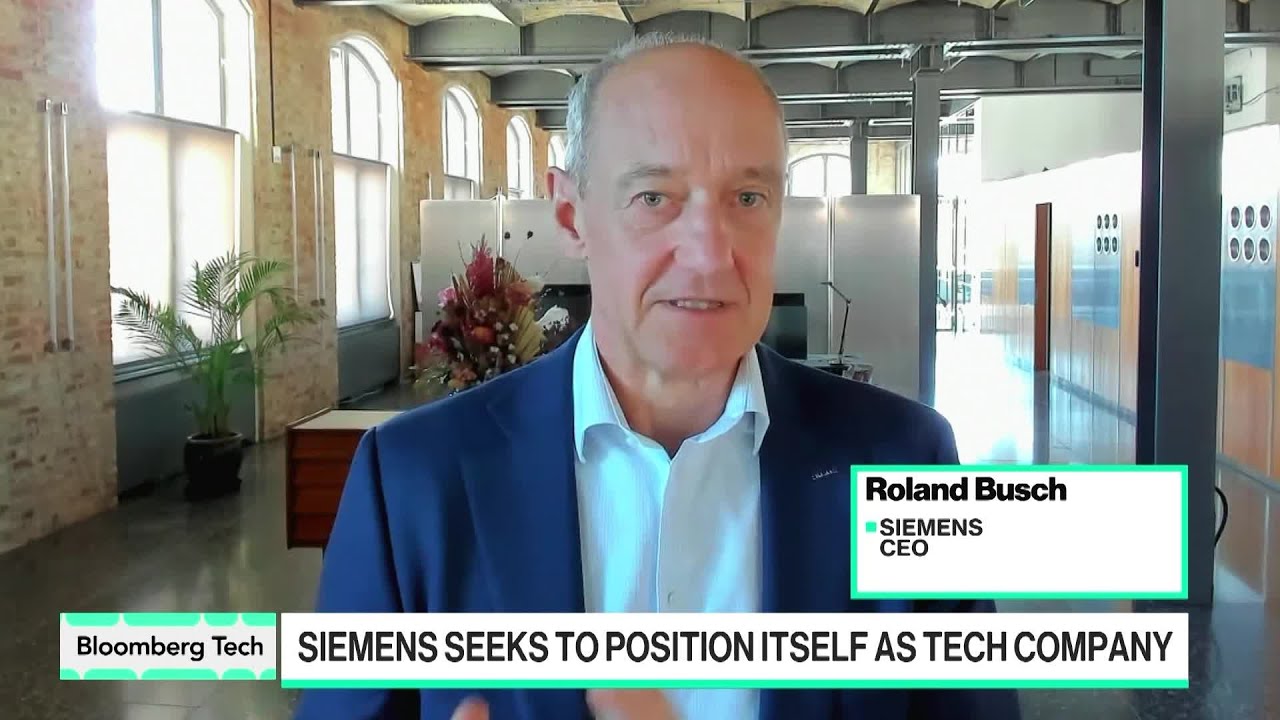
Siemens CEO on Industrial AI's Future - Bloomberg Technology
Siemens CEO on Industrial AI's Future, from Bloomberg Technology

The 'AI Industrial Agent'

A key element of Siemens' AI strategy is the development of what Busch described as an 'AI industrial agent.' This agent is designed to act as an intelligent assistant for engineers and factory operators. It functions by analyzing complex problems, programming industrial controllers like PLCs (Programmable Logic Controllers), and optimizing operational workflows. The demonstration showed how this agent can take a high-level request, such as creating documentation for a project, and translate it into actionable code and configurations. Busch stated that this process is significantly faster, estimating a 2-5x acceleration compared to manual workflows, while also improving the quality and consistency of the output. Furthermore, the AI agent can learn from its programming and execution, continually refining its performance.

Key Sectors for Industrial AI

Busch identified several key sectors where he sees the most immediate and impactful applications for industrial AI. These include:

  • Semiconductors: The complex and high-precision nature of semiconductor manufacturing makes it a prime candidate for AI-driven optimization and quality control.
  • Automotive: AI can streamline assembly lines, improve supply chain management, and enhance vehicle design and testing processes.
  • Pharmaceuticals: The drug discovery and manufacturing processes, with their intricate data requirements and stringent quality controls, stand to benefit greatly from AI's analytical capabilities.
  • Aerospace and Defense: Similar to automotive, these sectors require high levels of precision, efficiency, and safety, all areas where AI can provide significant advantages.
  • Data Centers: The increasing demand for computing power and the energy consumption of data centers make AI an essential tool for optimization and management.

Busch also noted that industries currently under pressure, such as the automotive sector, are particularly eager to adopt AI to increase their flexibility and speed up production cycles.

Siemens' Strategy: Combining Physical and Digital

Siemens' approach is rooted in its unique position as a company with deep expertise in both the physical industrial world and advanced digital technologies. Busch emphasized the importance of combining these two realms: 'You need both hardware and software... and we have that,' he stated. This integrated approach allows Siemens to create what are termed 'digital twins', virtual replicas of physical assets and processes, that are powered by AI. These digital twins enable simulation, testing, and optimization in a virtual environment before implementation in the real world, reducing risks and accelerating innovation.

The company is also focusing on making AI more accessible, aiming to 'democratize' its use. This involves simplifying the process of integrating AI into existing industrial systems and making the technology understandable and usable for a broader range of engineers and operators. The focus is on delivering tangible results, such as increased productivity and improved quality, rather than abstract technological advancements.

The Future of AI in Manufacturing

Busch highlighted that AI is not just about automating tasks but about creating a more intelligent and adaptive industrial future. He explained that AI can analyze vast amounts of data from sensors and machinery, identify patterns, predict failures, and recommend or even automate corrective actions. This predictive maintenance capability alone can significantly reduce downtime and operational costs.

The CEO also touched upon the competitive landscape, noting that Siemens' long-standing presence in industry, combined with its significant investments in software and AI, positions it favorably against competitors. The company’s partnership with NVIDIA (NASDAQ:NVDA) for its AI-driven digital twin technology is a testament to this strategy, leveraging advanced hardware to power sophisticated AI applications.

In essence, Siemens is building a blueprint for the 'AI factory,' where intelligence is embedded at every level, from the design and manufacturing phases to the operational and maintenance stages. This comprehensive approach, backed by substantial investment and a clear strategic focus, aims to redefine industrial competitiveness in the coming years.

© 2026 StartupHub.ai. All rights reserved. Do not enter, scrape, copy, reproduce, or republish this article in whole or in part. Use as input to AI training, fine-tuning, retrieval-augmented generation, or any machine-learning system is prohibited without written license. Substantially-similar derivative works will be pursued to the fullest extent of applicable copyright, database, and computer-misuse laws. See our terms.