

Robotics Startup Leans on LLMs for General-Purpose Robots

Quan Vuong of Physical Intelligence discusses how LLMs are revolutionizing robotics, enabling general-purpose AI for robots and overcoming data challenges. Learn about their 'GPT-1 moment' for robotics.

4 min read
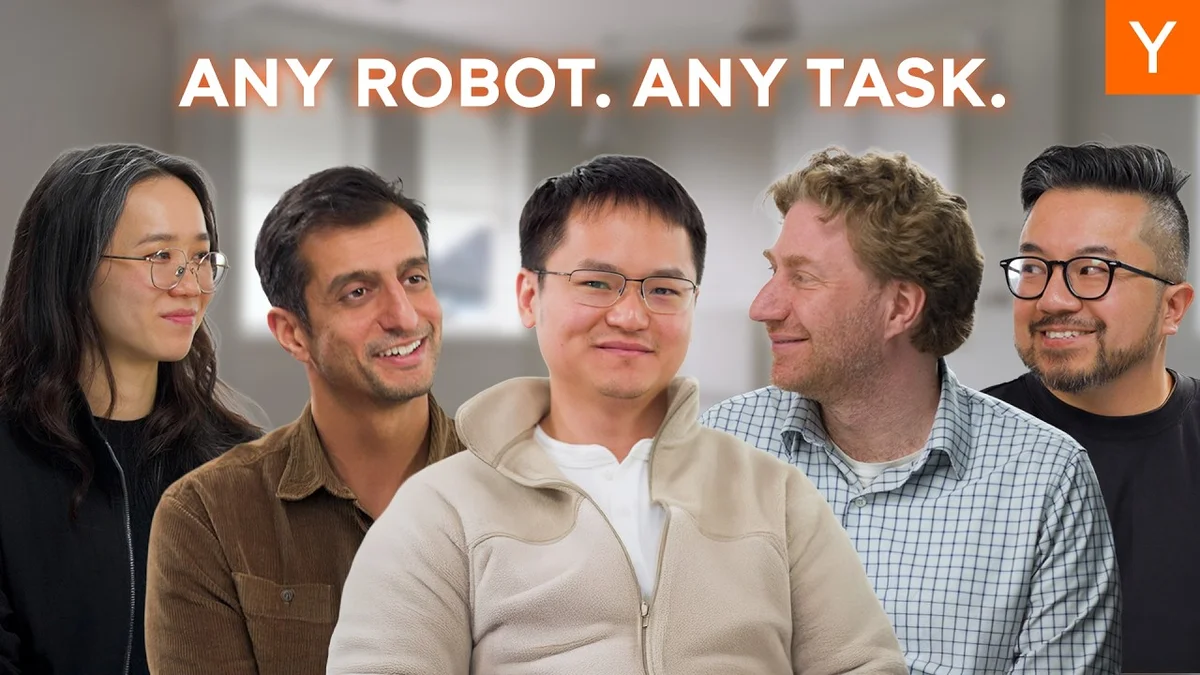
Quan Vuong speaking with other individuals around a table with microphones
Image credit: Lightcone Podcast· YC

In the rapidly evolving world of robotics, the quest for general-purpose AI that can control any robot to perform any task is a central challenge. Quan Vuong, co-founder of Physical Intelligence, a startup focused on this very problem, shared his insights on the "Lightcone Podcast" about the transformative potential of large language models (LLMs) in the field.

Physical Intelligence aims to bridge the gap between the digital intelligence of LLMs and the physical world of robotics. Vuong explained that while current AI systems excel in language and vision tasks, applying this intelligence to physical manipulation remains a significant hurdle. The company's approach involves creating models that can learn from vast amounts of data, including internet-scale data, to control robots effectively.

The full discussion can be found on YC's YouTube channel.
Related startups

Robots Are Finally Starting to Work - YC
Robots Are Finally Starting to Work — from YC

The "GPT-1 Moment" for Robotics

Vuong drew a parallel between the current advancements in robotics and the impact of models like GPT-1 on natural language processing. He suggested that robotics is experiencing its own "GPT-1 moment," where the ability to leverage large-scale pre-training on language and vision-language data from the web is opening up new possibilities. This approach allows robots to gain a more general understanding of the world and perform tasks with greater adaptability.

The company's work focuses on "X-embodiment," which refers to the ability of a model to transfer knowledge and skills across different robotic platforms. By training on diverse datasets from various robots and institutions, Physical Intelligence aims to create models that are not only effective but also generalizable. This approach is crucial for overcoming the limitations of traditional robotics, which often require highly specialized hardware and software for each specific task.

Challenges in Robotics Data and Control

Vuong highlighted the inherent difficulties in robotics data collection and control. Unlike language models, which can draw from the vastness of text data on the web, robot data is often scarce and task-specific. This makes it challenging to train models that can perform well across a wide range of tasks and hardware platforms. The company's strategy involves creating a "physical intelligence layer" that is accessible and reusable, enabling developers to build upon existing foundation models rather than starting from scratch.

He elaborated on the "onion analogy" for building robot intelligence: starting with a strong base model that already possesses common sense knowledge and then layering on more specialized capabilities. This approach allows for incremental improvements and faster development cycles, as the model can learn from its experiences and adapt to new tasks more efficiently.

RT-X and the Future of Robotics

The conversation touched upon the company's research, including the RT-X models, which aim to improve upon existing robotic control methods by incorporating minimal modification and enabling positive transfer. By training on diverse datasets spanning grasping, pushing, and object manipulation, Physical Intelligence is demonstrating the potential for general-purpose models to learn and adapt to new scenarios.

Vuong emphasized that the goal is not to create robots that can only perform a single, highly specific task, but rather to build systems that can generalize their knowledge and skills to a wide variety of real-world problems. This vision aligns with the broader trend in AI towards more adaptable and versatile systems that can operate in dynamic and unpredictable environments.

The company's commitment to open-source tools and community-driven research is also a key aspect of their strategy. By fostering collaboration and sharing knowledge, they aim to accelerate progress in the field and democratize access to advanced robotics capabilities. The ultimate goal is to enable robots that can perform complex, everyday tasks, making them more useful and accessible to a wider range of users.

© 2026 StartupHub.ai. All rights reserved. Do not enter, scrape, copy, reproduce, or republish this article in whole or in part. Use as input to AI training, fine-tuning, retrieval-augmented generation, or any machine-learning system is prohibited without written license. Substantially-similar derivative works will be pursued to the fullest extent of applicable copyright, database, and computer-misuse laws. See our terms.