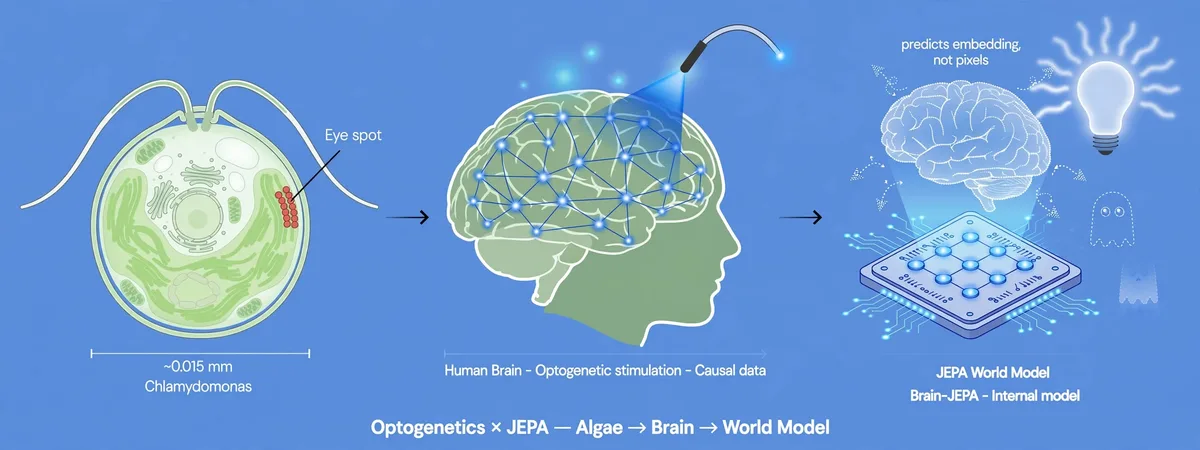
Three scientists taught algae to control the brain. Yann LeCun wants to build a brain that controls itself. The convergence is the opportunity.
TL;DR for founders
The 2026 Nobel Prize in Medicine went to Deisseroth, Hegemann and Nagel for optogenetics, a light switch for individual neurons. For 15 years it was a great lab tool. Now three AI shifts, protein design, closed-loop edge AI, and JEPA world models, make it a platform for devices, therapeutics, and foundation models. If you are building in neurotech, bio-AI, or human-machine interfaces, this is your window.
The Nobel in 60 seconds
In the early 90s, Peter Hegemann in Martinsried stared at a green alga, Chlamydomonas, about 0.015mm across. It swam toward light insanely fast, a 0.5ms reaction. How? He hypothesized a single protein both saw light and was the ion channel.
A decade later, he and Georg Nagel injected the algal genes into frog eggs. They glowed. Literally. The proteins, channelrhodopsin-1 and -2, opened when hit with blue light and let ions flood in, an electrical signal. In 2005, Karl Deisseroth at Stanford put that gene into rat neurons. Shine blue light, neuron fires. On command.
They named it optogenetics in 2006. By 2007 they were steering mouse whiskers with light through a fiber. By 2012, with Tonegawa, they were turning on a memory engram and making a mouse freeze with fear in a safe box.
The popular info sheet ends with the clinical tease: blind patients with retinitis pigmentosa getting some vision back after receiving a channelrhodopsin-like protein in their retina, paired with light-emitting glasses.