


"We believe that if the robot is cheap, safe, and capable, everyone will want our robots." This statement from Tony Zhao and Cheng Chi, co-founders of Sunday Robotics, encapsulates the ambitious vision driving their work on Memo, the first general-intelligence personal robot. Sarah Guo, host of the No Priors podcast, sat down with Zhao and Chi to discuss the state of AI robotics and the path toward widespread home robot adoption.
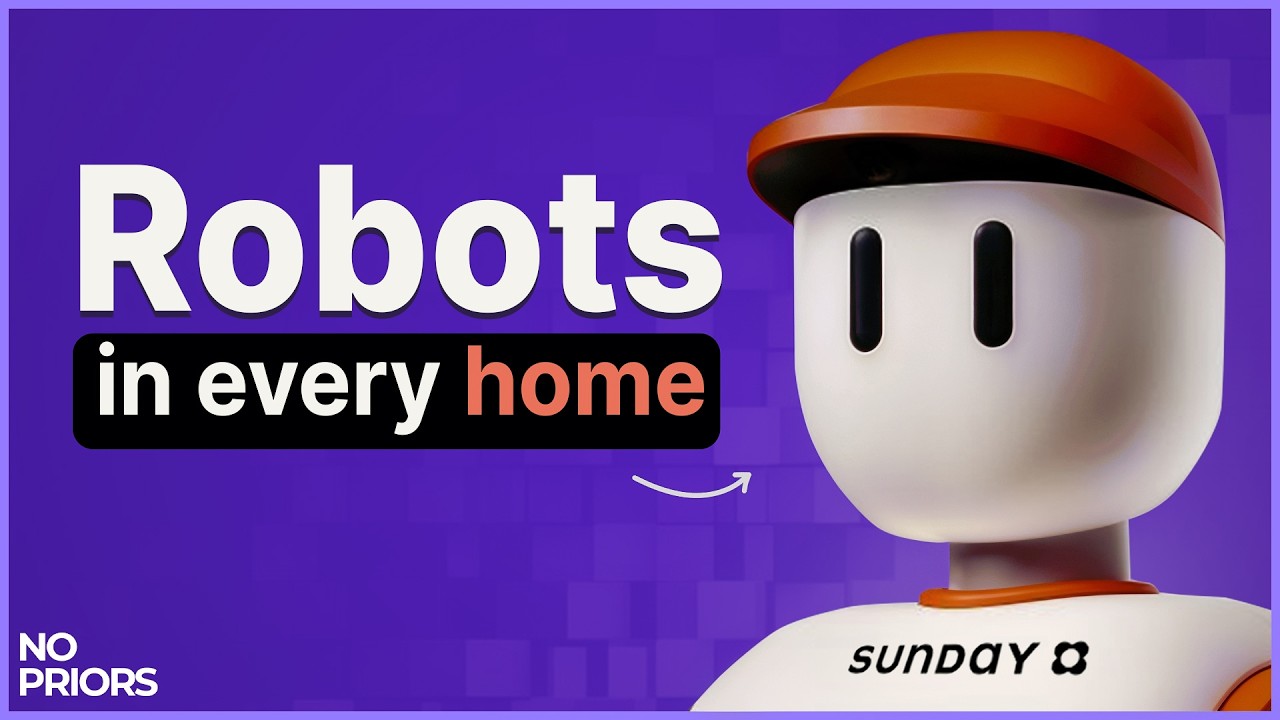
The conversation highlighted the significant shift in the robotics industry, moving from specialized, task-specific machines to more adaptable, general-purpose robots. This evolution is largely catalyzed by recent advancements in AI, particularly in areas like diffusion policy and imitation learning. These breakthroughs have enabled robots to learn complex tasks through observation and to generalize that learning to new situations, a significant leap from previous methods.
The co-founders elaborated on the challenges they encountered while developing Memo. One key hurdle was the sheer scale of data collection required for real-world robot training. Traditional methods of data collection were proving too slow and expensive to achieve the necessary breadth and depth. To overcome this, Sunday Robotics developed an innovative glove system. This system allows human users to teleoperate the robot's actions, effectively collecting real-world data at scale and with high fidelity. "The glove system allows us to scale real-world data collection," explained Zhao, underscoring its importance in training Memo for diverse tasks.
The impact of diffusion policy and imitation learning was a recurring theme. These techniques allow robots to learn from demonstrations, mimicking human actions to perform tasks. This is a significant departure from older methods that relied on explicit programming for every action. "Imitation learning, enter UMI," as the discussion framed it, signifies a move towards more intuitive and human-like robotic capabilities. This approach not only speeds up the learning process but also enables robots to perform tasks that are difficult to explicitly program.
Sunday Robotics' design philosophy for Memo emphasizes a balance between capability, safety, and affordability. Chi elaborated on this, stating, "We believe that if the robot is cheap, safe, and capable, everyone will want our robots." This philosophy guides every aspect of Memo's development, from its hardware design to its software capabilities. The robot is envisioned as a personal assistant, capable of taking on household chores and freeing up human time for more meaningful activities.