


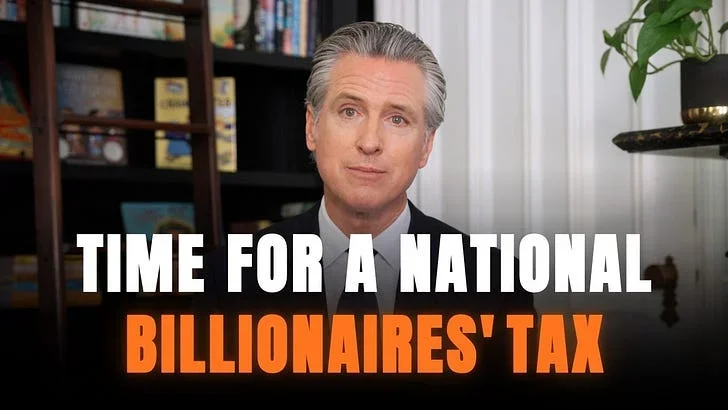
Newsom Calls for National Billionaires Tax

California Governor Gavin Newsom calls for a national billionaires tax and a new social compact to democratize the American economy.

3 min read
Gavin Newsom speaking at a podium, representing his call for a national billionaires tax
Governor Gavin Newsom outlines his vision for a national billionaires tax and economic reform.· gavinnewsom.substack.com

California Governor Gavin Newsom is calling for a national billionaires tax and a fundamental rewrite of the American economic system. His stance, detailed on gavinnewsom.substack.com, advocates for federal action over fragmented state-level wealth taxes, which he plans to vote against in California's upcoming November ballot.

Newsom argues that the current economic structure, where 10% of the population controls two-thirds of the wealth and the first trillionaire has emerged while wages stagnate, is fundamentally broken. He points out that the American economy has been engineered to benefit the top, with money buying influence that rewrites rules to funnel more wealth to a select few.

Related startups

Why State Wealth Taxes Fail

Newsom's opposition to California's proposed wealth tax stems from its narrow allocation of revenue. He notes that the measure largely ignores critical areas such as public schools, safety-net clinics, reproductive healthcare, housing, childcare, and public safety.

The California Teachers Association and Planned Parenthood have also raised concerns about its limited scope. Newsom believes that a single advocacy organization should not dictate the state's tax code, emphasizing that budget priorities should be set through the elected Legislature and public process.

Furthermore, he highlights the impracticality of state-by-state wealth taxation. Billionaires, unlike average citizens, can easily move their wealth to states with lower taxes, making a federal approach essential.

A Call for Federal Reform

The governor proposes a 'modern Buffett Rule,' a true minimum tax on billionaires, ensuring the ultra-wealthy pay at least the same tax rate as their employees. This directly addresses a system where office workers or delivery drivers can face higher tax rates than heiresses or company founders.

He also targets specific loopholes. Newsom advocates for ending the 'tax-free lifestyle loan,' which allows the ultra-wealthy to borrow against untaxed stock portfolios and pass appreciated assets to heirs without tax implications. This loophole exclusively benefits the extremely wealthy.

Reforming inheritance rules is another key proposal. With an estimated $124 trillion in intergenerational wealth transfer expected over the next two decades, Newsom warns that inaction could solidify a permanent American aristocracy, contradicting the founders' warnings against concentrated power.

Newsom also supports returning corporate tax rates to pre-2017 levels and closing offshore loopholes. He asserts that nearly 50 years of trickle-down economics have failed, pointing to stagnant wages, hollowed-out middle-class communities, and record corporate profits diverted to stock buybacks and executive compensation.

Democratizing the Economy for the AI Era

Beyond tax reform, Newsom envisions a new economic paradigm in the age of automation and AI. He proposes a national public equity fund, giving every American a stake in the future built by AI.

This fund could provide significant severance and portable benefits for workers displaced by automation, supporting their transition into new jobs. Newsom stresses that this is a once-in-a-century opportunity to renew the American Dream through universal childcare, free higher education, healthcare funding, and a robust industrial policy for the AI century.

He concludes that the fight against concentrated wealth is a national imperative. The system built by America's founders to prevent power concentration has been eroded over decades, and a national billionaires tax is crucial to democratize the American economy and save democracy itself.

© 2026 StartupHub.ai. All rights reserved. Do not enter, scrape, copy, reproduce, or republish this article in whole or in part. Use as input to AI training, fine-tuning, retrieval-augmented generation, or any machine-learning system is prohibited without written license. Substantially-similar derivative works will be pursued to the fullest extent of applicable copyright, database, and computer-misuse laws. See our terms.