


• StartupHub.ai
    StartupHub.aiAI Intelligence
Discover
  • Home
  • Search
  • Trending
  • News
Intelligence
  • Market Analysis
  • Comparison
Tools
  • Market Map Maker
    New
  • Email Validator
Company
  • Pricing
  • About
  • Editorial
  • Terms
  • Privacy
  1. Home
  2. AI News
  3. Kimi K2 Thinking Reshapes Open Source AI Frontier
  1. Home
  2. AI News
  3. AI Video
  4. Kimi K2 Thinking Reshapes Open-Source AI Frontier
Ai video

Kimi K2 Thinking Reshapes Open-Source AI Frontier

Startuphub.ai Staff
Startuphub.ai Staff
Nov 8, 2025 at 12:16 AM5 min read
Kimi K2 Thinking

Moonshot Labs, a burgeoning Chinese AI firm, has unleashed Kimi K2 Thinking, an open-source, open-weights model that is rapidly redefining the competitive landscape of artificial intelligence. As commentator Matthew Berman of Forward Future AI starkly noted, "Moonshot Labs, a Chinese frontier AI company just released a completely open-source, completely open weights, frontier-level model that is better than GPT-5, better than Claude 4.5 on some of the hardest benchmarks." This bold claim, substantiated by a suite of rigorous evaluations, signals a pivotal moment for the industry, challenging the established dominance of Western tech giants and underscoring the accelerating pace of global AI innovation.
Berman's commentary in his video provides a thorough overview of Kimi K2 Thinking's capabilities and implications, presenting benchmarks and practical demonstrations that showcase its advanced reasoning, coding, and agentic prowess. The model's emergence marks a critical juncture, highlighting how open-source initiatives are not merely catching up but actively setting new performance standards. This rapid convergence of capabilities between open and closed models is a central insight, suggesting a future where accessibility to cutting-edge AI is increasingly democratized.

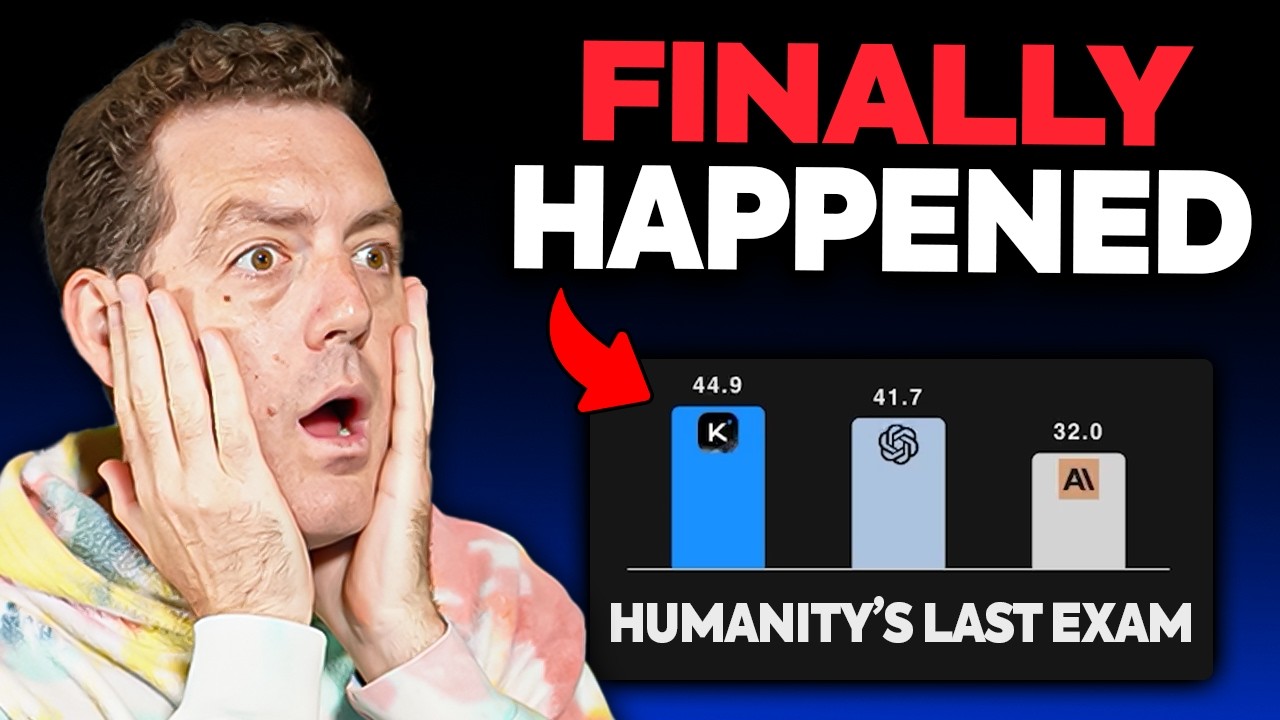
Kimi K2 Thinking's benchmark results are particularly striking. On "Humanity's Last Exam" (HLE), a notoriously difficult test for agentic reasoning, K2 Thinking scored an impressive 44.9, outperforming GPT-5's 41.7 and Claude Sonnet 4.5 Thinking's 32.0. Similarly, in agentic search scenarios, K2 Thinking achieved a 60.2 on BrowseComp, surpassing GPT-5's 54.9 and Claude Sonnet 4.5 Thinking's 34.1. These figures are more than just numbers; they represent a tangible shift in the state of the art, demonstrating Kimi K2's superior capacity for goal-directed, web-based reasoning.

The model’s agentic capabilities extend beyond benchmarks into real-world problem-solving. Kimi K2 Thinking is engineered to execute "up to 200 – 300 sequential tool calls without human interference, reasoning coherently across hundreds of steps to solve complex problems," as highlighted in Moonshot Labs' own documentation. This ability was vividly illustrated in a demonstration where Kimi K2 tackled a PhD-level mathematics problem, meticulously performing 23 tool calls, including multiple web searches for relevant academic papers, to arrive at the correct solution. Such a robust, multi-step reasoning chain, autonomously navigated, represents a significant leap in AI's capacity for complex logical deduction.

Further examples showcased Kimi K2’s versatility. It generated a fully functional "Word clone" website from a single prompt, complete with editable text, font options, and local saving functionality. In another instance, it created an animated visualization of gradient descent, dynamically illustrating complex mathematical concepts. The model also demonstrated its prowess in simulations, building an interactive virus-attacking-cells scenario, and even producing live music through code in Strudel. These diverse applications underscore the model's strong generalization across programming languages and agent scaffolds.

Emad Mostaque, founder of Stability AI, offered a compelling perspective on the broader economic implications of Kimi K2's release. He remarked, "The gap between closed & open continues to narrow even as the cost of increasingly economically valuable tokens collapses." Mostaque also provided insights into the model's training costs, estimating the base Kimi K2 model used 2.8 million H800 hours with 14.8 trillion tokens, amounting to approximately $5.6 million. He further speculated that achieving state-of-the-art performance might cost less than $3 million if developers had access to advanced Blackwell chips, indicating a future where high-performance AI becomes even more economically viable.

The emergence of such a powerful open-source model from a Chinese lab also signals a significant geopolitical shift in the AI ecosystem. Nathan Lambert of Interconnects.ai articulated this sentiment, noting, "At the start of the year, most people loosely following AI probably knew of 0 AI labs. Now, and towards wrapping up 2025, I'd say all of DeepSeek, Qwen, and Kimi are becoming household names. They all have seasons of their best releases and different strengths." He pointed out that Chinese companies have managed to catch up to the "open frontier in ballpark of performance" within a mere six months of DeepSeek's initial release, highlighting the accelerated pace of innovation outside traditional Western hubs. This growing share of cutting-edge mindshare shifting to China suggests a more diversified and competitive global AI landscape.

Sebastian Raschka, a prominent ML/AI researcher, further elucidated Kimi K2's architectural specifics, comparing it to DeepSeek R1. Kimi K2, with its 1 trillion parameters, surpasses DeepSeek R1's 671 billion, and notably employs more experts (384 vs. 256). Despite its larger overall parameter count, Kimi K2 is more efficient during inference, activating fewer parameters (32 billion compared to DeepSeek R1's 37 billion), which points to a sophisticated design optimizing performance per compute. This efficiency, combined with its open-source nature, positions Kimi K2 as a formidable contender.

Related Reading

  • Google's Ironwood Chip Reshapes the AI Hardware Battle
  • OpenAI's Trillion-Dollar Bet on AI Dominance
  • OpenAI's "Too Big to Fail" Playbook and the AI Bubble

The comprehensive analysis of healthcare accessibility in Ghana, generated by Kimi K2 with minimal human input, further solidifies its position as a transformative tool. The model autonomously downloaded relevant data, computed population densities, ranked districts by facility coverage, and produced an interactive dashboard with maps and charts. This intricate process, completed in minutes with just one piece of corrective feedback, demonstrates Kimi K2's potential for robust, data-driven analysis and visualization.

Kimi K2 Thinking represents more than just another incremental improvement in AI; it is a testament to the power of open-source development in pushing the boundaries of what's possible. Its superior performance on demanding benchmarks, coupled with its advanced agentic reasoning and the economic efficiencies demonstrated, establishes a new high-water mark for accessible, frontier-level AI.

#AI
#Emad Mostaque
#Launch
#LLM
#Moonshot Labs
#Open-Source AI
#OpenAI
#Sebastian Raschka

AI Daily Digest

Get the most important AI news daily.

GoogleSequoiaOpenAIa16z
+40k readers