Jed Borovik, Product Lead at Google Labs, recently spoke with Swyx, Editor of Latent Space, at GitHub Universe, hosted at Founders Inc.'s podcast studios, offering a deep dive into Google's autonomous AI coding agent, Jules, and its transformative implications for software development. The conversation illuminated Google's strategic positioning in the burgeoning coding agent race, revealing how the evolution of AI models is fundamentally reshaping software engineering.
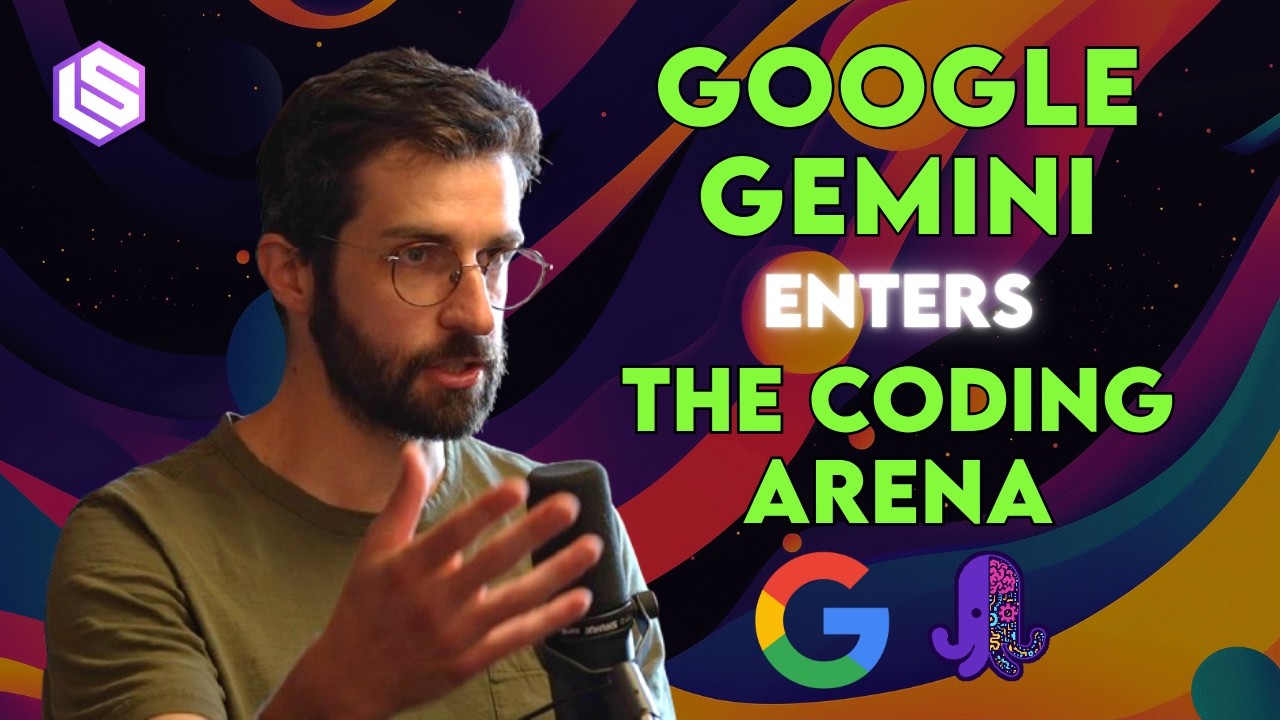
Borovik's personal journey into generative AI began not with large language models for text, but with Stable Diffusion. This experience sparked a profound realization: "This is either it's going to take my my art, my craft, or this is a tool to create better art." This philosophical pivot, viewing AI not as a threat, but as a "new brush" for creation, proved pivotal in his transition from Google Search to leading the ambitious Jules project within Google Labs. This perspective underscores a core insight: the most successful integration of AI into creative or complex fields will come from those who embrace it as an augmentation of human capability, not a replacement.
Google Labs operates at the unique intersection of DeepMind's model development and product innovation, allowing for an end-to-end approach to AI products. This close collaboration is crucial for a product like Jules, which is designed to be a truly autonomous coding agent. Unlike many other agents that run locally or within a user's workspace, Jules operates on its own dedicated infrastructure, enabling it to tackle complex, long-running tasks that might span hours or even days. This autonomy, combined with its ability to manage extensive context windows, pushing up to 2 million tokens, sets Jules apart in a crowded landscape of coding assistants.
The evolution of agent scaffolding further highlights the rapid advancements in AI. Borovik noted that early models required incredibly complex scaffolding to guide their actions. However, as the underlying models have improved in quality and sophistication, the need for intricate scaffolding has diminished, simplifying the agent architecture. This progressive simplification is a testament to the increasing intelligence and capabilities of foundational models. Concurrently, the method of code understanding is also shifting. What was once heavily reliant on embeddings-based Retrieval-Augmented Generation (RAG) is now giving way to attention-based search, suggesting a more nuanced and context-aware approach to processing code.
Related Reading
- Google Cloud's Vertex AI Agent Engine Bridges the Production Gap for AI Agents
- Model Context Protocol: Streamlining AI Agent Interaction with Cloud Tools
- Agentic AI: The Human-Centric Revolution in Business Automation
A particularly striking anecdote from Borovik illustrates the power of these long-running agents. He recounted instances where users would keep a single Jules session active for 30 days, continually working on a complex problem. This level of sustained engagement and capability challenges conventional notions of developer workflow. Such extended use cases necessitate sophisticated context management, where the agent intelligently summarizes and externalizes information, often writing notes or updating tickets, to maintain coherence over time without overwhelming its internal context window.