

Sam Altman's AGI Shift: From Extinction Warning to Gentle Singularity

Sam Altman co-signed an AI extinction warning in May 2023. By June 2025, he was writing of a 'gentle singularity.' Here is how his public position on AGI risk and AI safety evolved, and what OpenAI's $25B revenue run-rate means for that framing.

6 min read
Sam Altman, AGI and AI safety public position evolution, 2026
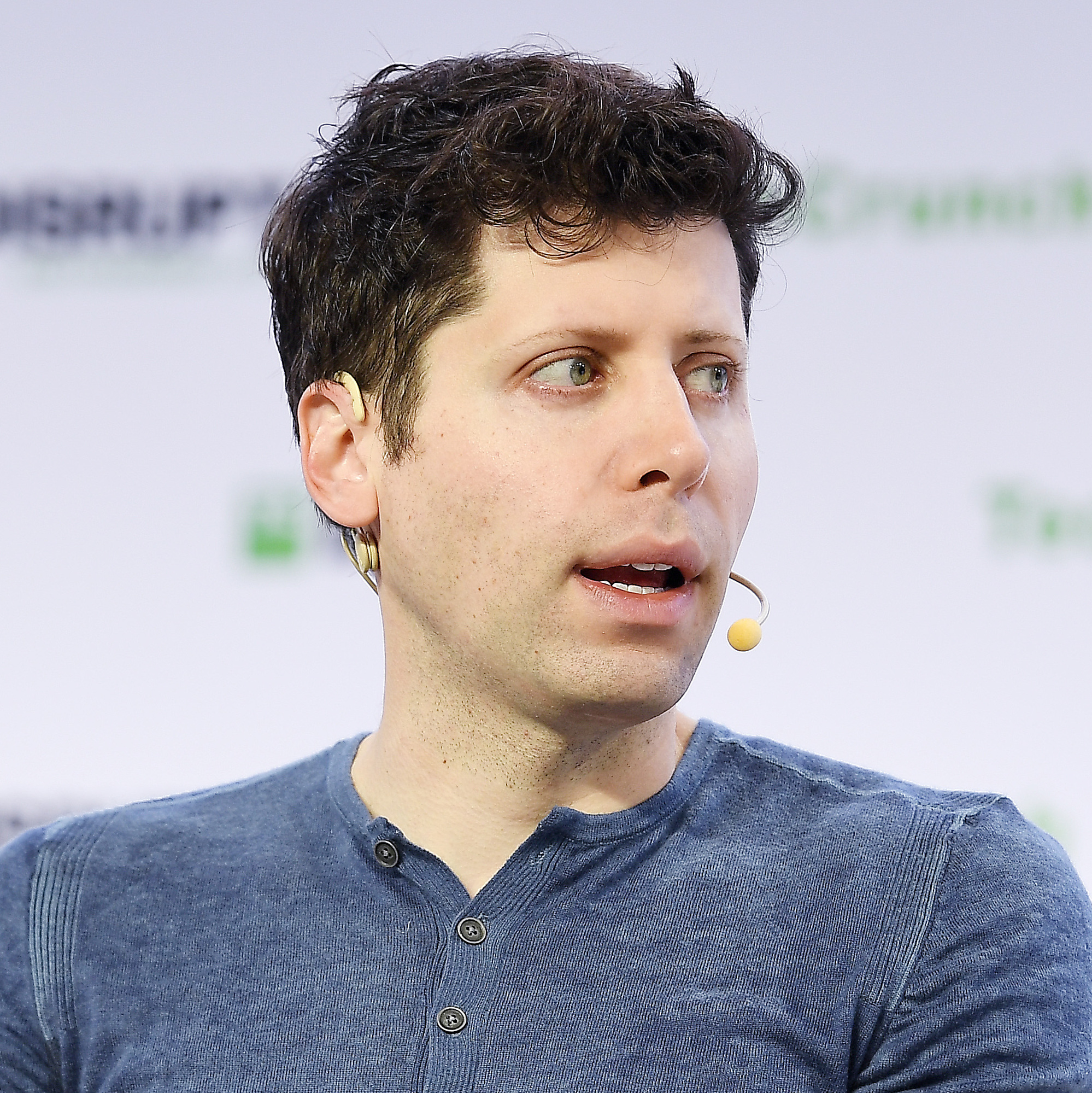
Sam Altman speaking at TechCrunch Disrupt San Francisco 2019.· Photo by Steve Jennings/TechCrunch, via Wikimedia Commons (CC BY 2.0)

OpenAI crossed $25 billion in annualized revenue in March 2026, according to PYMNTS citing Reuters, as its chief executive, Sam Altman, completed a striking public evolution: from co-signer of an AI extinction warning in 2023 to the architect of what he now calls "the gentle singularity." The journey is documented in a paper trail of blog posts, Senate testimony, and corporate filings that reveals how Altman's framing of AI risk has shifted more explicitly than almost any other voice in the field.

Related startups

From Nonprofit Safety Lab to Superintelligence Company

OpenAI was incorporated in 2015 as a nonprofit with a founding premise that artificial general intelligence posed existential risk and required a structure that prioritized humanity over profit. Altman joined as chief executive in 2019, and for several years amplified that framing directly. In May 2023, he co-signed a one-sentence statement from the Center for AI Safety reading: "Mitigating the risk of extinction from AI should be a global priority alongside other societal-scale risks such as pandemics and nuclear war."

One month later, Altman testified before the US Senate, calling for a federal licensing regime for frontier AI models and warning of the consequences if the technology went wrong. Both statements placed him squarely in the camp of researchers who argued that advanced AI warranted regulatory constraint, not just voluntary internal guardrails.

By June 2025, the register had changed substantially. In a 3,000-word essay titled "The Gentle Singularity", Altman described a coming inflection as "gradual and manageable" rather than catastrophic. He predicted that by 2026 AI systems would generate novel scientific insights autonomously, that by 2027 robots would perform meaningful real-world physical work, and that within a decade intelligence could be "too cheap to meter." He described OpenAI, for the first time in public writing, as "a superintelligence research company." As TechCrunch noted, the essay reframed the singularity not as a rupture to be feared but as a transition already under way.

OpenAI annual recurring revenue line chart 2023 to March 2026 showing growth from $2B to $25B
OpenAI ARR grew from $2B in 2023 to $25B annualized by March 2026. Sources: PYMNTS (citing OpenAI CFO Sarah Friar), Reuters.

The Safety Commitments That Contracted

Between those two public registers, OpenAI's internal safety infrastructure contracted while its commercial ambitions expanded. In mid-2023, the company pledged 20 percent of its total compute to a "superalignment" team charged specifically with preventing AI from causing "the disempowerment of humanity or even human extinction." Reporting by The New Yorker, published in April 2026, found that the team received roughly 1 to 2 percent of total compute in practice and was ultimately dissolved. The investigation described Altman as having "repeatedly chosen to deprioritize safety commitments he publicly championed." OpenAI disputed characterizations in the report, but the departures of the superalignment team's co-leads in May 2024 were publicly confirmed by those executives at the time.

The structural underpinning of safety also shifted. In October 2025, OpenAI completed its conversion from nonprofit to a public benefit corporation, the OpenAI Group PBC, per an OpenAI announcement. Under the new structure, Altman received an equity stake and the original nonprofit, renamed the OpenAI Foundation, retained governance rights: it can appoint and replace all board members. California Attorney General Rob Bonta negotiated concessions requiring charitable assets be used for their intended purpose and that safety remain a stated priority. The nonprofit Foundation holds a stake valued at approximately $130 billion under the restructuring terms.

Horizontal bar chart showing OpenAI superalignment compute pledged at 20% versus delivered at approximately 1.5%
OpenAI pledged 20% of compute to superalignment in 2023; The New Yorker/TechBrew reported delivery of roughly 1-2%. The team was dissolved before 2026.

A Geopolitical Framing for 2026

Altman's Washington strategy in 2026 has moved from regulation-seeker to policy-shaper. In early June, he met with members of Congress and Trump administration officials involved in drafting an executive order on artificial intelligence. Writing after those meetings, Altman stated: "The U.S. should lead on AI by continuing to develop the very best models, making sure they're safe, and getting cyber tools into the hands of trusted defenders," adding that "the new EO gets the balance right," per CNBC's reporting.

The posture contrasts with his 2023 Senate testimony, in which he explicitly requested that Congress impose licensing requirements on frontier model developers, a position that would have constrained OpenAI's own pace of release. In 2026, the emphasis has shifted from external constraint to domestic competitiveness: Altman's case for safety is now nested inside an argument that the United States must outpace China in AI development. The framing is broadly aligned with the Trump administration's export-control and infrastructure priorities, which OpenAI has engaged with directly through the Stargate initiative.

OpenAI's revenue trajectory gives that framing commercial ballast. ARR climbed from $6 billion at end-2024 to $20 billion by year-end 2025, per CFO Sarah Friar as cited by PYMNTS, then crossed $25 billion annualized by March 2026, per Reuters. Enterprise accounts, which carry higher margins than consumer subscriptions, represented more than 40 percent of that mix and were on track to reach parity with consumer by year-end 2026. The company is now generating roughly $2 billion per month in revenue, making the safety-versus-speed tension a nine-figure-per-month question, not a philosophical one. For a counterpoint on how a rival lab frames the same tension, see Dario Amodei's position evolution.

Doughnut chart showing OpenAI 2026 revenue mix: 42% enterprise, 58% consumer
Enterprise revenue exceeded 40% of OpenAI's total mix heading into 2026, with parity with consumer revenue projected by year-end. Source: Reuters / PYMNTS.

What It Means

Altman's public position evolution reflects a pattern common among technology founders who build companies around the premise of managing a powerful technology's risks: the closer that technology gets to commercial scale, the harder it becomes to maintain the original framing intact. His specific contribution has been to coin vocabulary ("the gentle singularity," "superintelligence research company") that preserves a sense of historic stakes while shifting the expected outcome from catastrophic to managed. The $25 billion revenue run-rate means that vocabulary now has enormous institutional weight behind it. Whether OpenAI's internal safety commitments track the public optimism, or continue to lag it, is what the next set of model releases and independent audits will reveal.

Sources

Editorial standards: every claim is sourced. Tips: [email protected]

© 2026 StartupHub.ai. All rights reserved. Do not enter, scrape, copy, reproduce, or republish this article in whole or in part. Use as input to AI training, fine-tuning, retrieval-augmented generation, or any machine-learning system is prohibited without written license. Substantially-similar derivative works will be pursued to the fullest extent of applicable copyright, database, and computer-misuse laws. See our terms.