

Erik Hanchett on Spec-Driven Development with AI

Erik Hanchett from AWS discusses Spec-Driven Development, explaining how clear specifications and AI assistants like Kiro.dev can streamline production workflows.

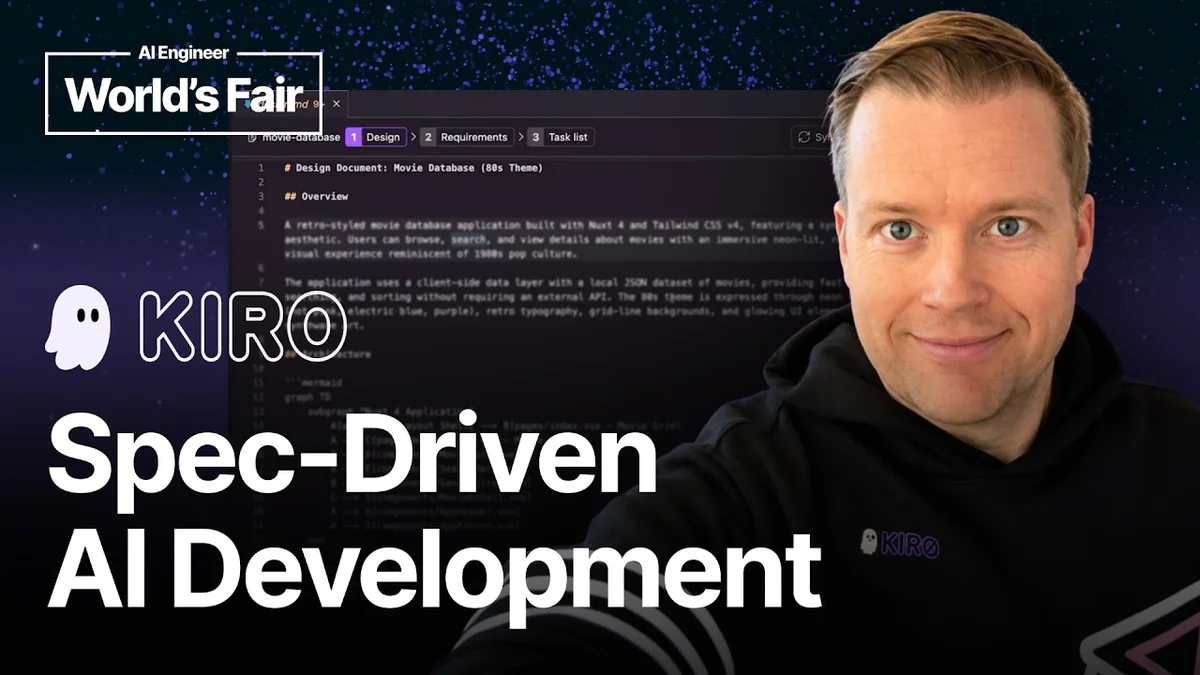
Presentation slide on Spec-Driven Development with a ghost icon
Erik Hanchett from AWS discusses Spec-Driven Development for production workflows.· AI Engineer
Visual TL;DR
Spec-Driven DevelopmentContext
structured specifications created before any code is written
From the article 7 mentionsErik Hanchett, Senior Developer Advocate at AWS, recently shared insights on leveraging Spec-Driven Development for production workflows, particularly in the context of AI-assisted coding.
Clear AI GuidanceDriver
provides clear direction and requirements for AI assistants
From the article 7 mentionsJust as a human intern needs clear instructions and guidance to perform tasks effectively, AI assistants require well-defined specifications to deliver the desired outcomes.
AI Coding AssistantsCore
like an AI intern needing clear instructions to perform tasks
From the article 8 mentionsHanchett emphasized that this approach is particularly beneficial when working with AI coding assistants, as it provides clear direction and requirements for the AI to follow.
Streamline WorkflowsEffect
enhances productivity and code quality through effective AI guidance
From the article 2 mentionsKiro offers both an IDE and a command-line interface (CLI) version, allowing developers to choose their preferred workflow.
Kiro.devCore
an example of an AI assistant for spec-driven development
From the article 4 mentionsHanchett introduced Kiro.dev, a new AI IDE coding assistant that aims to simplify the integration process.
Higher Quality CodeOutcome
the ultimate outcome of guiding AI effectively with specifications
From the article 2 mentionsThe goal is not just to code faster, but to produce higher quality code by guiding the AI effectively.
Contents(6)

Erik Hanchett, Senior Developer Advocate at AWS, recently shared insights on leveraging Spec-Driven Development for production workflows, particularly in the context of AI-assisted coding. In a presentation, Hanchett explained the core principles of this development methodology and how it can be effectively integrated with AI tools to enhance productivity and code quality.

Erik Hanchett on Spec-Driven Development with AI - AI Engineer
Erik Hanchett on Spec-Driven Development with AI, AI Engineer

Understanding Spec-Driven Development

At its heart, Spec-Driven Development is a process where structured specifications are created before any code is written. Hanchett emphasized that this approach is particularly beneficial when working with AI coding assistants, as it provides clear direction and requirements for the AI to follow. The goal is not just to code faster, but to produce higher quality code by guiding the AI effectively.

The Role of AI in Development

Hanchett drew a parallel between using AI coding assistants and having an AI intern. Just as a human intern needs clear instructions and guidance to perform tasks effectively, AI assistants require well-defined specifications to deliver the desired outcomes. He highlighted that without proper prompting and context, AI assistants might go 'off the rails,' underscoring the importance of precise instructions.

Addressing the 'Why' and 'How'

A common question Hanchett addressed is whether the latest frontier models can do everything on their own. While acknowledging the rapid advancements in AI capabilities, he stressed that providing context and clear specifications is still vital. He likened it to the need for a clear roadmap for any AI project, ensuring the AI is steered in the right direction. Hanchett shared a personal anecdote from his early career where a VP would provide random ideas, and he learned the importance of formalizing these ideas into actionable specifications.

Key Considerations for AI-Assisted Development

Hanchett outlined several key considerations when using AI for development:

  • Too much context can be detrimental: Models can get confused if provided with excessive or irrelevant information. It's important to strike a balance, providing just enough context and clear guidelines.
  • Utilize 'Skills': AI coding assistants can leverage 'skills,' which are essentially instruction files with keywords that guide their actions. This allows for more precise and targeted code generation.
  • Leverage existing tools: Hanchett demonstrated how specifications can be pulled from project management services, streamlining the process of feeding requirements into the AI.
  • The 'Specification Phase': He emphasized the importance of a clear requirements phase, where user stories, design documents, and implementation details are meticulously laid out. This phase helps ensure the AI understands the project's goals and constraints.

Introducing Kiro.dev

Hanchett introduced Kiro.dev, a new AI IDE coding assistant that aims to simplify the integration process. Kiro offers both an IDE and a command-line interface (CLI) version, allowing developers to choose their preferred workflow. The tool is designed to work with various AI models and data sources, acting as a unified interface for AI development. He highlighted that Kiro can help developers create structured specifications, generate code, and even assist with debugging by providing property-based tests.

The Future of Spec-Driven Development

Hanchett concluded by emphasizing that Spec-Driven Development, combined with AI tools, is a powerful approach to modern software development. By providing clear, structured specifications, developers can better guide AI assistants, leading to more efficient and effective development cycles. He encouraged the audience to explore Kiro.dev and connect with him on LinkedIn or X/Bluesky for further discussion.

© 2026 StartupHub.ai. All rights reserved. You may not republish this article in full without a license. Search engines and AI research tools may crawl and summarize for reference. Bulk reproduction or model training requires a license. See our terms.
Daniel Singer

Written by

Daniel Singer

Editor, StartupHub.ai

Daniel Singer is the editor of StartupHub.ai, a technology expert and thought leader on AI and its applications across sectors, from fintech and healthcare to developer tooling and consumer software. He writes and tests the tools covered here thoroughly and regularly, and built StartupHub.ai to give founders, operators and buyers a clearer read on what they are actually being sold.