


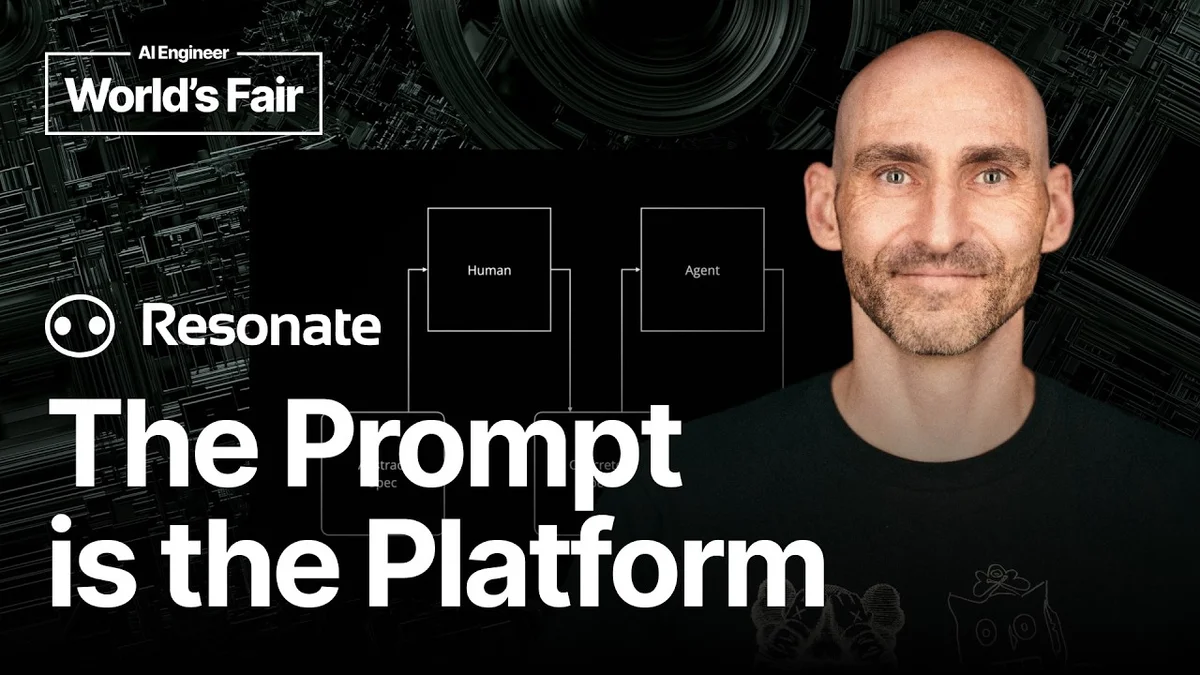
Dominik Tornow: The Prompt is the Platform in AI

Dominik Tornow of Resonate argues that AI development is shifting towards prompt engineering, making 'The Prompt is the Platform' a reality by 2026.

5 min read
Dominik Tornow speaking about 'The Prompt is the Platform'
AI Engineer
Visual TL;DR
Software Dev EvolutionContext
moving towards more abstract layers of interaction
AI Capabilities AdvanceDriver
traditional coding agents declining in relevance
From the article 2 mentionsTornow's core thesis is that as AI capabilities advance, the human role in software development will evolve.
Prompt Engineering RisesCore
nuanced prompts interpreted and acted upon by systems
From the articleDominik Tornow, founder and CEO of Resonate, presented a compelling vision for the future of software engineering, arguing that 'The Prompt is the Platform'.
2026 PredictionOutcome
From the articleHe predicts that by 2026, traditional coding agents will see a decline in relevance, being superseded by systems that can interpret and act upon nuanced prompts.
Prompt is PlatformContext
primary interface for creating and interacting with software
From the article 9+ mentionsThe platform aims to facilitate the creation of durable execution systems, allowing for the generation of bespoke implementations based on specific prompts.
Bespoke ImplementationsEffect
systems that can interpret and act upon nuanced prompts
From the article 7 mentionsThe presentation highlighted a progression from general-purpose implementations to bespoke ones, generated on demand.
Shift in ValueOutcome
value moving from code to prompt engineering
From the article 6 mentionsThese core technical values are crucial for enabling this new paradigm of prompt-driven development.
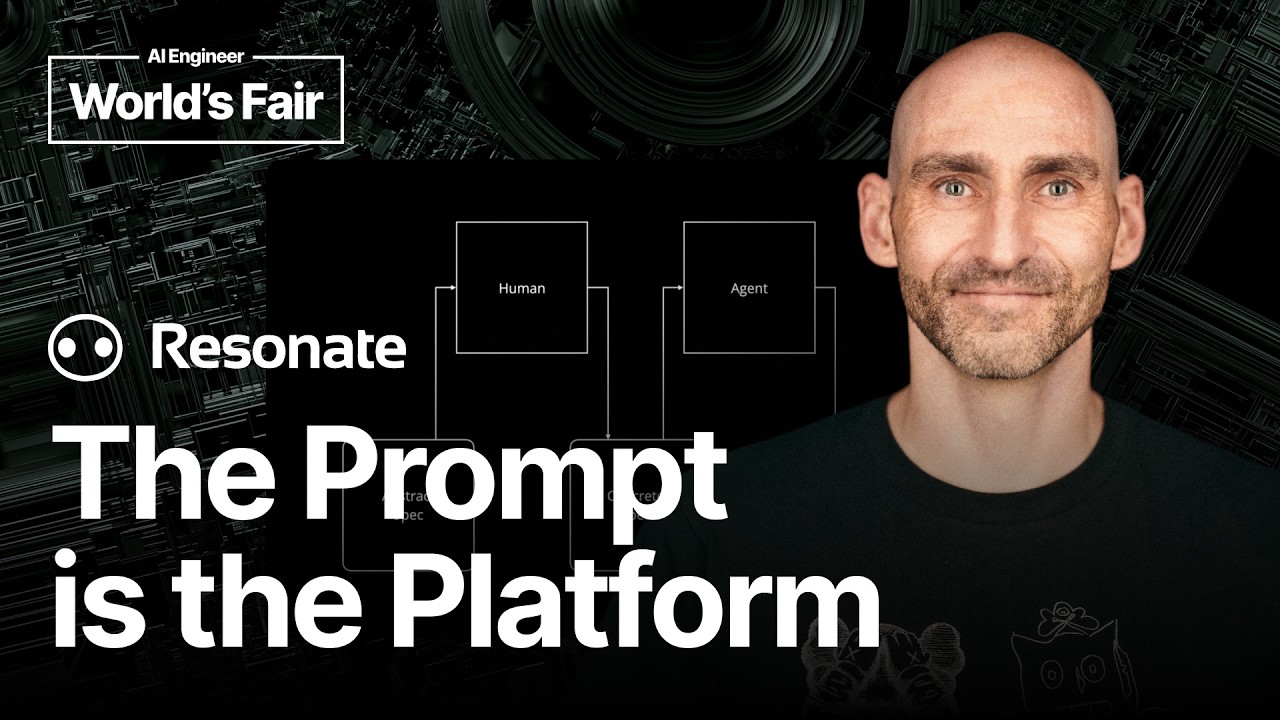
Dominik Tornow, founder and CEO of Resonate, presented a compelling vision for the future of software engineering, arguing that 'The Prompt is the Platform'. In his talk, Tornow outlined how the industry is moving away from traditional coding and towards a model where well-crafted prompts become the primary interface for creating and interacting with software.

Dominik Tornow: The Prompt is the Platform in AI - AI Engineer
Dominik Tornow: The Prompt is the Platform in AI — from AI Engineer

Tornow's core thesis is that as AI capabilities advance, the human role in software development will evolve. He predicts that by 2026, traditional coding agents will see a decline in relevance, being superseded by systems that can interpret and act upon nuanced prompts. This shift, he suggests, fundamentally changes how we think about building and deploying software.

The Evolution of Software Development

Tornow elaborated on this by drawing parallels to existing technological shifts. He posited that software engineering is 'hiding' and moving towards a more abstract layer of interaction. This means that instead of writing explicit code, developers will increasingly focus on defining what they want done through prompts. The AI, in turn, will handle the implementation details.

Resonate, as described by Tornow, is a platform built on the principles of minimalism and simplicity. These core technical values are crucial for enabling this new paradigm of prompt-driven development. The platform aims to facilitate the creation of durable execution systems, allowing for the generation of bespoke implementations based on specific prompts.

From General to Bespoke Implementations

The presentation highlighted a progression from general-purpose implementations to bespoke ones, generated on demand. This means that rather than relying on pre-built libraries or frameworks, developers will be able to prompt an AI to create exactly what is needed for a specific task. This approach shifts the focus from the 'how' of coding to the 'what' of the desired outcome.

Tornow illustrated this with a conceptual model showing how 'specification' leads to 'implementation'. The key insight is that this relationship is becoming increasingly direct through AI agents. The prompt acts as the specification, and the agent translates it into a concrete implementation, leveraging existing infrastructure.

The Role of Agents and Verification

The talk also touched upon the crucial aspect of verification in this new model. If implementations are generated by agents, the challenge becomes ensuring their correctness and reliability. Tornow suggested that agents themselves will need to be able to verify their own outputs, a process that requires clear, verifiable specifications.

This leads to a more sophisticated understanding of the agent's role: not just to generate code, but to ensure that the generated code meets the specified requirements. The process, as outlined by Tornow, involves a cycle of 'specification', 'agent', and 'implementation', with verification acting as a critical feedback loop.

The Shift in Value: From Code to Prompt

Tornow emphasized that in this future, the real value will lie not in the ability to write code, but in the ability to articulate clear, effective prompts. This requires a deep understanding of how AI models interpret instructions and how to translate complex requirements into precise language.

The presentation also showcased how Resonate is partnering with infrastructure providers like NATS.IO to build durable execution capabilities directly into their technology stack. This integration allows developers to build Resonate on top of existing infrastructure with minimal dependencies, further simplifying the development process.

Conclusion: Building with Prompts

Tornow's central message is that the future of software development is about mastering the art of the prompt. By understanding how to effectively communicate with AI agents, developers can unlock new levels of productivity and creativity, moving from writing code to orchestrating intelligent systems. This paradigm shift promises to democratize software creation and accelerate innovation across industries.

© 2026 StartupHub.ai. All rights reserved. Do not enter, scrape, copy, reproduce, or republish this article in whole or in part. Use as input to AI training, fine-tuning, retrieval-augmented generation, or any machine-learning system is prohibited without written license. Substantially-similar derivative works will be pursued to the fullest extent of applicable copyright, database, and computer-misuse laws. See our terms.