

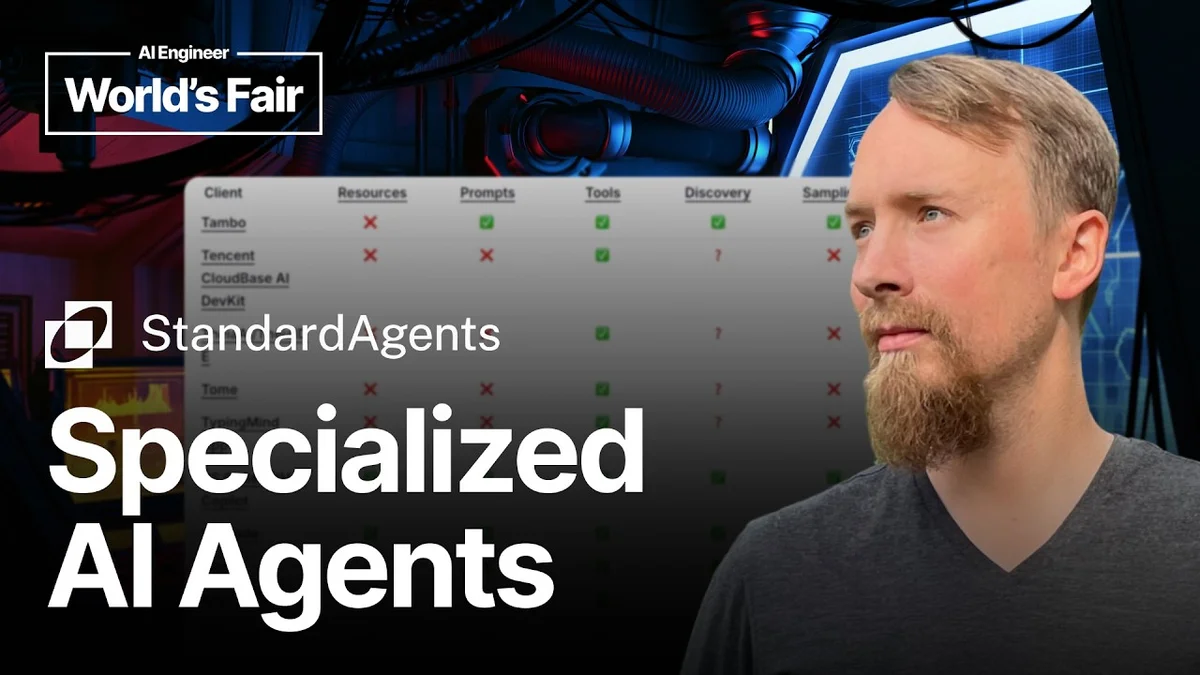
Domain-Specific Agents: The Future of AI?

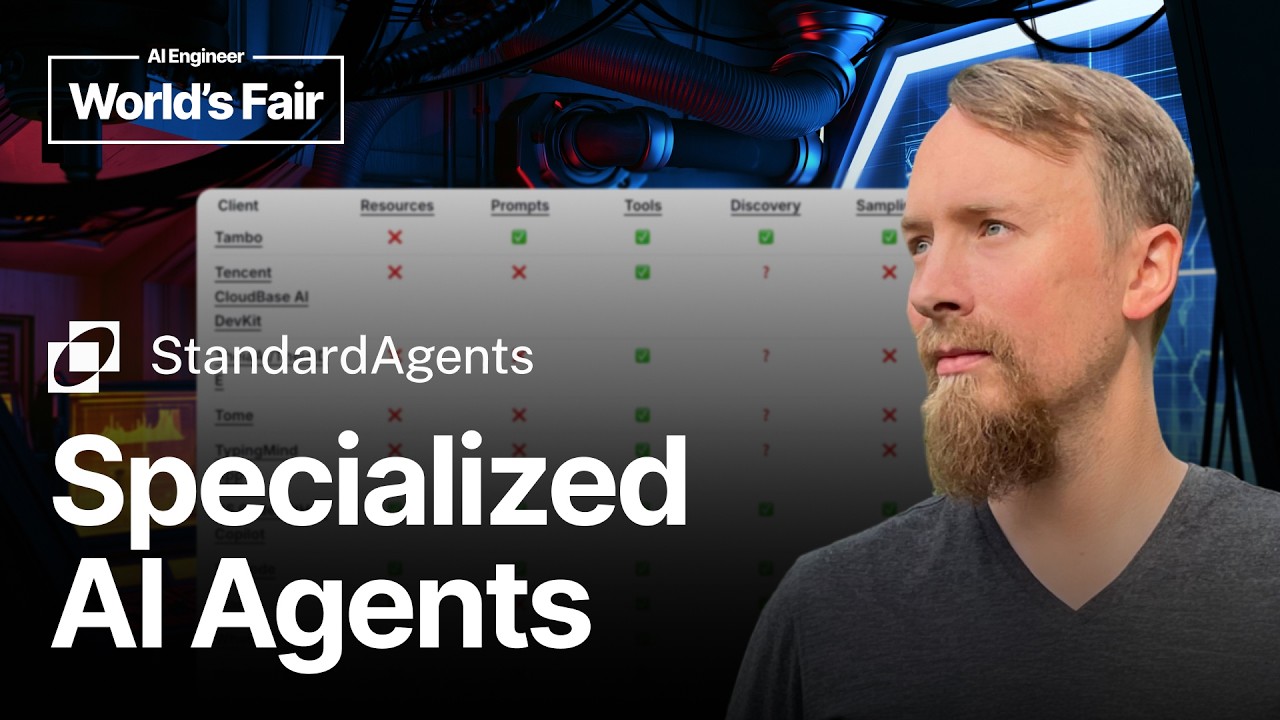
Justin Schroeder of StandardAgents argues that the future of AI lies in domain-specific agents, which offer greater efficiency and controllability than general-purpose models.

Presentation slide with the title 'The Future Is Domain-Specific Agents' and an image of a ship at sunset.
Presentation slide on the future of AI.· AI Engineer
Visual TL;DR
AI Industrial RevolutionDriver
From the article 2 mentionsSchroeder draws a parallel between the current AI boom and the Industrial Revolution, suggesting that we are witnessing an accelerated transformation driven by intelligence rather than sheer mechanical power.
Define the AgentCore
deterministic software harnessing non-deterministic model results for objectives
From the article 9+ mentionsJustin Schroeder, representing StandardAgents, posits a compelling vision for the future of artificial intelligence: domain-specific agents.
Agent Development ChallengeDriver
creating these specialized AI tools presents significant hurdles
From the article 2 mentionsSchroeder advocates for a "composition over inheritance" approach to agent development.
Domain-Specific AgentsCore
AI meticulously designed for particular tasks and industries
From the article 9+ mentionsSchroeder predicts that while broad, general-purpose agents will exist, the real advancements will come from highly specialized, domain-specific agents.
Integration & CompositionContext
combining agents unlocks greater power and functionality
From the articleSchroeder advocates for a "composition over inheritance" approach to agent development.
Future of AIEffect
greater efficiency and controllability than general-purpose models
From the articleJustin Schroeder, representing StandardAgents, posits a compelling vision for the future of artificial intelligence: domain-specific agents.
Practical AI PowerOutcome
From the article 2 mentionsIn his presentation, Schroeder argues that while the current AI landscape is rapidly evolving, the real power and practicality will emerge from agents meticulously designed for particular tasks and industries.
Contents(5)

Justin Schroeder, representing StandardAgents, posits a compelling vision for the future of artificial intelligence: domain-specific agents. In his presentation, Schroeder argues that while the current AI landscape is rapidly evolving, the real power and practicality will emerge from agents meticulously designed for particular tasks and industries.

Domain-Specific Agents: The Future of AI? - AI Engineer
Domain-Specific Agents: The Future of AI?, AI Engineer

The Industrial Revolution of AI

Schroeder draws a parallel between the current AI boom and the Industrial Revolution, suggesting that we are witnessing an accelerated transformation driven by intelligence rather than sheer mechanical power. He posits that just as the Industrial Revolution harnessed energy with machines, the AI revolution will harness intelligence through agents.

Defining the Agent

Schroeder offers a concise definition: "Agents are deterministic software that harnesses the non-deterministic results produced by models in pursuit of a desired objective." He acknowledges that defining an agent can be challenging, with many examples like Claude or Codex readily coming to mind. However, he emphasizes that the core concept is a piece of software that uses AI models to achieve a specific goal.

The Challenge of Agent Development

Despite the proliferation of AI models and tools, Schroeder highlights the significant difficulties in building truly effective agents. He lists several key challenges:

  • Agentic loop orchestration
  • Provider abstraction
  • Durable execution
  • Tool call validation
  • Stop conditions
  • Multi-agent turn coordination
  • Persistent thread state
  • Message hierarchy (sub-prompts)
  • Context window management
  • Parallel tool execution
  • Real-time log streaming
  • Memory-efficient image processing
  • Large file chunking
  • Automatic image optimization
  • Zero-config discovery
  • Message lifecycle hooks
  • Tool lifecycle hooks
  • Framework-agnostic clients
  • Workblock transformation
  • Agent packaging & distribution
  • Sub-prompt chaining
  • Graceful execution abort
  • Serial tool execution
  • Retry with backoff
  • Unified response format
  • HTTP streaming for long execution
  • WebSocket
  • Execution namespaces
  • Hallucination mitigation

He stresses that building robust agents is hard, and there's no single defined way to do it. Furthermore, the lack of standardization in telemetry and observability makes debugging and refinement a significant hurdle.

Integration and the Power of Composition

Schroeder advocates for a "composition over inheritance" approach to agent development. He illustrates this with a layered model, starting with the core Model, then adding System Prompt, Tools, and Messages. This layered structure allows for modularity, where specific tools and prompts can be integrated to create specialized agents. He showcases examples like a Figma agent, a Gmail agent, and a Google Sheets agent, demonstrating how these can be composed to perform complex tasks. He further elaborates on the concept of agents calling other agents, creating intricate and powerful agentic systems, such as a coordination agent orchestrating multiple specialized agents like Salesforce, Google Workspace, and Legal Team agents.

The Future is Domain-Specific

Schroeder predicts that while broad, general-purpose agents will exist, the real advancements will come from highly specialized, domain-specific agents. These agents, he argues, are far more efficient with tokens, cost-effective, and can be precisely tailored to specific tasks and industries. He concludes with a forward-looking statement: "They're coming," referring to the rise of these domain-specific agents, and predicts a significant acceleration in their development and adoption as we move through 2026 and into 2027.

© 2026 StartupHub.ai. All rights reserved. You may not republish this article in full without a license. Search engines and AI research tools may crawl and summarize for reference. Bulk reproduction or model training requires a license. See our terms.
Daniel Singer

Written by

Daniel Singer

Editor, StartupHub.ai

Daniel Singer is the editor of StartupHub.ai, a technology expert and thought leader on AI and its applications across sectors, from fintech and healthcare to developer tooling and consumer software. He writes and tests the tools covered here thoroughly and regularly, and built StartupHub.ai to give founders, operators and buyers a clearer read on what they are actually being sold.