

Cursor Enterprise Adds Organizations for Scalability

Cursor Enterprise introduces 'Organizations' to provide centralized management for budgets, identity, and security across multiple teams.

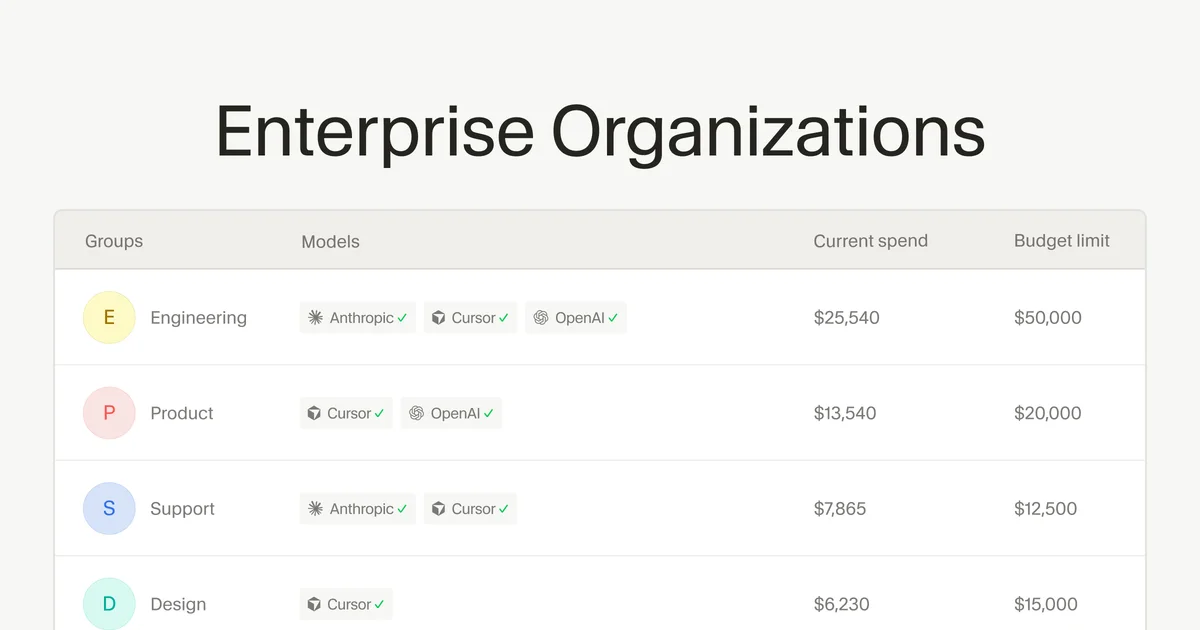
Diagram illustrating Cursor Enterprise Organizations, Teams, and Groups hierarchy.
Cursor's new 'Organizations' feature provides a hierarchical structure for managing multiple teams.· Cursor Blog
Visual TL;DR
Enterprise needs controlDriver
large enterprises need distinct controls for budgets, security, and feature access
From the article 2 mentionsThis prevents the need for duplicate accounts and allows for rapid iteration without compromising control.
Cursor Enterprise OrganizationsCore
From the article 2 mentionsTo address this, Cursor has launched Organizations for Cursor Enterprise, a new structural layer designed to manage multiple Cursor teams from a unified dashboard.
Centralized ManagementContext
consolidates identity, administration, and membership management at the top level
From the article 4 mentionsAn Organization serves as the top-level container, consolidating identity, administration, and membership management.
Decentralized OperationContext
teams nested within organizations, independently configured for specific needs
Improved ScalabilityOutcome
enables enterprises to scale their AI development and usage effectively
Granular ControlsEffect
set separate budgets, enable varied AI models, create sandboxed environments
From the article 6 mentionsThis granular control supports chargebacks and cost center accounting through detailed usage analytics aggregated at the organization level.
Company-wide AnalyticsEffect
monitor company-wide usage analytics for better oversight and optimization
From the article 3 mentionsThis feature, now generally available, allows administrators to set separate budgets, enable varied AI models for different user groups, create sandboxed environments for testing, and monitor company-wide usage analytics.
Contents(3)

Large enterprises, often a complex web of business units and subsidiaries, require distinct controls for budgets, security, and feature access. To address this, Cursor has launched Organizations for Cursor Enterprise, a new structural layer designed to manage multiple Cursor teams from a unified dashboard. This feature, now generally available, allows administrators to set separate budgets, enable varied AI models for different user groups, create sandboxed environments for testing, and monitor company-wide usage analytics.

Centralized Control, Decentralized Operation

An Organization serves as the top-level container, consolidating identity, administration, and membership management. Below this sit Teams, the former primary management unit, now nested within an Organization to allow for multiple, independently configured teams. Groups offer a lighter-weight way to manage user cohorts across or within teams, assigning specific model access, spend limits, or agent permissions without the overhead of creating a new team.

The most permissive setting dictates access when a user belongs to multiple teams or groups. For instance, engineering and product teams might have broader network access and automated agent command execution, while sales, marketing, and finance teams could face tighter security controls, particularly concerning agent access to production systems.

Enterprise Use Cases Emerge

Early adopters have highlighted key use cases. Sandboxing new features for security-sensitive teams is a significant pattern, enabling users to test updates in isolated environments before company-wide rollout. This prevents the need for duplicate accounts and allows for rapid iteration without compromising control.

Organizations also facilitate segmentation of model access, budgets, and agent permissions. Engineering, product, and design teams can access a wider array of advanced models with higher budgets, while other departments may have restricted access and tighter controls on agent actions. This granular control supports chargebacks and cost center accounting through detailed usage analytics aggregated at the organization level.

The platform also simplifies identity and membership management at scale. By configuring identity providers and SCIM directories at the organization level, administrators can ensure consistent synchronization of user groups across teams and leverage these cohorts for seamless onboarding and permission assignment.

Future Iterations

Cursor plans to enhance policy controls, simplify onboarding, and refine user subset management. The introduction of Organizations for Cursor Enterprise features marks a significant step in adapting the platform for complex organizational structures, building on its reputation as a leader in Cursor Enterprise features.

© 2026 StartupHub.ai. All rights reserved. You may not republish this article in full without a license. Search engines and AI research tools may crawl and summarize for reference. Bulk reproduction or model training requires a license. See our terms.
Daniel Singer

Written by

Daniel Singer

Editor, StartupHub.ai

Daniel Singer is the editor of StartupHub.ai, a technology expert and thought leader on AI and its applications across sectors, from fintech and healthcare to developer tooling and consumer software. He writes and tests the tools covered here thoroughly and regularly, and built StartupHub.ai to give founders, operators and buyers a clearer read on what they are actually being sold.