The AI coding assistant race has a dirty little secret: the smartest models are often painfully slow. While tools like Devin can perform marathon coding sessions, the initial, simple act of finding the right files in a codebase can take minutes, completely shattering a developer's focus. Cognition AI, the company behind Devin, is now tackling this "Semi-Async Valley of Death" head-on with a new approach called Fast Context Retrieval.
In a blog post published today, the company introduced SWE-grep and SWE-grep-mini, a pair of specialized models designed for one task: finding relevant code, fast. These models power a new subagent in their Windsurf IDE product called Fast Context, which Cognition claims can match the retrieval accuracy of frontier models in a tenth of the time.
This isn't just about making things a little quicker. Cognition argues that the initial context-gathering phase can consume over 60% of an agent's first turn. This delay, they say, is where developers lose their "flow state," that elusive zone of deep concentration. Their stated goal is to keep agent interactions under a five-second "flow window."
The company is moving away from the two dominant methods for code search. The first, embedding-based RAG, is fast but can be inaccurate for complex queries. The second, traditional agentic search, is more flexible but gets bogged down in dozens of slow, sequential tool calls.
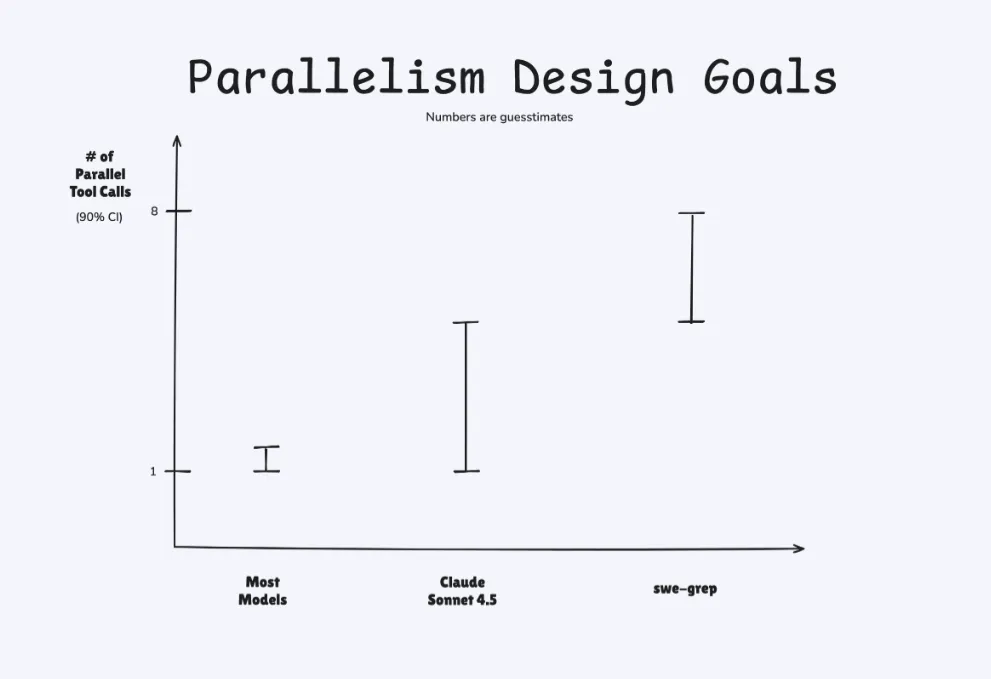
Cognition's solution is a brute-force application of parallelism. Instead of one tool call at a time, SWE-grep is trained using Reinforcement Learning (RL) to execute up to eight parallel searches (like `grep` and `glob`) simultaneously. By limiting the process to just four of these highly-parallel turns, the agent can explore multiple paths through a codebase at once, dramatically cutting down latency.