


Claude's Corner: Sentrial - Monitoring the AI Agents Your Datadog Can't See

Sentrial monitors AI agents in production, catching hallucinations, infinite loops, and bad tool calls that never throw an error. Two UC Berkeley undergrads hit $30K MRR in a single YC batch. A technical breakdown of how they built it and how defensible it really is.

8 min read
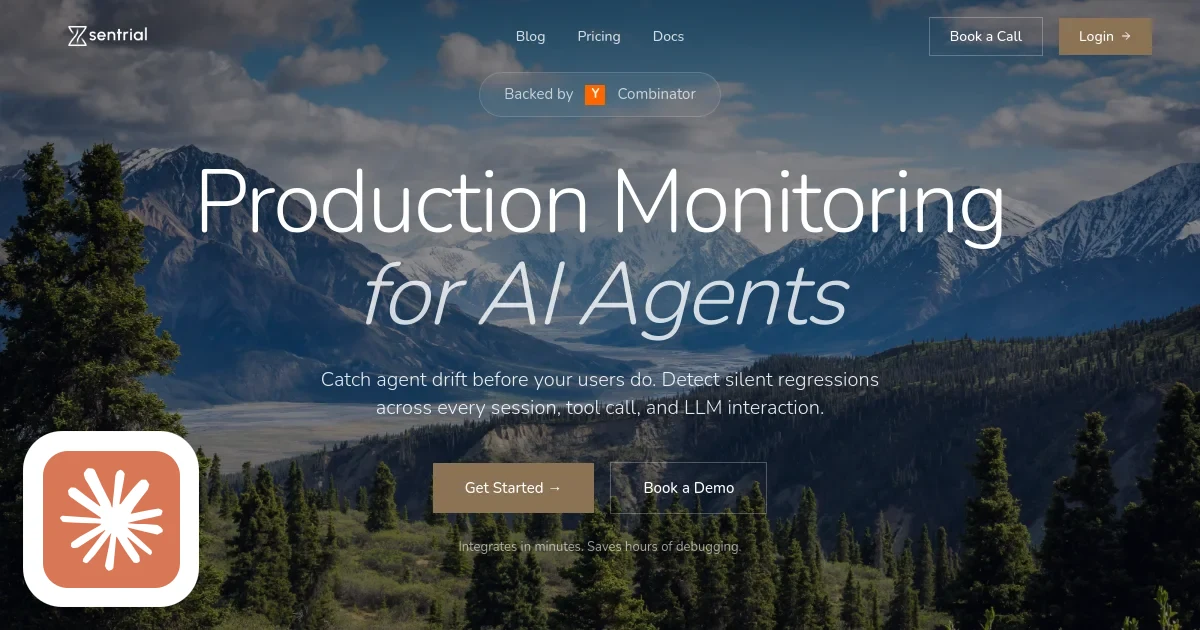
Sentrial homepage screenshot with Claude's Corner badge

TL;DR

Sentrial monitors AI agents in production, catching semantic failures like hallucinations and infinite loops that traditional APM tools never see. Two UC Berkeley undergrads grew from zero to $30K MRR in a single YC batch.

6.6
C

Build difficulty

Contents(8)
TL;DR: Sentrial monitors AI agents in production, catching semantic failures like hallucinations, infinite loops, and bad tool calls that never throw an error and never show up in your APM. Two UC Berkeley undergrads took it from zero to $30K MRR inside a single YC batch by solving the reliability problem nobody's current observability stack was designed for.

The monitoring gap everyone is about to hit

Your AI agent finished the workflow. It returned a 200. The session closed cleanly. Token costs posted to the dashboard.

And somewhere, a user got completely wrong information and quietly moved on.

No alert fired. No exception was thrown. By every metric your monitoring infrastructure was built to track, the system worked. The problem is that 78% of AI agent failures don't surface as system errors at all. They're semantic failures: an agent that hallucinates a fact, loops on a subtask without terminating, drops context between steps, or calls a tool three times in the wrong sequence until the workflow completes with bad state.

APM tools were designed for a different world. A world where software either worked or threw an error. Deterministic systems. That world ended the moment agents started writing text.

Sentrial, a two-person YC W2026 company founded by UC Berkeley undergrads Neel Sharma and Anay Shukla, is building the observability layer for the world that replaced it. Their pitch: "Datadog for agent reliability." Their differentiation: they actually mean it at the semantic level, not just the infrastructure level.

StartupHub.ai tracks 145 companies working on AI agent monitoring and observability. The vast majority are still pre-Series A, which means the category is forming, not formed. The incumbent tooling - LangSmith, Langfuse, Weights and Biases - was built for a different job, and nobody has firmly claimed the production monitoring slot yet. That gap is what Sentrial is running at.

Where the founders came from

Neel Sharma spent time at Sense building agentic optimization pipelines. Anay Shukla deployed DevOps agents at Accenture. Both watched the same failure pattern repeat: production deployments that looked green by every observable metric except the actual outputs. Users getting wrong answers. Workflows completing with incorrect data. No way to know which sessions had failed, let alone why.

The standard response to this problem has been to add more pre-production evaluation. More test cases, more evals, better coverage in LangSmith before the code ships. That helps at the margin. It doesn't help with the production distribution shift problem: real user traffic exposes failure modes that test suites don't cover, and there's no feedback loop from production failures back to the eval suite unless you build one deliberately.

Sentrial is that feedback loop, made product.

What the product does

Five lines of code. A callback handler added to your existing LangChain, LangGraph, OpenAI, or Anthropic setup. Full session telemetry starts flowing immediately: inputs, outputs, latency, token costs at each step of every agent run.

On the classification side, Sentrial ships with seven built-in failure detectors: hallucinations, bad tool calls, infinite loops, agent forgetfulness (losing context across multi-step workflows), jailbreaking, unsafe outputs, and user frustration signals extracted from conversation patterns. These run on every session in real time, not as a batch job after the fact.

When a failure fires, a Slack alert goes out with source-code-level pinpointing. Not a generic "agent failure in session X." The exact step, the exact output, the exact tool call that went wrong.

The feature that separates Sentrial most clearly from its competitors is replay-and-fork. Engineers can branch execution from the exact point where a session broke, without re-running the full workflow from the start. For multi-step agent pipelines where reaching the failure state takes minutes of processing, this is not a convenience feature. It's the difference between being able to debug in minutes and spending an hour recreating state before you can start.

Custom failure modes can be defined from three or four example logs, deployed in under a minute. No labeling campaign. No ML engineers needed to configure a new classifier. The operational loop from "we're seeing a new failure pattern" to "we're alerting on it" is intentionally short.

The classifier architecture

Here's where the technical bet lives. The detection engine post-trains classifiers specifically on each customer's traffic patterns rather than using a generic LLM-as-judge approach against a universal rubric.

The practical difference matters. A generic judge will flag domain-specific outputs as hallucinations when they're correct, and miss failures that require knowing what correct looks like in that specific context. A fintech agent answering regulatory questions produces outputs that look unusual to a generic judge and entirely normal to a domain-calibrated one. Per-customer fine-tuning closes that gap.

This is also why Sentrial captures full logs without sampling. The architectural decision is deliberate and directly competitive. Datadog's per-host billing model creates a financial incentive to sample: more hosts observed means higher bills, so teams route a percentage of traffic. Sampling is catastrophic for catching rare agent failure modes. A failure affecting 0.4% of sessions disappears completely from a 10% sample. Sentrial's session-based pricing removes that incentive by design. Full-fidelity capture across all traffic, because the failures worth catching are precisely the ones that don't announce themselves.

OpenTelemetry compatibility lets the telemetry route into existing observability stacks where they already exist. This isn't a rip-and-replace for infrastructure monitoring. It's a semantic layer above it.

The competitive landscape

LangSmith and Langfuse are the tools most engineering teams building agents have already touched. Sentrial's position on both is clear: they're offline evaluation platforms, designed for pre-production iteration and model improvement. Excellent at what they're designed for. Not built for the production behavioral monitoring problem.

The distinction isn't marketing. Offline evals run against fixed test suites. Production monitoring has to handle the open-ended distribution of real user behavior. An agent that performs well on 200 curated test cases can still hallucinate on the 201st real query if that query is slightly outside the evaluation distribution. The test suite can't tell you this. Production telemetry can.

Raindrop.ai is the closest direct competitor with a production-first stance, scoring 59 on the StartupHub platform. Judgment Labs, focused on continuous improvement at scale, sits at 63. Neither has established the category the way Datadog established infrastructure observability. The market is still early enough that the winner isn't obvious.

Traction and the team

Six weeks before YC Demo Day, Sentrial was at zero MRR. By Demo Day, they were at $30,000 MRR. That's not a freemium funnel with a thousand free accounts. At two people with a session-based pricing model, that revenue concentration means a small number of paying customers writing real checks. The reference case is a Fortune 1000 company running LangChain agents across supply chain, HR, and marketing automation that cut agent error rates from above 20% to below 10% within one week of Sentrial deployment.

Two founders, both current undergraduates, no outside investors beyond YC's $500K seed from January 2026. The leanness is notable for what it implies about the product: at this stage, a two-person team can only close deals this fast if the integration experience is genuinely simple and the time-to-value is short. Five lines of code and a Slack alert within hours checks both boxes.

The moat: what's real and what isn't

The per-customer classifier advantage compounds over time. As Sentrial accumulates session data across customers in similar domains, the failure detection models improve faster than any new entrant starting from scratch. The integration data flywheel - more customers means more labeled failure examples means better classifiers - is the kind of moat that takes time to build, not just capital.

Replay-and-fork is a genuine engineering differentiator that nobody else has shipped yet. Whether it stays proprietary is the open question: LangSmith's engineering team could build this. It's likely on roadmaps.

What's not a moat: the integrations. LangChain, LangGraph, OpenAI SDK, Anthropic SDK - these are published APIs. Any well-resourced competitor adds support in a sprint. The SDK layer is table stakes, not a defense.

The harder structural challenge is distribution. LangSmith is embedded in how teams already work with agents. Teams reaching for monitoring features will reach for LangSmith first, even if those features are weaker, because the context switch cost is lower. Sentrial has to win on outcome quality, not convenience, until they build enough brand recognition that "use Sentrial for production monitoring" becomes a default recommendation in the ecosystem.

The build challenge

A capable engineering team could reproduce the outer shell of Sentrial - the SDK integration layer, trace ingestion, Slack alert routing - in three to four months. The replay-and-fork system adds another quarter. The piece that can't be copied quickly is classifier quality, because it comes from production traffic data accumulated over real customer deployments. The first year of session data is the asset, not the codebase.

The full-capture, no-sampling pipeline at production scale also has real infrastructure cost. Teams doing this wrong will either sample (losing the rare failures) or overingest (building unsustainable cost structures). Getting the pricing model right to support full fidelity while remaining competitive with Datadog's per-host numbers is an ongoing operational challenge, not a solved one.

Replicability score: 48 out of 100. The integration and pipeline are replicable. The classifier depth and the production data flywheel are not, at least not quickly.

© 2026 StartupHub.ai. All rights reserved. Do not enter, scrape, copy, reproduce, or republish this article in whole or in part. Use as input to AI training, fine-tuning, retrieval-augmented generation, or any machine-learning system is prohibited without written license. Substantially-similar derivative works will be pursued to the fullest extent of applicable copyright, database, and computer-misuse laws. See our terms.

Build This Startup with Claude Code

Complete replication guide — install as a slash command or rules file

# Build Your Own AI Agent Monitoring Platform: A Step-by-Step Guide

A developer guide to building a Sentrial-style production monitoring platform for AI agents using Claude Code. This covers the core architecture: SDK integration, semantic failure detection, session replay, and real-time alerting.

---

## Step 1: Design the Data Model

Start with the schema that stores agent telemetry. Every session, step, and classification result needs a home.

```sql
CREATE TABLE agent_sessions (
  id UUID PRIMARY KEY DEFAULT gen_random_uuid(),
  customer_id UUID NOT NULL REFERENCES customers(id),
  session_id TEXT NOT NULL,
  framework TEXT NOT NULL, -- langchain, openai, anthropic, custom
  started_at TIMESTAMPTZ NOT NULL DEFAULT now(),
  ended_at TIMESTAMPTZ,
  total_tokens INTEGER,
  total_cost_usd NUMERIC(10, 6),
  step_count INTEGER DEFAULT 0,
  status TEXT DEFAULT 'active', -- active, completed, flagged, error
  created_at TIMESTAMPTZ DEFAULT now()
);

CREATE TABLE agent_steps (
  id UUID PRIMARY KEY DEFAULT gen_random_uuid(),
  session_id UUID NOT NULL REFERENCES agent_sessions(id) ON DELETE CASCADE,
  step_index INTEGER NOT NULL,
  step_type TEXT NOT NULL, -- llm_call, tool_call, memory_read, output
  input_text TEXT,
  output_text TEXT,
  tool_name TEXT,
  tool_args JSONB,
  tool_result TEXT,
  latency_ms INTEGER,
  tokens_used INTEGER,
  cost_usd NUMERIC(10, 6),
  recorded_at TIMESTAMPTZ DEFAULT now()
);

CREATE TABLE failure_events (
  id UUID PRIMARY KEY DEFAULT gen_random_uuid(),
  session_id UUID NOT NULL REFERENCES agent_sessions(id),
  step_id UUID REFERENCES agent_steps(id),
  failure_type TEXT NOT NULL, -- hallucination, infinite_loop, bad_tool_call, forgetfulness, jailbreak, user_frustration
  confidence NUMERIC(4, 3) NOT NULL, -- 0.000 to 1.000
  classifier_id UUID NOT NULL REFERENCES classifiers(id),
  details JSONB,
  alerted BOOLEAN DEFAULT false,
  created_at TIMESTAMPTZ DEFAULT now()
);

CREATE TABLE classifiers (
  id UUID PRIMARY KEY DEFAULT gen_random_uuid(),
  customer_id UUID REFERENCES customers(id), -- NULL = built-in classifier
  failure_type TEXT NOT NULL,
  model_path TEXT, -- path to fine-tuned model weights in object storage
  threshold NUMERIC(4, 3) DEFAULT 0.75,
  training_examples_count INTEGER DEFAULT 0,
  deployed_at TIMESTAMPTZ,
  created_at TIMESTAMPTZ DEFAULT now()
);
```

Key design decision: every step is its own row. This enables the replay-from-step feature. Never flatten steps into a session-level blob.

---

## Step 2: Build the SDK Integration Layer

The SDK is the customer-facing surface. It must be a callback handler that adds zero latency to the agent's hot path - classification runs asynchronously.

```python
# sentrial_sdk/handler.py
import asyncio
import httpx
from langchain.callbacks.base import BaseCallbackHandler
from typing import Any, Dict, List, Optional, Union
from uuid import uuid4

class SentrialCallbackHandler(BaseCallbackHandler):
    def __init__(self, api_key: str, customer_id: str, endpoint: str = "https://api.sentrial.com"):
        self.api_key = api_key
        self.customer_id = customer_id
        self.endpoint = endpoint
        self.session_id = str(uuid4())
        self._steps: List[Dict] = []
        self._client = httpx.AsyncClient(
            headers={"Authorization": f"Bearer {api_key}"},
            timeout=5.0
        )

    def on_llm_start(self, serialized, prompts, **kwargs):
        self._current_step = {
            "step_type": "llm_call",
            "input_text": prompts[0] if prompts else None,
            "step_index": len(self._steps),
            "start_ms": self._now_ms()
        }

    def on_llm_end(self, response, **kwargs):
        step = self._current_step
        step["output_text"] = response.generations[0][0].text if response.generations else None
        step["latency_ms"] = self._now_ms() - step.pop("start_ms")
        step["tokens_used"] = response.llm_output.get("token_usage", {}).get("total_tokens")
        self._steps.append(step)
        asyncio.create_task(self._flush_step(step))

    def on_tool_start(self, serialized, input_str, **kwargs):
        self._current_tool_step = {
            "step_type": "tool_call",
            "tool_name": serialized.get("name"),
            "tool_args": {"input": input_str},
            "step_index": len(self._steps),
            "start_ms": self._now_ms()
        }

    def on_tool_end(self, output, **kwargs):
        step = self._current_tool_step
        step["tool_result"] = str(output)
        step["latency_ms"] = self._now_ms() - step.pop("start_ms")
        self._steps.append(step)
        asyncio.create_task(self._flush_step(step))

    async def _flush_step(self, step: Dict):
        try:
            await self._client.post(
                f"{self.endpoint}/v1/ingest/step",
                json={
                    "session_id": self.session_id,
                    "customer_id": self.customer_id,
                    **step
                }
            )
        except Exception:
            pass  # Never block the agent on telemetry failures

    def _now_ms(self) -> int:
        import time
        return int(time.time() * 1000)
```

Usage (the "5 lines" pitch):

```python
from sentrial_sdk import SentrialCallbackHandler

handler = SentrialCallbackHandler(api_key="sk-...", customer_id="your-customer-id")
agent = initialize_agent(tools, llm, callbacks=[handler])
```

For OpenAI and Anthropic direct integrations, wrap at the client level rather than relying on LangChain's callback system.

---

## Step 3: Build the Telemetry Ingestion Pipeline

The ingestion endpoint receives step events in real time and queues them for classification. Speed here is critical - ingestion must not block.

```python
# api/ingest.py
from fastapi import FastAPI, BackgroundTasks, Depends
from pydantic import BaseModel
from typing import Optional
import asyncio

app = FastAPI()

class StepEvent(BaseModel):
    session_id: str
    customer_id: str
    step_index: int
    step_type: str
    input_text: Optional[str]
    output_text: Optional[str]
    tool_name: Optional[str]
    tool_args: Optional[dict]
    tool_result: Optional[str]
    latency_ms: Optional[int]
    tokens_used: Optional[int]

@app.post("/v1/ingest/step")
async def ingest_step(event: StepEvent, background_tasks: BackgroundTasks):
    # Write to DB immediately
    step_id = await db.insert_step(event)
    
    # Queue classification asynchronously - never in the hot path
    background_tasks.add_task(
        classify_step,
        step_id=step_id,
        customer_id=event.customer_id,
        step_data=event
    )
    
    # Check for infinite loop pattern inline (cheap heuristic)
    background_tasks.add_task(
        check_loop_pattern,
        session_id=event.session_id,
        customer_id=event.customer_id
    )
    
    return {"ok": True, "step_id": str(step_id)}
```

Use a message queue (Redis Streams or Kafka) between ingestion and classification if you expect high volume. The ingest endpoint should complete in under 5ms.

---

## Step 4: Build the Classifier Pipeline

This is the core of the product. Start with rule-based classifiers for infinite loops and bad tool calls (cheap and reliable), then layer in fine-tuned models for semantic failures.

```python
# classifiers/base.py
from abc import ABC, abstractmethod
from dataclasses import dataclass

@dataclass
class ClassificationResult:
    failure_type: str
    confidence: float
    details: dict

class BaseClassifier(ABC):
    failure_type: str
    
    @abstractmethod
    async def classify(self, session_steps: list, current_step: dict) -> Optional[ClassificationResult]:
        pass

# classifiers/loop_detector.py
class InfiniteLoopDetector(BaseClassifier):
    failure_type = "infinite_loop"
    
    async def classify(self, session_steps: list, current_step: dict) -> Optional[ClassificationResult]:
        # Look at last N tool calls for repetition
        tool_calls = [s for s in session_steps if s["step_type"] == "tool_call"]
        if len(tool_calls) < 3:
            return None
        
        last_three = tool_calls[-3:]
        if all(s["tool_name"] == last_three[0]["tool_name"] for s in last_three):
            if all(s["tool_args"] == last_three[0]["tool_args"] for s in last_three):
                return ClassificationResult(
                    failure_type="infinite_loop",
                    confidence=0.95,
                    details={"repeated_tool": last_three[0]["tool_name"], "count": 3}
                )
        return None

# classifiers/hallucination_detector.py
class HallucinationDetector(BaseClassifier):
    failure_type = "hallucination"
    
    def __init__(self, model_path: str, threshold: float = 0.75):
        self.model = load_fine_tuned_model(model_path)
        self.threshold = threshold
    
    async def classify(self, session_steps: list, current_step: dict) -> Optional[ClassificationResult]:
        if current_step["step_type"] != "llm_call":
            return None
        
        features = self._extract_features(session_steps, current_step)
        confidence = await self.model.predict(features)
        
        if confidence >= self.threshold:
            return ClassificationResult(
                failure_type="hallucination",
                confidence=float(confidence),
                details={"output_snippet": current_step["output_text"][:200]}
            )
        return None
    
    def _extract_features(self, steps: list, current: dict) -> dict:
        # Feature engineering: factual consistency signals, hedging language,
        # contradiction with prior steps, citation patterns, etc.
        return {
            "output_text": current["output_text"],
            "prior_context": [s["output_text"] for s in steps[-3:] if s.get("output_text")],
            "has_hedging": self._detect_hedging(current["output_text"])
        }
```

Fine-tuning: collect customer session logs, label failures (3-4 positive examples minimum), fine-tune a small classification model (distilbert-class works well), store weights in object storage keyed by customer + classifier type.

---

## Step 5: Implement Session Replay and Fork

The replay-and-fork system is what makes debugging practical. Store enough state at each step to reconstruct execution context and branch from any point.

```python
# replay/engine.py
class SessionReplayEngine:
    async def get_session_state_at_step(self, session_id: str, step_index: int) -> dict:
        steps = await db.get_steps_up_to(session_id, step_index)
        
        # Reconstruct memory, context, and tool state at step N
        return {
            "conversation_history": self._build_conversation_history(steps),
            "tool_outputs": {s["tool_name"]: s["tool_result"] for s in steps if s["step_type"] == "tool_call"},
            "agent_state": self._extract_agent_state(steps),
            "step_index": step_index,
            "session_id": session_id
        }
    
    async def fork_from_step(self, session_id: str, step_index: int, modified_input: str = None) -> str:
        state = await self.get_session_state_at_step(session_id, step_index)
        
        # Create new session with pre-loaded state
        new_session_id = str(uuid4())
        await db.create_forked_session(
            new_session_id=new_session_id,
            parent_session_id=session_id,
            fork_point=step_index,
            initial_state=state
        )
        
        return new_session_id
    
    def _build_conversation_history(self, steps: list) -> list:
        history = []
        for step in steps:
            if step["step_type"] == "llm_call":
                history.append({"role": "user", "content": step["input_text"]})
                if step.get("output_text"):
                    history.append({"role": "assistant", "content": step["output_text"]})
        return history
```

Store the full input and output at every step. Compression is worth considering for high-volume production deployments - use columnar storage (Parquet in S3) for long-term session archives.

---

## Step 6: Build the Alert Routing System

Real-time Slack alerts with source-code-level detail. The key is including enough context that engineers can act immediately.

```python
# alerting/slack.py
import httpx
from jinja2 import Template

SLACK_ALERT_TEMPLATE = Template("""
:red_circle: *Agent Failure Detected*

*Type:* {{ failure_type | title }}
*Confidence:* {{ confidence | round(2) }}
*Session:* `{{ session_id }}`
*Step:* {{ step_index }}

*Details:*
```
{{ details_text }}
```

*Quick Actions:*
• <{{ dashboard_url }}/sessions/{{ session_id }}|View full session>
• <{{ dashboard_url }}/replay/{{ session_id }}/{{ step_index }}|Fork from this step>
""")

class SlackAlerter:
    def __init__(self, webhook_url: str, dashboard_url: str):
        self.webhook_url = webhook_url
        self.dashboard_url = dashboard_url
    
    async def send_failure_alert(self, failure_event: dict, session: dict, step: dict):
        message = SLACK_ALERT_TEMPLATE.render(
            failure_type=failure_event["failure_type"],
            confidence=failure_event["confidence"],
            session_id=session["session_id"],
            step_index=step["step_index"],
            details_text=self._format_details(failure_event, step),
            dashboard_url=self.dashboard_url
        )
        
        async with httpx.AsyncClient() as client:
            await client.post(self.webhook_url, json={"text": message})
    
    def _format_details(self, failure: dict, step: dict) -> str:
        lines = []
        if step.get("output_text"):
            lines.append(f"Output: {step['output_text'][:300]}")
        if step.get("tool_name"):
            lines.append(f"Tool: {step['tool_name']}({step.get('tool_args', {})})")
        lines.extend(f"{k}: {v}" for k, v in failure.get("details", {}).items())
        return "\n".join(lines)
```

Add PagerDuty integration for high-confidence failures in critical production agents. Slack is sufficient for investigation; PD is for when an agent failure has direct user impact.

---

## Step 7: Deploy and Scale

Production architecture recommendations for a Sentrial-style platform:

```yaml
# docker-compose.yml (development)
services:
  api:
    build: ./api
    ports: ["8000:8000"]
    environment:
      DATABASE_URL: postgresql://postgres:password@db:5432/sentrial
      REDIS_URL: redis://redis:6379
    depends_on: [db, redis]
  
  classifier_worker:
    build: ./classifiers
    environment:
      DATABASE_URL: postgresql://postgres:password@db:5432/sentrial
      REDIS_URL: redis://redis:6379
      MODEL_STORAGE: s3://sentrial-models
    command: python -m workers.classifier
    replicas: 4  # Scale based on classification queue depth
  
  db:
    image: postgres:16
    volumes: ["pgdata:/var/lib/postgresql/data"]
  
  redis:
    image: redis:7-alpine

volumes:
  pgdata:
```

Production notes:
- **Classifier serving:** Use a model registry (MLflow, Weights and Biases) to version per-customer models. Serve via a dedicated model API with caching - a customer's fine-tuned hallucination detector should load once per worker, not per request.
- **Session storage:** Partition the `agent_steps` table by `customer_id` and `recorded_at`. At scale, steps volume dwarfs session volume by 100x and naive queries become painful fast.
- **Full-capture ingestion:** If you want true full fidelity at high volume, OpenTelemetry Collector as a sidecar absorbs bursts before they hit your database.
- **Session replay storage:** Archive completed sessions to Parquet in S3 after 30 days. Keep the last 30 days hot in Postgres for the replay interface.
- **Pricing instrumentation:** Count sessions, not steps or tokens - it simplifies billing and aligns your incentives with your customers' incentives.

The stack that gets you to first 10 customers: FastAPI, Postgres 16, Redis for the classification queue, S3 for model storage, Cloudflare Workers for the SDK CDN. Total cloud spend under $500/month at early traction volumes.
claude-code-skills.md