
Bala Ramdoss on Generative UI for Agentic CX

Bala Ramdoss of Amazon discusses generative UI, the critical layer between LLM output and product experience, emphasizing rendering contracts, streaming, and BFF patterns for agentic CX.

9 min read
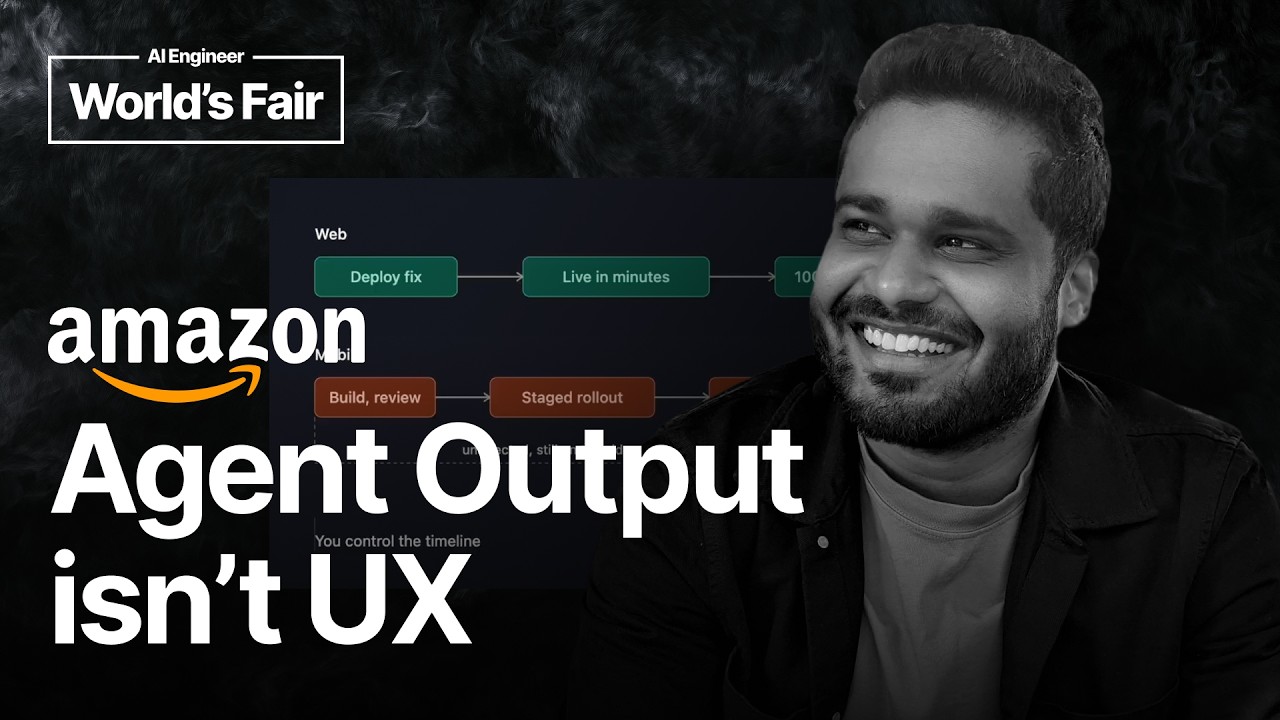
Slide titled 'Agent Output Is Not UX' with speaker photo of Bala Ramdoss.
Bala Ramdoss discusses the importance of the generative UI rendering layer in AI product development.· AI Engineer

Visual TL;DR. Agent Output Not UX drives need for Generative UI Frontier. Generative UI Frontier requires Rendering Layer. Rendering Layer leverages UI-Shaping APIs. Rendering Layer utilizes BFF & Context. UI-Shaping APIs enables Effective Agentic CX. BFF & Context contributes to Effective Agentic CX. Rendering Layer achieves Effective Agentic CX. Mobile Complexity complicates Rendering Layer. Rendering Layer is a Product Decision.

  1. Agent Output Not UX: LLM output alone often fails to deliver seamless, usable product experiences
  2. Generative UI Frontier: critical layer translating AI output into a responsive and natural user interface
  3. Rendering Layer: emphasizes rendering contracts, streaming, and BFF patterns for agentic CX
  4. UI-Shaping APIs: move beyond data APIs to directly influence the structure and flow of the UI
  5. BFF & Context: Backend-for-Frontend (BFF) crucial for managing context and orchestrating UI elements
  6. Effective Agentic CX: delivering impressive AI features that perform well and feel natural in production
  7. Mobile Complexity: adds challenges with varying screen sizes, input methods, and performance constraints
  8. Product Decision: the rendering layer is a strategic choice impacting user experience and development
Visual TL;DR
Visual TL;DR, startuphub.ai Agent Output Not UX drives need for Generative UI Frontier. Generative UI Frontier requires Rendering Layer. Rendering Layer achieves Effective Agentic CX drives need for requires achieves Agent Output Not UX Generative UI Frontier Rendering Layer Effective Agentic CX From startuphub.ai · The publishers behind this format
Visual TL;DR, startuphub.ai Agent Output Not UX drives need for Generative UI Frontier. Generative UI Frontier requires Rendering Layer. Rendering Layer achieves Effective Agentic CX drives need for requires achieves Agent Output NotUX Generative UIFrontier Rendering Layer Effective AgenticCX From startuphub.ai · The publishers behind this format
Visual TL;DR, startuphub.ai Agent Output Not UX drives need for Generative UI Frontier. Generative UI Frontier requires Rendering Layer. Rendering Layer achieves Effective Agentic CX drives need for requires achieves Agent Output Not UX LLM output alone often fails to deliverseamless, usable product experiences Generative UI Frontier critical layer translating AI output intoa responsive and natural user interface Rendering Layer emphasizes rendering contracts, streaming,and BFF patterns for agentic CX Effective Agentic CX delivering impressive AI features thatperform well and feel natural inproduction From startuphub.ai · The publishers behind this format
Visual TL;DR, startuphub.ai Agent Output Not UX drives need for Generative UI Frontier. Generative UI Frontier requires Rendering Layer. Rendering Layer achieves Effective Agentic CX drives need for requires achieves Agent Output NotUX LLM output aloneoften fails todeliver seamless,… Generative UIFrontier critical layertranslating AIoutput into a… Rendering Layer emphasizesrenderingcontracts,… Effective AgenticCX deliveringimpressive AIfeatures that… From startuphub.ai · The publishers behind this format
Visual TL;DR, startuphub.ai Agent Output Not UX drives need for Generative UI Frontier. Generative UI Frontier requires Rendering Layer. Rendering Layer leverages UI-Shaping APIs. Rendering Layer utilizes BFF & Context. UI-Shaping APIs enables Effective Agentic CX. BFF & Context contributes to Effective Agentic CX. Rendering Layer achieves Effective Agentic CX. Mobile Complexity complicates Rendering Layer. Rendering Layer is a Product Decision drives need for requires leverages utilizes enables contributes to achieves complicates is a Agent Output Not UX LLM output alone often fails to deliverseamless, usable product experiences Generative UI Frontier critical layer translating AI output intoa responsive and natural user interface Rendering Layer emphasizes rendering contracts, streaming,and BFF patterns for agentic CX UI-Shaping APIs move beyond data APIs to directlyinfluence the structure and flow of the UI BFF & Context Backend-for-Frontend (BFF) crucial formanaging context and orchestrating UIelements Effective Agentic CX delivering impressive AI features thatperform well and feel natural inproduction Mobile Complexity adds challenges with varying screen sizes,input methods, and performance constraints Product Decision the rendering layer is a strategic choiceimpacting user experience and development From startuphub.ai · The publishers behind this format
Visual TL;DR, startuphub.ai Agent Output Not UX drives need for Generative UI Frontier. Generative UI Frontier requires Rendering Layer. Rendering Layer leverages UI-Shaping APIs. Rendering Layer utilizes BFF & Context. UI-Shaping APIs enables Effective Agentic CX. BFF & Context contributes to Effective Agentic CX. Rendering Layer achieves Effective Agentic CX. Mobile Complexity complicates Rendering Layer. Rendering Layer is a Product Decision drives need for requires leverages utilizes enables contributes to achieves complicates is a Agent Output NotUX LLM output aloneoften fails todeliver seamless,… Generative UIFrontier critical layertranslating AIoutput into a… Rendering Layer emphasizesrenderingcontracts,… UI-Shaping APIs move beyond dataAPIs to directlyinfluence the… BFF & Context Backend-for-Frontend(BFF) crucial formanaging context… Effective AgenticCX deliveringimpressive AIfeatures that… Mobile Complexity adds challengeswith varying screensizes, input… Product Decision the rendering layeris a strategicchoice impacting… From startuphub.ai · The publishers behind this format

In the rapidly evolving world of AI-powered features, getting a model to produce the correct output is only half the battle. The other, often more challenging, half is translating that output into a seamless and usable product experience for the end-user. Bala Ramdoss, a Tech Lead at Amazon known for his work on AI features like Amazon Lens, recently shared insights on this crucial aspect in a talk titled "Agent Output Is Not UX: Rendering Layer Your LLM Pipeline Is Missing." He highlighted the common pitfalls teams encounter when building agentic customer experiences (CX) and offered solutions rooted in practical engineering principles.


Bala Ramdoss on Generative UI for Agentic CX - AI Engineer
Bala Ramdoss on Generative UI for Agentic CX — from AI Engineer

The Generative UI Frontier

Ramdoss began by identifying a recurring challenge in the industry: impressive AI feature demos that falter in production due to poor user experience. He pointed to issues like broken latency, the interface's inability to handle unexpected model output types, and the general difficulty in making AI feel natural and responsive. These, he emphasized, are not model-centric problems but rather engineering challenges residing in what is now being termed generative UI.

Generative UI, in this context, refers to the layer responsible for rendering the output of large language models (LLMs) into a user-friendly interface. It's the bridge between raw model data and a tangible user interaction.

Key Patterns for Effective Generative UI

Ramdoss outlined three core patterns that are essential for building robust and user-centric generative AI features:

  • The Rendering Contract: This involves establishing a typed, versioned agreement between the model's output and the UI components. A key aspect is a deliberate fallback mechanism for unknown content types. This ensures that if a model generates something new, the UI can degrade gracefully instead of breaking entirely, especially critical for client-side applications that cannot be easily hot-fixed.
  • Streaming into Structured UI: Instead of waiting for a complete response, models can progressively render their output into typed components. This allows the interface to assemble and display information as it arrives, improving perceived performance and user engagement. Examples include assembling product cards or follow-up prompts incrementally.
  • BFF Patterns for AI Features: Implementing a Backend-for-Frontend (BFF) layer is crucial for absorbing the inherent unpredictability of models. This layer can manage conversational context across turns, abstracting model complexities away from the client and ensuring a more consistent user experience.

Mobile Adds Complexity

The presentation also touched upon the unique challenges of implementing these patterns in mobile applications. Unlike web deployments where fixes can be pushed live within minutes, mobile updates involve a longer cycle of building, review, and staged rollouts, often spanning days or weeks. This difference in deployment speed means that any issues in the AI rendering layer can have a prolonged impact on a significant user base. Ramdoss illustrated this by contrasting the immediate deployment of web fixes with the phased approach for mobile, where users control their own timeline of receiving updates. This highlights the importance of getting the client-side rendering right from the start.

The Rendering Layer as a Product Decision

Ramdoss stressed that latency is not just a technical metric but a product decision. When beating latency is not feasible, designing around it becomes paramount. This involves providing users with visual cues and clear feedback about what the AI is doing, such as loading indicators or partial renderings, to manage expectations and maintain engagement. The goal is to ensure that users feel informed and in control, even when the underlying processes take time.

From Data APIs to UI-Shaping APIs

The talk also categorized approaches to generative UI into three spectrums:

  • Controlled: The model picks a pre-built component (e.g., a product card).
  • Declarative: The model composes UI from a catalog of components, such as with A2UI (Action to UI), which is an open standard developed by Google for streaming UI components.
  • Open-ended: The model generates novel UI on the fly, as seen with MCP Apps.

Traditional data APIs return data that the client then renders. In contrast, UI-shaping APIs enable the model to dictate not just the data but also how it should be presented, offering greater control and a more integrated user experience.

The Role of BFF and Context

Ramdoss elaborated on how the BFF layer can be instrumental in this process. By handling tasks like formatting, context management, hydration, and actions, the BFF can effectively shield the client from the complexities of model interactions. This allows the client to remain simpler, or 'dumb,' making development and maintenance more manageable. The BFF can also manage platform-specific CX, ensuring that the user experience is optimized for different devices and operating systems. Crucially, the BFF can maintain conversational context across turns, providing a more coherent and natural interaction for the user.

Ultimately, Ramdoss's presentation underscored that the success of AI-powered features hinges not only on the intelligence of the models but also on the engineering discipline applied to the rendering layer. By focusing on generative UI, streaming, and robust BFF patterns, teams can bridge the gap between model output and exceptional user experiences, even at massive scale.

© 2026 StartupHub.ai. All rights reserved. Do not enter, scrape, copy, reproduce, or republish this article in whole or in part. Use as input to AI training, fine-tuning, retrieval-augmented generation, or any machine-learning system is prohibited without written license. Substantially-similar derivative works will be pursued to the fullest extent of applicable copyright, database, and computer-misuse laws. See our terms.