


Apple unveils M6 chip 2nm, M5 Ultra pushes AI compute

5 min read
Apple unveils M6 chip 2nm, M5 Ultra pushes AI compute
Apple Newsroom
Visual TL;DR
Apple unveils M6 chipCore
From the article 4 mentionsApple today announced its next-generation silicon, the M6 chip, marking a significant advancement with its first 2-nanometer process technology.
Pressure on competitorsOutcome
Google (74/100) and Samsung (37/100) face increased competition
From the articleThis latest announcement places further pressure on competitors like Google (NASDAQ:GOOGL), which has a StartupHub score of 74/100, and Samsung Electronics (NASDAQ:SSNLF) (score 37/100) in the high-performance, AI-focused chip market.
M5 Ultra unveiledCore
most powerful chip to date, quad-die architecture for extreme desktop performance
From the article 3 mentionsAlongside the M6, Apple also unveiled the M5 Ultra in the new Mac Studio.
Targets AI workloadsEffect
M5 Ultra offers massive unified memory bandwidth, specifically for professional AI tasks
From the article 2 mentionsThis chip represents Apple's most powerful to date, utilizing a quad-die architecture for extreme desktop-class performance and massive unified memory bandwidth, targeting professional and AI workloads.
Apple unveils M6 chipCore
From the article 4 mentionsApple today announced its next-generation silicon, the M6 chip, marking a significant advancement with its first 2-nanometer process technology.
M6: 2nm ArchitectureContext
features 12-core CPU, 12-core GPU, Dual 16-core Neural Engine for efficiency
From the article 5 mentionsThe M6 chip's 2nm architecture is engineered for enhanced transistor density, leading to improved performance per watt.
M5 Ultra unveiledCore
most powerful chip to date, quad-die architecture for extreme desktop performance
From the article 3 mentionsAlongside the M6, Apple also unveiled the M5 Ultra in the new Mac Studio.
Targets AI workloadsEffect
M5 Ultra offers massive unified memory bandwidth, specifically for professional AI tasks
From the article 2 mentionsThis chip represents Apple's most powerful to date, utilizing a quad-die architecture for extreme desktop-class performance and massive unified memory bandwidth, targeting professional and AI workloads.
Apple's strong innovationOutcome
From the articleStartupHub.ai data shows Apple with a strong score of 83/100, reflecting its consistent innovation in custom silicon.
Pressure on competitorsOutcome
Google (74/100) and Samsung (37/100) face increased competition
From the articleThis latest announcement places further pressure on competitors like Google (NASDAQ:GOOGL), which has a StartupHub score of 74/100, and Samsung Electronics (NASDAQ:SSNLF) (score 37/100) in the high-performance, AI-focused chip market.

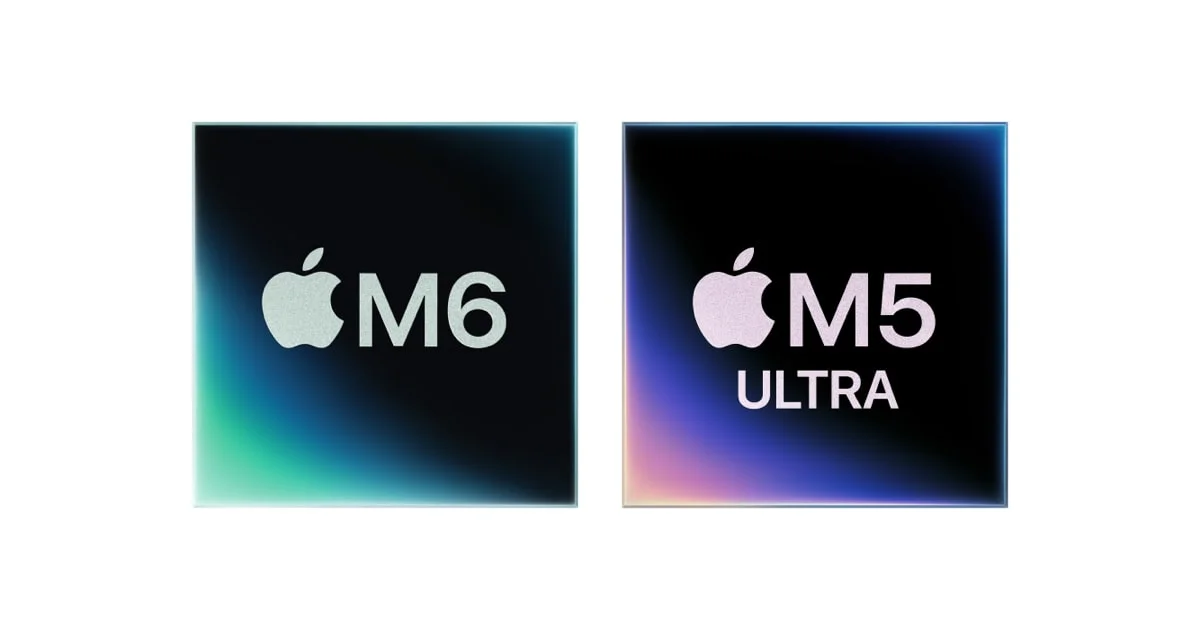
Apple today announced its next-generation silicon, the M6 chip, marking a significant advancement with its first 2-nanometer process technology. The M6, debuting in the new Mac mini, features a 12-core CPU, 12-core GPU, and a Dual 16-core Neural Engine, promising substantial gains in everyday performance and power efficiency. Alongside the M6, Apple also unveiled the M5 Ultra in the new Mac Studio. This chip represents Apple's most powerful to date, utilizing a quad-die architecture for extreme desktop-class performance and massive unified memory bandwidth, targeting professional and AI workloads.

StartupHub.ai data shows Apple with a strong score of 83/100, reflecting its consistent innovation in custom silicon. This latest announcement places further pressure on competitors like Google (NASDAQ:GOOGL), which has a StartupHub score of 74/100, and Samsung Electronics (NASDAQ:SSNLF) (score 37/100) in the high-performance, AI-focused chip market.

The M6 chip's 2nm architecture is engineered for enhanced transistor density, leading to improved performance per watt. Its 12-core CPU, featuring 2 super cores, 4 performance cores, and 6 efficiency cores, aims to deliver the world's fastest single-threaded performance. The integrated 12-core GPU includes Neural Accelerators, boosting AI compute by nearly 30 percent over the M5 generation.

For demanding professional tasks, the M5 Ultra stands out with its quad-die architecture, achieved through Apple's UltraFusion technology connecting two M5 Max chips. This design enables an up-to-36-core CPU and an up-to-80-core GPU, coupled with a massive 1.2TB/s of unified memory bandwidth. This configuration is designed to handle complex 3D rendering, visual effects, and large-scale AI model training and inference directly on device.

Apple's continued investment in custom silicon, particularly in advanced process nodes like 2nm for the Apple M6 chip 2nm, underscores its strategy to maintain a performance lead. The M5 Ultra's quad-die approach, while complex, positions Apple to compete directly with high-end discrete GPUs from companies like NVIDIA (NASDAQ:NVDA) for AI-centric workloads, leveraging its unified memory architecture for efficiency and speed.

The enhanced Neural Engines and Neural Accelerators across both chips signal a strong push towards on-device AI capabilities, aligning with broader industry trends. Developers utilizing Apple's frameworks like Core ML and Metal will gain access to significantly increased compute power for AI model execution and fine-tuning, potentially accelerating the adoption of sophisticated AI applications across the Mac ecosystem.

© 2026 StartupHub.ai. All rights reserved. Do not enter, scrape, copy, reproduce, or republish this article in whole or in part. Use as input to AI training, fine-tuning, retrieval-augmented generation, or any machine-learning system is prohibited without written license. Substantially-similar derivative works will be pursued to the fullest extent of applicable copyright, database, and computer-misuse laws. See our terms.