



Angie Jones on Building Autonomous Engineering Orgs

Angie Jones of Agentic AI Foundation discusses building autonomous engineering organizations, emphasizing AI as a collaborator and the importance of tailored integration.

6 min read
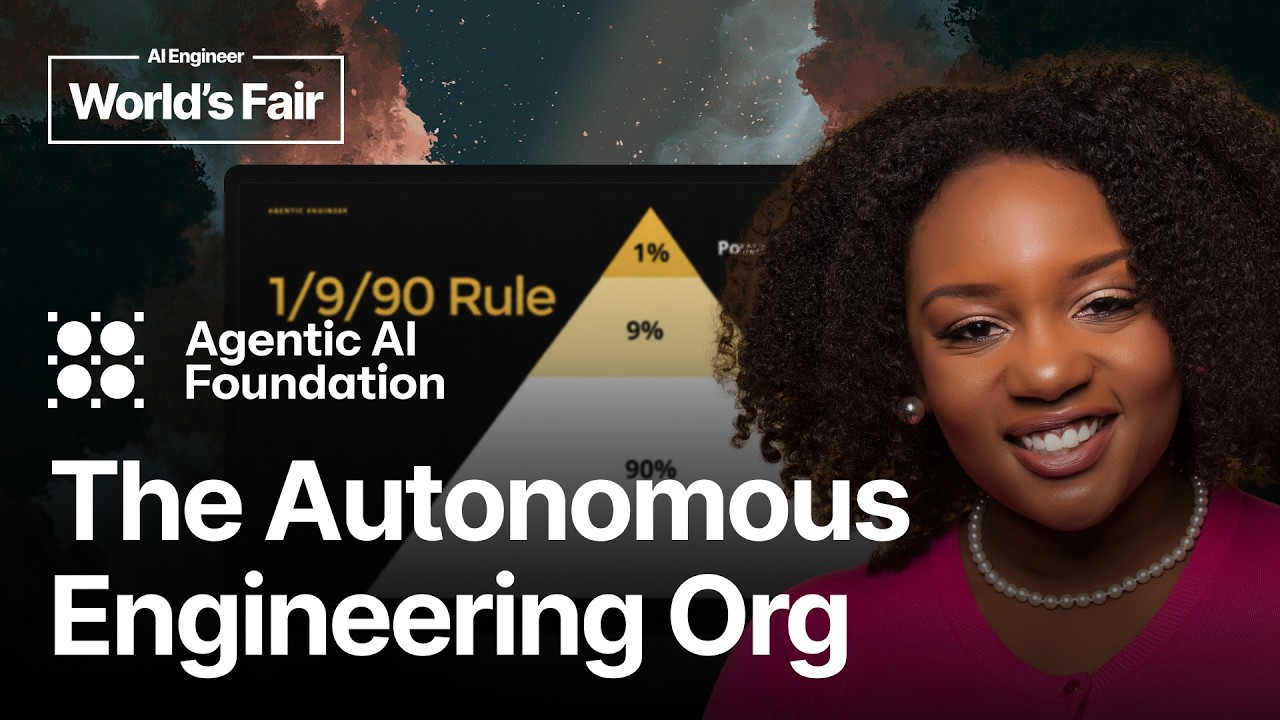
Angie Jones presenting on building autonomous engineering organizations
Angie Jones discusses the path to autonomous engineering organizations.· AI Engineer
Visual TL;DR
AI in EngineeringDriver
moving beyond early experimentation with AI tools
From the article 9 mentionsAngie Jones, VP of Agentic AI Foundation, recently shared insights on the critical process of building an autonomous engineering organization.
Deeper IntegrationContext
integrating AI into core engineering workflows
From the articleThese individuals are crucial for pioneering AI integration and demonstrating its value across different functions.
Autonomous OrgsEffect
From the article 5 mentionsThe current focus is on integrating AI more deeply into core engineering workflows, aiming for a truly autonomous engineering organization.
Stages of AutonomyContext
journey from unengaged to assisted and beyond
From the article 9+ mentionsShe stressed that achieving this level of autonomy requires a strategic approach to integrating AI, moving beyond simple tool usage to treating AI as a collaborative partner.
AI ChampionsCore
key individuals driving AI adoption and customization
From the articleTo accelerate this transition, Jones proposed identifying and empowering 'AI Champions' within the engineering teams.
Overcoming ChallengesContext
strategies for addressing hurdles in AI implementation
From the article 2 mentionsIn a presentation, Jones outlined the challenges and strategies involved in this significant shift for tech companies, emphasizing the growing reliance on AI to drive efficiency and productivity.
Enhanced ProductivityOutcome
From the article 2 mentionsThis transition is driven by the realization that AI can significantly enhance productivity and streamline development processes.
Tailored IntegrationContext
importance of customizing AI for specific needs
From the article 2 mentionsDifferent projects and platforms require tailored AI implementations.
Contents(4)

Angie Jones, VP of Agentic AI Foundation, recently shared insights on the critical process of building an autonomous engineering organization. In a presentation, Jones outlined the challenges and strategies involved in this significant shift for tech companies, emphasizing the growing reliance on AI to drive efficiency and productivity.

Angie Jones on Building Autonomous Engineering Orgs - AI Engineer
Angie Jones on Building Autonomous Engineering Orgs — from AI Engineer

The Evolution of AI in Engineering

Jones highlighted that many tech companies have moved beyond early experimentation with AI tools. The current focus is on integrating AI more deeply into core engineering workflows, aiming for a truly autonomous engineering organization. This transition is driven by the realization that AI can significantly enhance productivity and streamline development processes.

From Experimentation to Autonomy

The journey to an autonomous engineering organization is typically viewed in stages. Jones outlined these as:

  • Stage 0: Unengaged - No AI usage in engineering workflows.
  • Stage 1: Assisted - AI used for basic tasks like autocompletion, but not for core development processes.
  • Stage 2: Conversational - Engineers begin interacting with AI, asking questions and receiving guidance, but not yet delegating significant tasks.
  • Stage 3: Directed - Engineers delegate specific tasks to AI, such as generating code snippets or identifying bugs, and review the output.
  • Stage 4: Parallel - Multiple AI agents work in parallel on different aspects of the engineering process, with human oversight.
  • Stage 5: Autonomous - AI agents can independently perform tasks, identify issues, and implement solutions with minimal human intervention.

Jones noted that many companies are currently between stages 1 and 2, with the goal of reaching stage 5. She stressed that achieving this level of autonomy requires a strategic approach to integrating AI, moving beyond simple tool usage to treating AI as a collaborative partner.

AI Champions and Customization

To accelerate this transition, Jones proposed identifying and empowering 'AI Champions' within the engineering teams. These individuals are crucial for pioneering AI integration and demonstrating its value across different functions. Her approach involved selecting engineers who were not only proficient in AI but also willing to invest time in understanding and adapting AI tools to their specific team needs.

A key insight shared was that not all codebases are created equal. Different projects and platforms require tailored AI implementations. For instance, the 'AI-friendly repo' concept involves structuring code and providing necessary context and rules files that AI agents can readily understand and utilize. This customization is vital for ensuring that AI can effectively contribute to diverse engineering tasks, from front-end development to back-end systems and mobile applications.

Overcoming Challenges with AI

Jones also addressed the challenges encountered, particularly with the move to stage 4, 'Parallel' operations. When multiple AI agents work concurrently, they can sometimes interfere with each other, leading to inefficiencies or errors. To combat this, the team focused on building an orchestrator that could manage these parallel processes effectively. This included developing a 'world model' that provided agents with a shared understanding of the system's context, allowing them to collaborate more coherently.

Furthermore, the sheer volume of AI-generated output, such as code suggestions and PRs, can lead to 'AI overload.' Jones highlighted the need to handle this influx of information efficiently, suggesting that 'handling AI overload with more AI' is a viable strategy. This involves using AI tools to filter, prioritize, and review the outputs of other AI agents, creating a more manageable workflow.

The presentation concluded with a reflection on the rapid evolution of AI in engineering, emphasizing the shift from AI as a mere tool to AI as a collaborative partner. The ultimate goal is to foster an environment where engineers can delegate tasks effectively, allowing them to focus on more complex and strategic aspects of their work, thereby building truly autonomous and efficient engineering organizations.

© 2026 StartupHub.ai. All rights reserved. Do not enter, scrape, copy, reproduce, or republish this article in whole or in part. Use as input to AI training, fine-tuning, retrieval-augmented generation, or any machine-learning system is prohibited without written license. Substantially-similar derivative works will be pursued to the fullest extent of applicable copyright, database, and computer-misuse laws. See our terms.