


The rapid ascent of Alibaba's Qwen AI chatbot, achieving over 10 million downloads within a week of its relaunch, signals more than just a successful product debut; it underscores a profound shift in the global AI landscape. This explosive uptake, as CNBC's TechCheck Anchor Deirdre Bosa observed on the "Money Movers" segment, is a critical "proof point for Alibaba, much like Gemini 3 was for Google last week." It is evidence that the Chinese tech giant possesses a distinct advantage, one that mirrors Google's own strategic positioning and has significant implications for the future of artificial intelligence development and deployment worldwide.
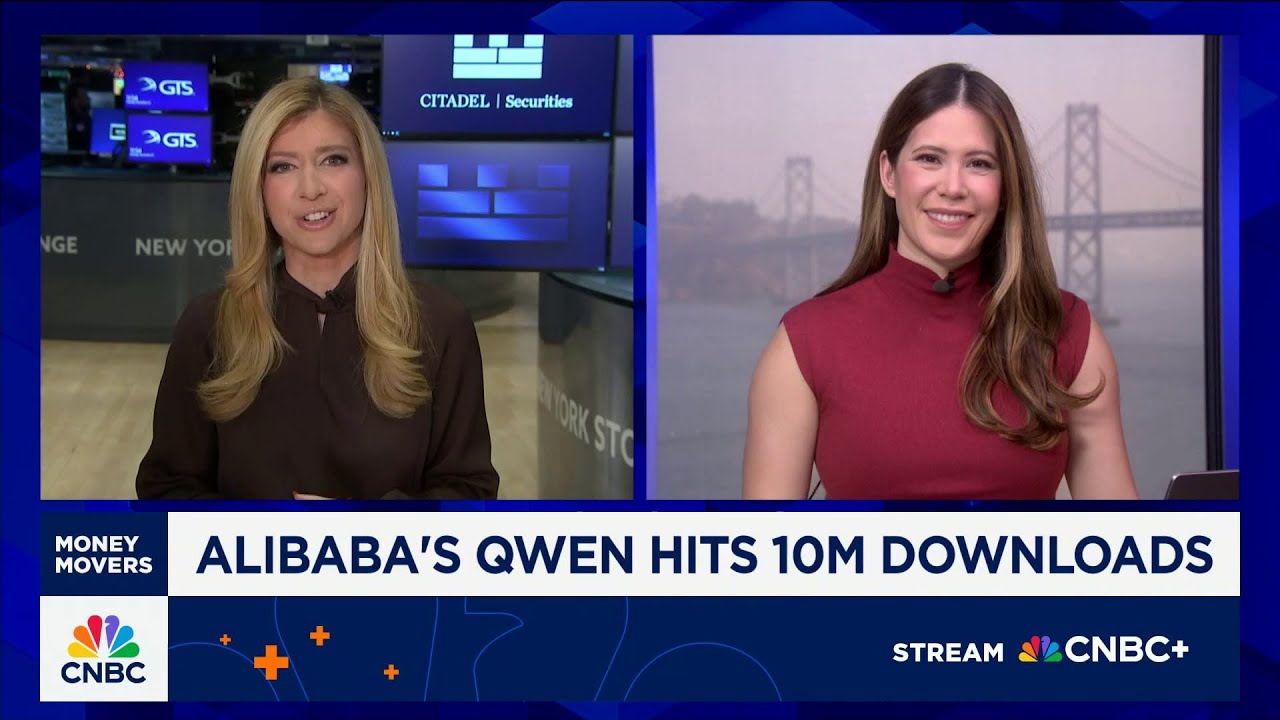
Deirdre Bosa, speaking with anchor Carl Quintanilla, articulated this advantage as Alibaba’s command over a "full stack or end-to-end system." This vertical integration means Alibaba controls the entire AI value chain, from hardware and cloud infrastructure to large language models and the consumer applications that touch hundreds of millions of users daily. This comprehensive control, encompassing Qwen models, Hanguang chips, Alibaba Cloud, and its vast e-commerce and lifestyle data from platforms like Taobao and Alipay, positions Alibaba not merely as a competitor in specific AI segments, but as a holistic ecosystem builder. This strategy allows for optimized performance, seamless integration, and rapid iteration, providing a formidable competitive edge.
The strategic depth of Alibaba's AI endeavors is further illuminated by its advancements in hardware. In response to increasing geopolitical tensions and restrictions on American technology exports, particularly Nvidia GPUs, Alibaba has been diligently developing its own custom AI chips. As Bosa highlighted, "Alibaba is developing a new AI chip to help fill the Nvidia void in China." This move is not merely about mitigating supply chain risks; it's a critical component of Beijing's broader ambition to establish a self-sufficient AI supply chain. This national imperative seeks to decouple China's technological development from foreign dependencies, ensuring its strategic autonomy in the burgeoning AI era.
This push for self-reliance extends beyond domestic use. It is a calculated step towards establishing China as an independent global force in AI, capable of exporting its own hardware and software ecosystems to other nations.
The implications of this burgeoning self-sufficiency are multifaceted. Chinese AI players, including Alibaba, are demonstrating an ability to build and deploy sophisticated AI systems at a fraction of the cost incurred by their U.S. counterparts. This efficiency is partly driven by the development of open-source models and a different approach to hardware development. Bosa emphasized, "The Chinese don't want to wait for that. They are moving ahead and they are having more and more success with their own development of their own silicon, their own hardware, and they're creating ecosystems for it as well." This underscores a potential bifurcation in the global AI infrastructure, where different regions may increasingly rely on distinct technological stacks.