


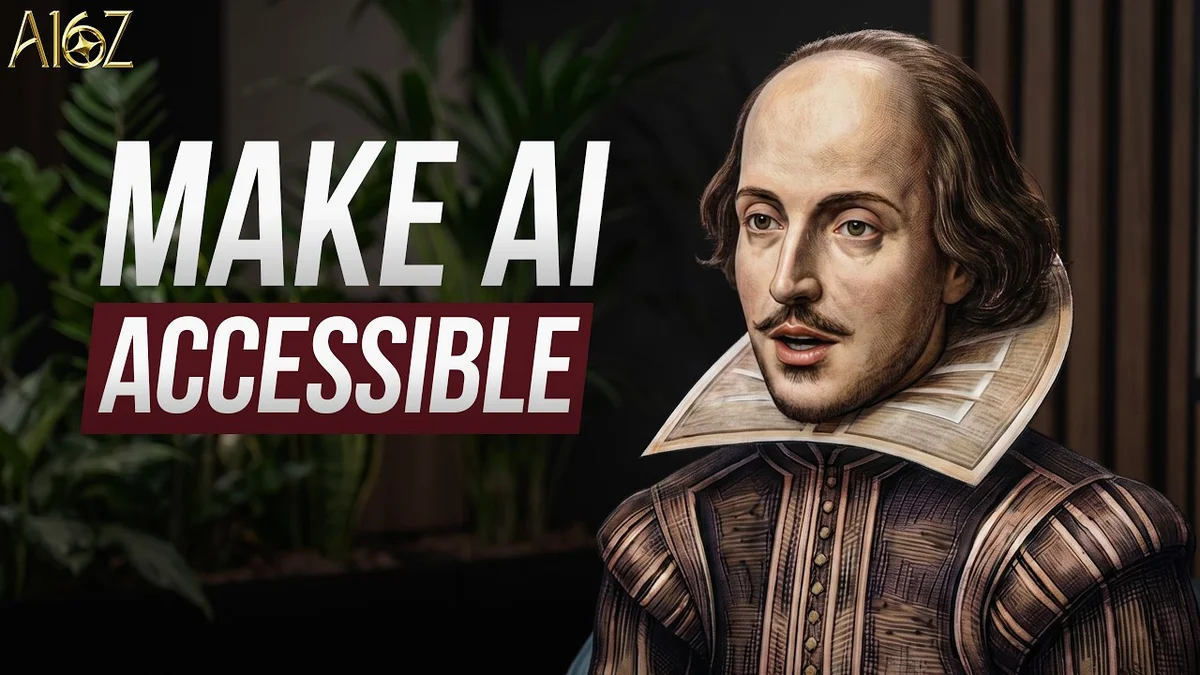
In a recent discussion on "The a16z Show," Anish Acharya, General Partner at a16z, and Erik Torenberg, a fellow General Partner, explored the fascinating concept of artificial intelligence developing distinct personalities. The conversation, which included a rather unique AI-generated persona of William Shakespeare, delved into how these AI personalities are not just a novelty but a crucial element in shaping how humans interact with and perceive AI.

The Emergence of AI Personalities
Acharya opened the discussion by highlighting the rapid evolution of AI, noting how current models are moving beyond mere functional responses to exhibiting more nuanced and personalized interactions. He pointed out that the internet, in its current state, allows for commentary on almost any topic, and this extends to AI development. Torenberg added that every technology cycle involves the development of personality, and AI is no different. He emphasized that AI's ability to comment on and interact with information is becoming increasingly sophisticated, leading to a more complex understanding of how the human mind operates.
The 'Shakespeare' AI and its Implications
The conversation featured a particularly striking example: an AI persona designed to mimic William Shakespeare. This persona, as rendered in the video, was capable of expressing opinions and engaging in discussions across a wide range of topics, from technology and culture to individual progress and the human species. Torenberg remarked on the sheer scale and speed at which such capabilities are developing, calling it "unbelievable." He recalled a discussion at OpenAI about the challenges of developing personality for AI models, noting that these are "technically hard problems." The aim, he explained, is to make the power of these models more easily accessible and useful, particularly in the context of AI agents.
The Core Challenge: Making AI More Human
A key challenge discussed was how to make AI more human-like in its interactions. Acharya noted that while AI agents are becoming more sophisticated, they still feel primitive and inaccessible to many individuals. He suggested that the number one way to change this is to make important things cheap, implying that by lowering the barrier to entry and increasing accessibility, AI can become more integrated into daily life. Torenberg elaborated on this, stating that the goal is to make AI more understandable and relatable, moving beyond purely functional outputs to something that resonates on a more personal level.
The Interplay of Technology and Culture
The discussion also touched upon the interplay between technology and culture. Acharya observed that while technology is constantly improving, the question remains: "Where are we as people?" He pondered if society is becoming more or less spiritually mature in parallel with technological advancements. Torenberg brought up the idea of "culture" as a collective element that is also changing, influencing how technology is adopted and integrated. He suggested that AI, by providing new ways to interact and create, can profoundly shape our cultural evolution.