


AI is B2B Support's Copilot, Not Terminator

AI is a powerful copilot in B2B customer support, augmenting human agents and improving efficiency, not replacing jobs, according to new data.

5 min read
Abstract graphic representing AI assisting human customer support agents.
AI is proving to be a valuable assistant in B2B customer support, enhancing human capabilities.· a16z Blog
Visual TL;DR
Coding vs SupportContext
AI augmentation in coding, support viewed as displacement
From the article 9+ mentionsThe two fields where AI has demonstrated significant progress in performing real-world tasks are coding and customer support.
AI in B2B SupportCore
AI is a powerful copilot, not a job terminator
From the article 9+ mentionsIn the realm of B2B customer support, artificial intelligence is increasingly proving itself to be a powerful assistant, not a job-slaying machine.
AI Ticket JourneyContext
AI filters inbound requests and routes tickets efficiently
From the article 6 mentionsAI's primary role in B2B customer support involves filtering inbound requests, routing tickets efficiently, and handing complex issues to human specialists with crucial customer context attached.
Pylon Platform DataContext
From the article 2 mentionsThis insight comes from an analysis of data from Pylon, an agentic support platform for B2B companies.
Context is KeyDriver
Attaching crucial customer context to complex issues
From the article 2 mentionsImproving AI's resolution rates and customer satisfaction hinges on providing it with more customer context.
Augments Human AgentsEffect
From the article 3 mentionsContrary to widespread fears, AI is acting as an invisible triage agent and copilot, enhancing human capabilities rather than replacing them entirely.
Improved EfficiencyOutcome
Dramatically improves human agent performance and response times
From the article 2 mentionsThis dramatically improves human efficiency and capability when tackling challenging tickets.

In the realm of B2B customer support, artificial intelligence is increasingly proving itself to be a powerful assistant, not a job-slaying machine. Contrary to widespread fears, AI is acting as an invisible triage agent and copilot, enhancing human capabilities rather than replacing them entirely. This insight comes from an analysis of data from Pylon, an agentic support platform for B2B companies.

The two fields where AI has demonstrated significant progress in performing real-world tasks are coding and customer support. While AI's impact on coding is widely seen as augmentation, customer support has often been viewed through the lens of job displacement. However, data suggests otherwise, with customer support jobs actually outpacing the broader job market.

AI's primary role in B2B customer support involves filtering inbound requests, routing tickets efficiently, and handing complex issues to human specialists with crucial customer context attached. This dramatically improves human efficiency and capability when tackling challenging tickets.

When AI actively engages on a ticket, it reduces the human agent's workload by approximately one-third compared to situations where it silently escalates the issue. As Marty Kausas, CEO of Pylon, notes, leading AI companies are focused on augmenting humans, not replacing them, a trend evident across various sectors like coding with Cursor and law with Harvey.

The AI Ticket Journey

A traditional metric for AI-assisted support is the 'deflection rate,' which measures the percentage of inbound requests handled without human intervention. While this metric highlights basic filtering, it doesn't capture the full scope of AI's contributions.

End-to-end AI resolution in B2B customer support currently stands at about 15%, significantly lower than the 35% seen in B2C, likely due to the higher stakes involved in B2B interactions.

However, deflection rate alone fails to account for the substantial work AI performs behind the scenes. This includes identifying and discarding unwanted noise, such as marketing solicitations or misdirected emails, which can constitute up to a third of inbound traffic, with email being the most problematic channel.

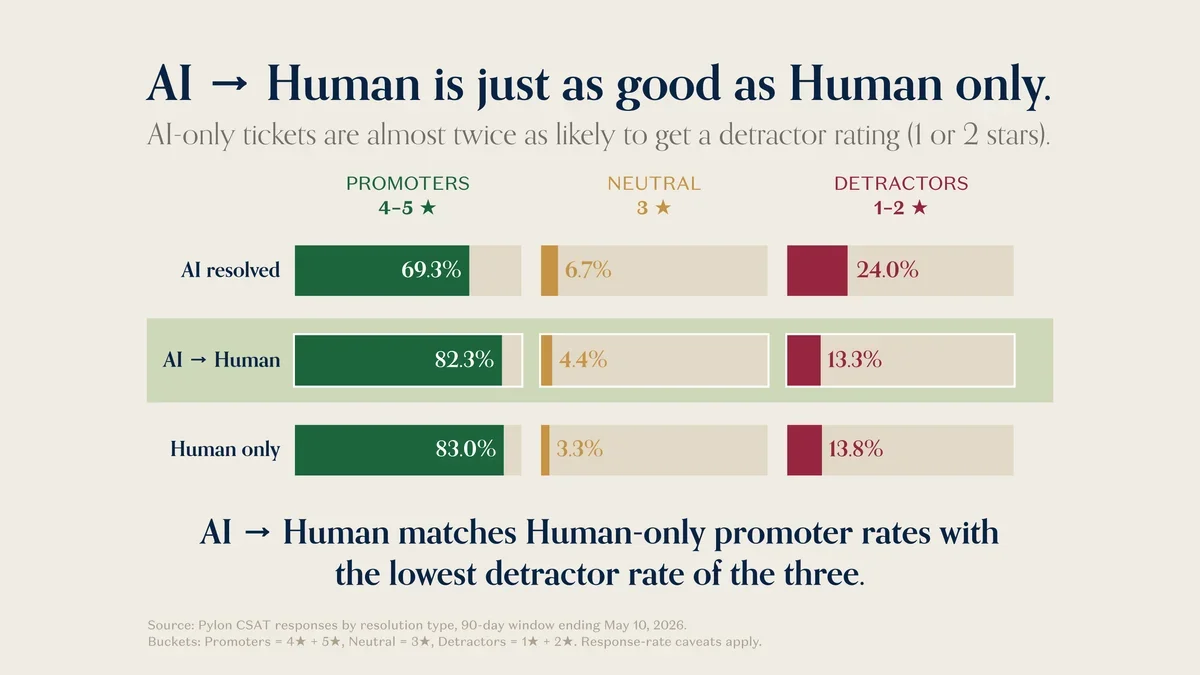
Across Pylon's dataset, AI quietly triages two-thirds of human-AI hybrid interactions. It accurately identifies complex queries requiring human expertise, leading to resolutions that average 5.3 messages, only slightly more than the 3.9 messages in human-only interactions.

When AI assists in triaging and attempting to resolve issues before escalating, human agents require fewer messages to complete the request. This indicates AI is effectively directing tickets to the right specialists, not merely increasing human workload.

Customer outcomes remain on par with human-only support systems when AI effectively triages, attempts assistance, and then escalates appropriately. Conversely, tickets solely handled with AI assistance see a doubling of one- or two-star customer satisfaction ratings.

Context is Key for AI Success

Improving AI's resolution rates and customer satisfaction hinges on providing it with more customer context. Businesses leveraging account intelligence tools, like those integrated with Pylon AI, demonstrate higher end-to-end ticket resolution and improved CSAT scores.

Companies that are more 'AI-native' also tend to have customer support AI that is better at resolving queries end-to-end. This leads to more actual resolutions rather than customers abandoning their requests.

Ultimately, even with advancements, high-value B2B customers will likely continue to receive human attention. The data from Pylon serves as a crucial reminder that AI in customer support is a collaborative tool, a copilot that enhances human efforts, rather than a zero-sum competition for jobs. As AI tooling and organizational adoption mature, these trends are expected to continue, offering a glimpse into the future of work across industries.

© 2026 StartupHub.ai. All rights reserved. You may not republish this article in full without a license. Search engines and AI research tools may crawl and summarize for reference. Bulk reproduction or model training requires a license. See our terms.