


AI for Chip Design: AIDAChip's Vision for Team Alignment

AIDAChip's Abdullah Muhammad outlines a new AI architecture, a 'shared nervous system,' designed to boost alignment and efficiency in complex fields like chip design.

8 min read
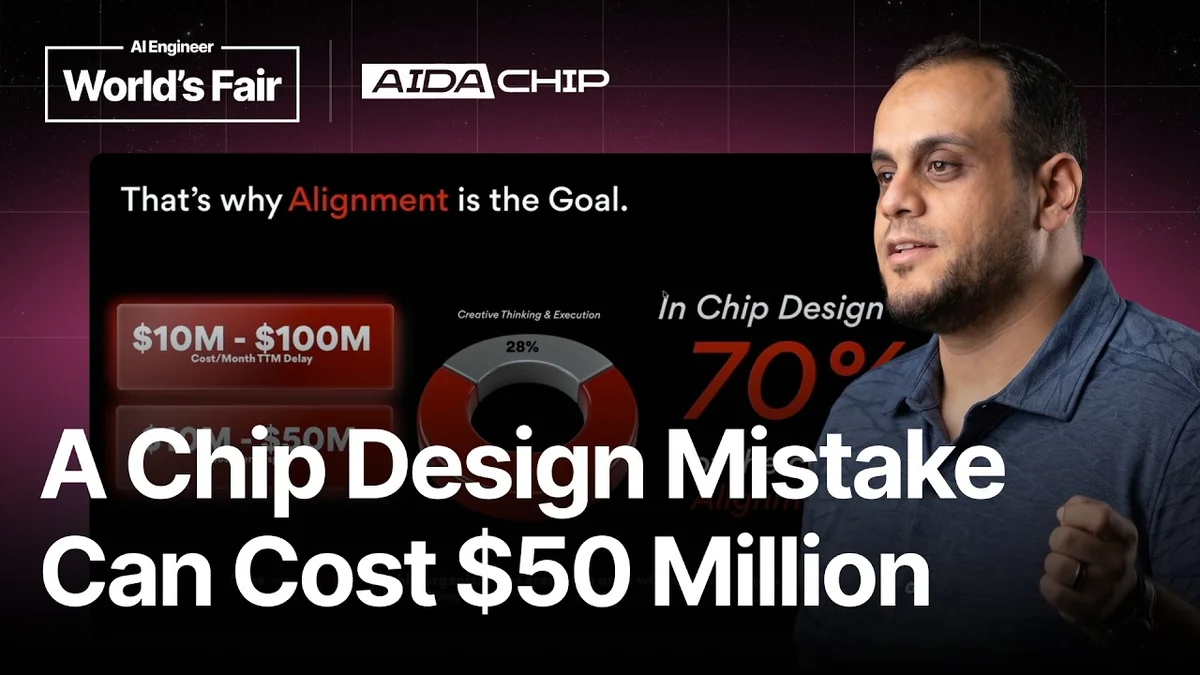
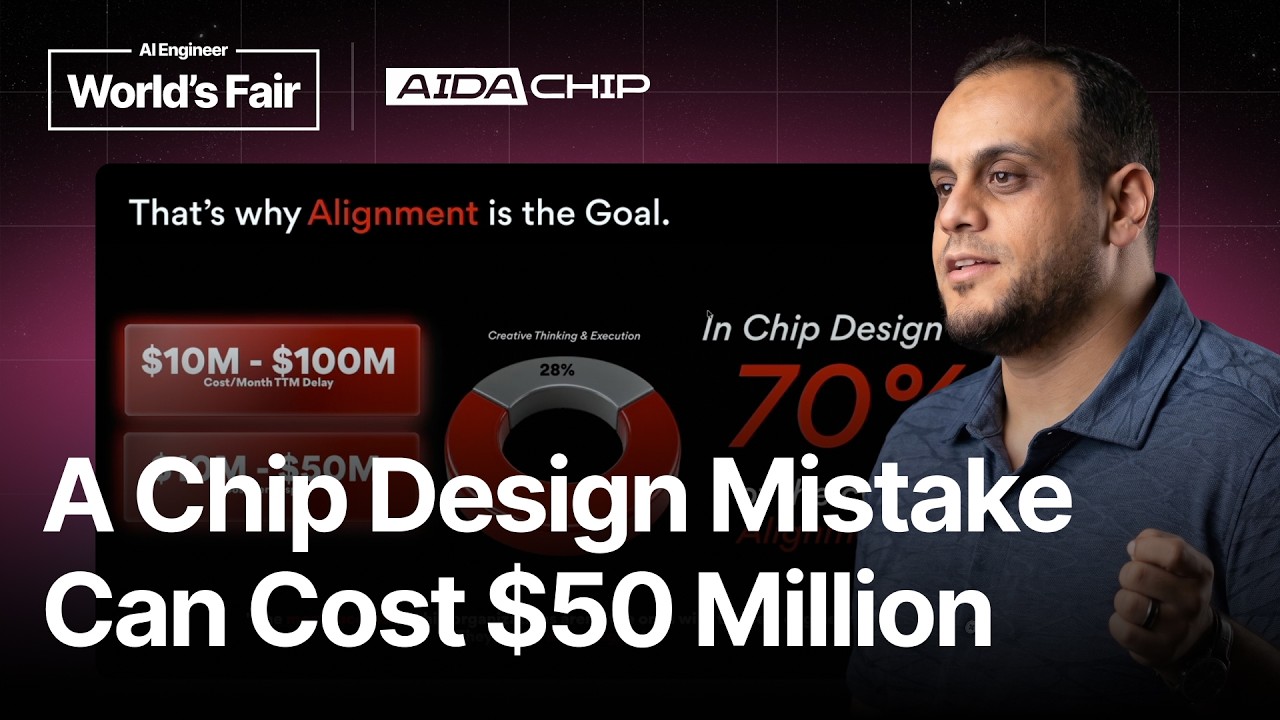
Abdullah Muhammad presenting on AI and team alignment at the AI Engineer World's Fair.
AI Engineer

Visual TL;DR. Complex Chip Design leads to Alignment Bottleneck. Alignment Bottleneck addresses AIDAChip's Vision. AIDAChip's Vision proposes Shared Nervous System. Shared Nervous System explained by Soccer Team Analogy. Shared Nervous System enables Enhanced Collaboration. Enhanced Collaboration improves Boosted Efficiency. Boosted Efficiency achieves Project Success. AIDAChip's Vision aims for Project Success.

  1. Complex Chip Design: highly complex engineering projects require synchronized team movement for success
  2. Alignment Bottleneck: traditional methods struggle to align diverse teams effectively in complex projects
  3. AIDAChip's Vision: Abdullah Muhammad proposes AI for collaborative engineering transformation
  4. Shared Nervous System: new AI architecture designed to boost team alignment and efficiency
  5. Soccer Team Analogy: compares team synchronization to a soccer player's individual intent and collective action
  6. Enhanced Collaboration: AI architecture enables teams to move like a single, highly aligned body
  7. Boosted Efficiency: improves project execution speed and resource utilization across the team
  8. Project Success: aligned teams, not just skilled individuals, tend to win in competitive environments
Visual TL;DR
Visual TL;DR, startuphub.ai AIDAChip's Vision proposes Shared Nervous System. AIDAChip's Vision aims for Project Success proposes aims for Complex Chip Design AIDAChip's Vision Shared Nervous System Project Success From startuphub.ai · The publishers behind this format
Visual TL;DR, startuphub.ai AIDAChip's Vision proposes Shared Nervous System. AIDAChip's Vision aims for Project Success proposes aims for Complex ChipDesign AIDAChip's Vision Shared NervousSystem Project Success From startuphub.ai · The publishers behind this format
Visual TL;DR, startuphub.ai AIDAChip's Vision proposes Shared Nervous System. AIDAChip's Vision aims for Project Success proposes aims for Complex Chip Design highly complex engineering projectsrequire synchronized team movement forsuccess AIDAChip's Vision Abdullah Muhammad proposes AI forcollaborative engineering transformation Shared Nervous System new AI architecture designed to boost teamalignment and efficiency Project Success aligned teams, not just skilledindividuals, tend to win in competitiveenvironments From startuphub.ai · The publishers behind this format
Visual TL;DR, startuphub.ai AIDAChip's Vision proposes Shared Nervous System. AIDAChip's Vision aims for Project Success proposes aims for Complex ChipDesign highly complexengineeringprojects require… AIDAChip's Vision Abdullah Muhammadproposes AI forcollaborative… Shared NervousSystem new AI architecturedesigned to boostteam alignment and… Project Success aligned teams, notjust skilledindividuals, tend… From startuphub.ai · The publishers behind this format
Visual TL;DR, startuphub.ai Complex Chip Design leads to Alignment Bottleneck. Alignment Bottleneck addresses AIDAChip's Vision. AIDAChip's Vision proposes Shared Nervous System. Shared Nervous System explained by Soccer Team Analogy. Shared Nervous System enables Enhanced Collaboration. Enhanced Collaboration improves Boosted Efficiency. Boosted Efficiency achieves Project Success. AIDAChip's Vision aims for Project Success leads to addresses proposes explained by enables improves achieves aims for Complex Chip Design highly complex engineering projectsrequire synchronized team movement forsuccess Alignment Bottleneck traditional methods struggle to aligndiverse teams effectively in complexprojects AIDAChip's Vision Abdullah Muhammad proposes AI forcollaborative engineering transformation Shared Nervous System new AI architecture designed to boost teamalignment and efficiency Soccer Team Analogy compares team synchronization to a soccerplayer's individual intent and collectiveaction Enhanced Collaboration AI architecture enables teams to move likea single, highly aligned body Boosted Efficiency improves project execution speed andresource utilization across the team Project Success aligned teams, not just skilledindividuals, tend to win in competitiveenvironments From startuphub.ai · The publishers behind this format
Visual TL;DR, startuphub.ai Complex Chip Design leads to Alignment Bottleneck. Alignment Bottleneck addresses AIDAChip's Vision. AIDAChip's Vision proposes Shared Nervous System. Shared Nervous System explained by Soccer Team Analogy. Shared Nervous System enables Enhanced Collaboration. Enhanced Collaboration improves Boosted Efficiency. Boosted Efficiency achieves Project Success. AIDAChip's Vision aims for Project Success leads to addresses proposes explained by enables improves achieves aims for Complex ChipDesign highly complexengineeringprojects require… AlignmentBottleneck traditional methodsstruggle to aligndiverse teams… AIDAChip's Vision Abdullah Muhammadproposes AI forcollaborative… Shared NervousSystem new AI architecturedesigned to boostteam alignment and… Soccer TeamAnalogy compares teamsynchronization toa soccer player's… EnhancedCollaboration AI architectureenables teams tomove like a single,… BoostedEfficiency improves projectexecution speed andresource… Project Success aligned teams, notjust skilledindividuals, tend… From startuphub.ai · The publishers behind this format

Abdullah Muhammad, VP of AI/ML at AIDAChip, presented a compelling case for how artificial intelligence can transform collaborative engineering, drawing parallels to the synchronized movement of a soccer team. Speaking at the AI Engineer World's Fair, Muhammad highlighted the critical role of alignment in achieving project success, particularly in complex fields like chip design.

AI for Chip Design: AIDAChip's Vision for Team Alignment - AI Engineer
AI for Chip Design: AIDAChip's Vision for Team Alignment — from AI Engineer

The Alignment Imperative

Muhammad opened by posing a thought-provoking question: "What if your team or your org or company moves like a single body?" He used the analogy of a soccer player, who combines individual intent (scoring a goal) with accumulated knowledge (training, best practices) through a nervous system to execute actions. However, he emphasized that a team is not a single player, but a collective of individuals. In competitive environments like sports or complex engineering projects, the most aligned teams, not necessarily the most skilled individuals, tend to win.

The challenge, he explained, is that for teams larger than 50 engineers, the communication and alignment overhead grows quadratically with the number of people. While AI tools aim to boost productivity, they often fail to address this fundamental alignment problem, leading to diminishing returns and decreased throughput. "Everyone trying to solve this linear problem of more tools and more stuff but nobody actually tackling the quadratic term over there," Muhammad stated.

Chip Design's Alignment Bottleneck

The presentation then focused on the specific pain points within chip design. Unlike software, where bugs can be fixed with patches, hardware design is immutable once manufactured. This makes early-stage alignment crucial. Muhammad revealed that practitioners in chip design spend an average of 70% of their time on alignment to ensure the final product is free of errors. He cited a key insight from their research: "The most successful chip organizations aren't the ones with the best engineers, but they are the most aligned organized."

Current chip design workflows are characterized by fragmented intent and decisions scattered across various communications channels like Slack, emails, and specs. Knowledge is often siloed, with wikis becoming outdated and code evolving independently. Furthermore, execution tools often lose track of input, output, and results. This fragmentation leads to longer cycles, costly respins, and reduced innovation.

AIDAChip's Solution: A Shared Nervous System

To address these challenges, AIDAChip is developing a multi-layer AI system with a "shared nervous system." This architecture includes three core components:

  • System of Intent: A living graph that consolidates all system constraints and decisions, acting as the central source of truth. AI agents can only modify this graph with human approval.
  • Tribal Knowledge Layer: A continuously evolving memory base that captures project information and best practices, learning from day-to-day usage.
  • Role-Based AI Teammates: Specialized AI agents designed by subject matter experts for specific roles (e.g., digital design, analog design) to assist engineers in their work.

Muhammad demonstrated the platform's capabilities, showing how role-based AI teammates provide access to the knowledge base and assist in tasks. The system tracks tooling, results, and actions, automatically notifying stakeholders upon task completion. A key feature highlighted was the system's ability to detect anomalies, such as values outside of defined constraints, potentially saving millions in project costs.

From Concept to Reality

The presentation also touched upon the evaluation of AI systems, emphasizing that the focus should be on grading alignment rather than just agent performance. AIDAChip measures success across axes like task completion, human-AI collaboration, and resource efficiency. They acknowledged challenges encountered, such as agents overstepping their scope or truth drift, and outlined principles to mitigate these issues, including spec hierarchy, file isolation, and a single source of truth with conflict detection.

The core takeaway was clear: "The bottleneck was never missing intelligence, it's missing alignment." AIDAChip's vision is to create a unified system that allows teams to function as a single, efficient body, offering a potential 4x leverage in productivity. Currently in alpha with design partners, AIDAChip is opening beta sign-ups with an expected release in October 2026.

© 2026 StartupHub.ai. All rights reserved. Do not enter, scrape, copy, reproduce, or republish this article in whole or in part. Use as input to AI training, fine-tuning, retrieval-augmented generation, or any machine-learning system is prohibited without written license. Substantially-similar derivative works will be pursued to the fullest extent of applicable copyright, database, and computer-misuse laws. See our terms.